

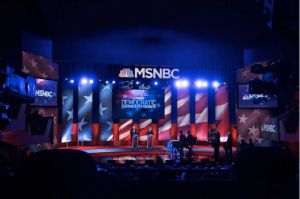
DURHAM, N.H. – In the most direct, down-and-dirty Democratic debate of the campaign so far, Bernie Sanders and Hillary Clinton diverged sharply in their visions for the country and where each of them stood along their party’s ideological spectrum.
Sanders reinforced his position as a rabble-rousing outsider who cares little about the trappings of endorsements and corporate fundraising. Clinton sought to stake out territory as a moderate leader with a progressive streak able to operate inside the establishment wing of the Democratic Party.
“I am a progressive who gets things done,” Clinton said, distilling a message she hopes will help win over fiery liberals, many of whom are now embracing Sanders. “And the root of that word, progressive, is progress.”
Sanders shot back, questioning Clinton’s progressive credentials early and often. He said in past she has bragged about being “a moderate” and noted she had the backing of the establishment of the Democratic Party, including governors and senators, even Vermont’s, which Clinton tried to portray as a rejection of Sanders in his home state.
After pointing to her super PAC donations and connections to Wall Street, he declared that an authentic progressive needs to “not only talk the talk, but walk the walk.”
Clinton pushed back forcefully on Sanders’ super PAC insinuations, calling them an “artful smear.” Some audience members booed at her attack. Sanders said “no, no, no” as laid out her criticisms.
But Clinton, behind in the New Hampshire polls, continued to jab at Sanders. “Enough is enough. If you’ve got something to say, say it directly.”
“Let’s talk about about the issues,” she added.
Sanders agreed and talked about the broader issue of Wall Street’s influence on the political system.
“Let’s talk about why, in the 1990s, Wall Street got deregulated,” Sanders countered, using one the most potent attacks he has had on the former secretary of state.
“Did it have anything to do with the fact that Wall Street provided — spent billions of dollars on lobbying and campaign contributions?” he asked. “Well, some people might think, yeah, that had some influence.”
“You will not find that I ever changed a view or a vote because of any donation that I ever received,” Clinton proclaimed in her defense.
A fight between the two candidates over who was progressive dominated the hastily scheduled MSNBC debate co-moderated by Chuck Todd and Rachel Maddow.
Midway through the tense talk on Clinton’s political backing, Todd asked the former secretary of state if she would release all the transcripts of past paid speeches, including ones delivered before executives at investment firm Goldman Sachs.
Clinton demurred.
“I don’t know the status, but I will certainly look into it,” she answered.
Clashes continued over the candidate’s health care proposals, which further separated Clinton and Sanders on what they see as proper political strategy for achieving a similar goal of universal coverage.
“There is no disagreement between us on universal coverage for health care,” Clinton said. “The disagreement is where do we start from and where do we end up.”
Clinton said she wants to work on improving the Affordable Care Act, to lower drug prices and increase coverage.
“Senator Sanders wants us to start all over again,” she said. “This was a major achievement of President Obama, of our country.”
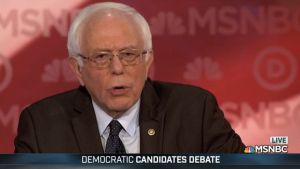
Sanders’ defended his Medicare-for-all proposal as a long overdue prescription for a costly health care system. He said the U.S. is an outlier among industrialized nations, most of which have single-payer systems.
He said he did not want to repeal Obamacare, but the Affordable Care Act, he said, has not solved American health care crisis and that problems remain.
“What [Obamacare] has not done is dealt with the fact we have 29 million people today who have zero health insurance,” Sanders said. “We have even more who are underinsured with large deductibles and copayments and prescription drug prices are off the wall.”
Clinton had her own attacks ready.
“If we’re going to get into labels, I don’t think it was particularly progressive to vote against the Brady Bill five times,” she said.
She also sought to point to other well-respected party leaders she shares positions with.
“Under [Sanders’] definition, President Obama is not progressive because he took donations from Wall Street,” Clinton said. “Vice President Biden is not progressive because he supported Keystone; Senator Shaheen is not progressive because she supports the trade pact.”
Sanders, not wanting to alienate himself too much from the Democratic Party, said Obama is a progressive president who has “done an excellent job.”
At one point, Maddow clearly didn’t have her facts straight and walked into a Sanders buzzsaw when she suggested he was the spoiler in the 1988 Vermont race for Congress. Republican Peter Smith won, but Sanders noted he finished a close second and the Democrat, Paul Poirier, was a distant third. Sanders ticked off each candidate’s percentage off the top of his head.
As the debate shifted into foreign policy, Sanders’ passion and punch cooled down.
Sanders agreed with many of Clinton’s diplomatic and military prescriptions.
He boiled down his foreign policy doctrine to a tweaked form of isolationism, saying “we cannot continue to do it alone; we need to work in coalition.”
He conceded that Clinton is the most experienced candidate for commander-in-chief, but said that his vote against the Iraq War was prudent.
“Once again, back in 2002, when we both looked at the same evidence about the wisdom of the war in Iraq, one of us voted the right way and one of us didn’t,” Sanders said.
Clinton, who was at her smoothest during the section on foreign policy, spoke with an acute understanding of world events, and peppered her answers with specific details and references to world leaders and diplomatic nuances.
“A vote in 2002 is not a plan to defeat ISIS,” Clinton said in regard to her vote for the Iraq War. “We have to look at the threats that we face right now.”
Other debate topics, which didn’t spur much disagreement, included veterans issues, the Flint water crisis and criminal justice reform.
In their final statements, they each applauded one another’s public service and political passion. Afterward, they smiled and shook hands.
“If I’m so fortunate as to be the nominee,” Clinton said, “the first person I will call to talk to about where we go and how we get it done will be Senator Sanders.”
Clinton won by a razor thin margin in the Iowa caucuses and enters New Hampshire down in the polls.
The Real Clear Politics polling average for the Granite State gives Sanders a 19.5 percentage lead over Clinton.
A CNN/WMUR poll released Thursday shows Sanders with a 2-to-1 margin over Clinton, 61 percent to 30 percent.
