

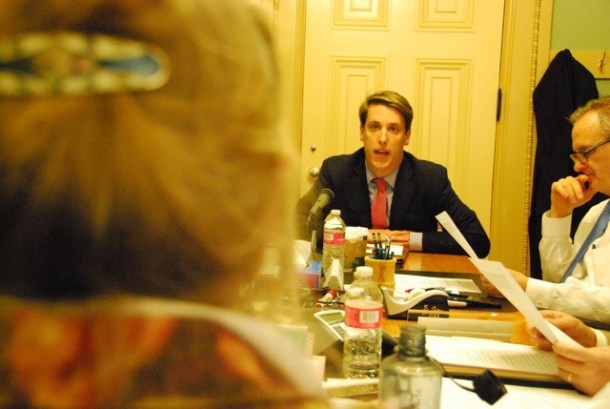
[A] Senate committee grappled Wednesday over how to define a Vermonter, a conversation spurred by the controversy surrounding a candidate for lieutenant governor who may not meet the residency requirements to run.
Garrett Graff, a former editor at Washington, D.C.-based Politico, has returned to Vermont, but he may not qualify because of a state Constitution requirement that a candidate for the No. 2 post live in Vermont for fours years prior to running.
Graff maintains he qualifies even though he has not physically lived in the state.
“Vermonters have proven themselves very adept at sniffing out flatlanders who are impostors coming to win and buy elections in the state of Vermont,” said Graff during testimony before the committee. “That’s not something that Vermonters need legislators to protect them from.”
While Graff has lived in Washington, D.C., for nearly a decade, he recently quit his job at Politico and moved to Burlington with his wife. He said he has remained a registered voter in the Green Mountain State and that he holds a Vermont license and car registration.
“If someone is able to vote for office, they should be able to run for office,” said Graff.
On Wednesday, Graff argued that legislators should use a nuanced definition of residency to include those whose “mental home” is Vermont. He argues the state has always used a mix of “physical presence” and “intent to return” as the way to measure residency.
He said the strict four-year residency requirement precludes people who leave the state temporarily for academic or professional enrichment, giving the example of someone who spends a year working at the White House before returning to run for statewide office.
“In many ways, defining residency as solely by physical presence is going to discourage precisely the types of people that we would want to be involved in state government,” Graff said.
Graff testified against a bill from Sen. Jeanette White, D-Windham, who is seeking to clarify that candidates for governor and lieutenant governor must have “resided in the state for at least four consecutive years preceding the day of the general election.”
Under White’s legislation, S. 234, candidates for state senator and representative would be required to reside in Vermont for two consecutive years before an election.
While White initially said she thought her bill would be a “slam dunk,” a breakfast meeting with Graff complicated the issue for her.
She seemed sympathetic to Graff’s argument that people should be able to leave the state for school, work or other service and come back to the state and be eligible to run.
“What is the residency requirement?” White asked openly, not sure of her answer. “Does it mean you physically have to be in Vermont every day for four years before the next election?”
While White, the committee chairwoman, was sympathetic, other committee members were less open to looser residency requirements.
Sen. Anthony Pollina, D/P-Washington, said it seemed appropriate that anyone who moves back to Vermont should have to acclimate to the state for a long period of time before being eligible to run.
“We keep hearing that this would prevent someone from serving,” Pollina said. “And I just don’t think that’s the case. What it does is it sets up a residence requirement before you serve.”
Preferring a literal interpretation of the Vermont Constitution’s definition, Sen. Joe Benning, R-Caledonia, said any change is “essentially abandoning whatever it was for rationale that our ancestors had in mind.”
Graff, 34, was raised in Vermont. He is the son of former Associated Press Montpelier bureau chief Christopher Graff and former Vermont Life editor Nancy Price Graff. He said he is returning to Vermont without a job here.
In an opinion piece, he argued: “Considering running for office here, I have never assumed anything would be handed to me on a silver platter. I was merely asking for the chance to spend time traveling the state, making my case to the people of Vermont, and offering policy ideas about where I’d like to see the state go in the years ahead.”
The Democratic field already has three declared candidates vying for the post being vacated by Phil Scott, who is running for governor.
Rep. Kesha Ram, a Burlington Democrat, and Progressive/Democratic Sen. David Zuckerman, have announced they are running. Brandon Riker, a businessman from Brattleboro, is also running as a Democrat.
Former Franklin County state Sen. Randy Brock is the sole Republican to have thrown his hat into the ring. Independent Dr. Louis Meyers from Rutland has also announced a bid.
Although some senators left the hearing with a number of lingering questions, it appears the Legislature is best positioned to determine Graff’s eligibility.
Secretary of State Jim Condos has said it appears Graff is not eligible, but his office has refused to make a ruling on the matter.
“It is not the role of the Secretary of State, nor that of the Attorney General, to make decisions on whether a prospective candidate is qualified, on the basis of residency, to hold a statewide elected office,” Condos said in a letter to Graff’s lawyer, Paul Gillies, earlier this month.
