

A week before the Iowa caucuses, Hillary Clinton and Bernie Sanders are in a nonstop sprint to gain supporters and then turn them out Feb. 1 in the first electoral test of the 2016 presidential race.
Recent polls in the Hawkeye state point to a very tight race for the Democratic nomination. The most recent Des Moines Register poll put Clinton 2 points ahead, with a 4.4 percent margin of error.
A CBS News poll released Sunday portrayed an even tighter margin, with Sanders edging Clinton 47 percent to 46 percent.
Clinton and Sanders are both camped out in Iowa, touring the state feverishly to woo undecided Iowans and push them to turn out.
Sanders is relying on young people and first-time caucusgoers to boost turnout. He recently launched www.provethemwrongandcaucus.com, a website urging young voters to translate their passion into action. It’s part of a larger effort by Sanders to turn out the same types of supporters who propelled Barack Obama to a win in 2008.
According to The New York Times, the campaign has also launched “‘Go Home for Bernie,’ a plan to dispatch a fleet of rental cars, vans and buses, if necessary, to carry students who are from Iowa back to their hometown.”
The campaign has also started posting Sanders moments on Instagram and Snapchat, two social networks the online team has neglected for much of the campaign.
If Sanders can organize a huge turnout of young people, experts say, his chances of winning are good. But polls also point to a Clinton advantage among those who have previously caucused and are seen as more likely to show.
“Mr. Sanders appears to be extraordinarily dependent on turnout from infrequent voters, even more than Democrats have recently been in general elections, and maybe more than Barack Obama in the 2008 Iowa caucuses,” Nate Cohen wrote in an article for The Upshot on Monday.
While Sanders continues to draw parallels between his candidacy and Obama’s 2008 insurgent campaign, the president brushed off any comparisons in an interview with Politico released Monday.
Asked if Sanders reminded him of his campaign in 2008, Obama answered, “I don’t think that’s true.”
While Obama said he won’t endorse a candidate in the primary, his remarks on Clinton were generally more positive.
While Obama’s rhetoric and idealism in his 2008 campaign track closer to Sanders’ current message than Clinton’s, Obama praised Clinton’s detailed campaign promises as realistic and “more prose than poetry.”
“If Bernie won Iowa or won New Hampshire, then you guys are going to do your jobs and, you know, you’re going to dig into his proposals and how much they cost and what does it mean,” Obama said, referring to the news media, “and, you know, how does his tax policy work and he’s subjected, then, to a rigor that hasn’t happened yet, but that Hillary is very well familiar with.”
While Obama won’t be on the campaign trail until after the primaries, Clinton and Sanders are enlisting other high-profile politicians and celebrities to stump in Iowa.
Clinton has singer Demi Lovato, actor Jamie Lee Curtis and U.S. Sen. Cory Booker, of New Jersey, among others. Sanders’ pack of famous personalities includes actress Susan Sarandon, rapper Killer Mike, Ben Cohen and Jerry Greenfield, and progressive radio host Jim Hightower.
One high-profile politician who doesn’t seem likely to endorse either candidate is Michael Bloomberg, former independent mayor of New York.
Unsettled by the current popularity of outsider candidates, including Sanders, Bloomberg tipped off The New York Times over the weekend that he may join the race for president if he thinks no candidate is moderate enough.
During a Sunday appearance on “Meet the Press,” Sanders brushed off Bloomberg’s threat, claiming he would easily win in a matchup against the successful businessman.
“My reaction is that if Donald Trump wins and Mr. Bloomberg gets in, you’re going to have two multibillionaires running for president of the United States against me,” Sanders said. “And I think the American people do not want to see our nation move toward an oligarchy where billionaires control the political process. I think we’ll win that election.”
As time ticks away, attacks are also ramping up. Sanders is upping his criticism of Clinton’s establishment status, often making mention of her paid speeches at Goldman Sachs and what he says are her shady super PAC connections.
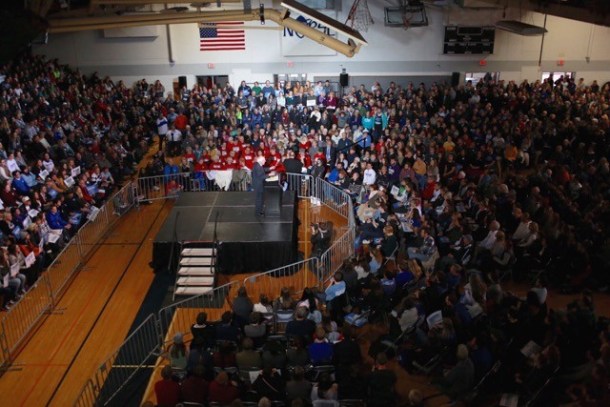
“The people of Iowa will have to determine … which candidate is willing to stand up to Wall Street and the billionaire class and represent working families,” Sanders said Sunday in a college gymnasium to nearly 3,000 people.
Clinton’s message to Iowans is that Sanders is a pie-in-the-sky liberal who lacks pragmatism and experience.
“It reminds me of what happened here in Iowa eight years ago,” Sanders responded to the attacks, claiming Clinton made the same digs about Obama’s experience and electability in 2008. “But you know what? People in Iowa saw through those attacks then, and they’re going to see through those attacks again.”
Clinton is also portraying Sanders as unfit to deal with foreign policy, a jab he has countered by pointing to his opposition to the Iraq War, which Clinton voted for.
“That is a difference in judgment in what turns out to be the most important foreign policy moment in the modern history of the United States,” Sanders said Sunday.
The Clinton endorsements included The Des Moines Register, The Boston Globe and
The Concord (N.H.) Monitor.
On Sunday, Sanders earned the endorsement of the Daily Nonpareil, a small regional paper in Iowa.
A Sanders win in Iowa would be critical and could start a snowball effect, especially if it were followed by a Granite State win. In New Hampshire, Sanders has a hefty lead in polls, and a win in both states could ramp up support in subsequent primary states like South Carolina and Nevada.
Sanders has struggled courting minority voters, in contrast to Clinton.
In a news conference Monday, Sanders staffers said the race will get tighter as more people learn about his stand on the issues.
The campaign said Monday it has knocked on more than 200,000 doors and made contact with more than 750,000 voters in South Carolina over the past few months. Sanders will also debut television ads in all major media markets this week, staffers said.
“We cannot be more excited with how things are going,” said Chris Covert, Sanders’ South Carolina state director, in a conference call Monday.
Justin T. Stamberg, a South Carolina state representative and lawyer, also announced Monday that he was switching his allegiance from Clinton to Sanders.
Stamberg is the lawyer for the family for Walter Scott, a black man who was fatally shot by police in South Carolina last year after a routine traffic stop.
In his endorsement, Stamberg noted that Sanders’ progressive proposals would benefit African-Americans more than Clinton’s.
“All things are achievable and attainable. We put man on the moon,” Stamberg said. “Don’t tell me we can’t provide Americans the right — the right — to health care, because that right is a matter of life and death for many Americans.”
“I, along with Bernie, am here to change the game of politics,” Stamberg added.
