


[A] key Senate committee is poised this week to advance legislation to legalize recreational marijuana, but don’t start growing any pot at home.
A majority of members of the Senate Judiciary Committee appear ready to vote for the legalization bill. Chairman Dick Sears, D-Bennington, said the bill will be voted on by Friday.
Two members of the committee, Sens. Jeanette White, D-Windham, and Joe Benning, R-Caledonia, co-sponsored one of the two bills in play, so their support is secure. Sen. Tim Ashe, D/P-Chittenden, says he’s “always been inclined” to vote yes. Sears says he is “50-50,” while the fifth member, Sen. Alice Nitka, D-Windsor, historically has not supported marijuana-related legislation.
However, Sears laid down one step he won’t take: allowing people to grow their own marijuana. That view caused people to attack him on social media over the weekend.
“I’ve drawn a line in the sand on homegrown,” Sears said. “You have to decide whether you’re going to have a regulated market or not. It’s got to be seed-to-sale.”
Asked whether finding a solution to his biggest concern, impaired drivers, would push him to a yes vote, Sears said: “It could.”
If approved by Judiciary, the bill would go to the Senate Finance Committee, where Ashe is the chairman. Ashe’s committee took extensive testimony last week on some of the financial questions surrounding pot legalization.
Final testimony in Judiciary will be taken Tuesday morning, from Allen Gilbert, executive director of the Vermont chapter of the American Civil Liberties Union. Sears said he also hopes to have the bill redrafted Tuesday to add several provisions, including a delayed start to the program and a ban on homegrown pot.

Ashe said Washington state, where recreational marijuana is legal, does not permit pot to be cultivated. Colorado does, but Ashe said a spokesman for the governor testified the state has had second thoughts because it creates a “gray area” for law enforcement.
“One of the things we have to be real about is when people say, ‘learn the lessons from other states,’ when those two states are saying very clearly to be careful how you approach the issue of homegrown, why Vermont would be very selective in what lessons it’s going to learn, that wouldn’t make sense,” Ashe said.
Ashe said it might make sense not to address every issue this year, including whether to approve edible marijuana products and the number of retail outlets.
“I’ve always been inclined to vote yes,” said Ashe, “as long as it’s properly constructed and realistic, and I think Sen. Sears’ approach is the path to a well-constructed bill. The realistic piece is making sure the state of Vermont, if it goes in this route, doesn’t bite off more than it could chew all at once, which might mean leaving some issues for the future.”
Meanwhile, testimony continued in Ashe’s committee on how a marijuana market would be financially regulated. Lawmakers also heard testimony on issues including public and personal health.
Much of the testimony made clear what researchers and stakeholders don’t know. On the public health side, experts were unsure if legalization would encourage use. Critics are wary legalization would send the wrong message to children.
In the finance committee, researchers said taxing the drug is more complicated than it appears. They also said retail marijuana shops will run into serious issues if they want to open a bank account.
TAXATION: MORE QUESTIONS THAN ANSWERS
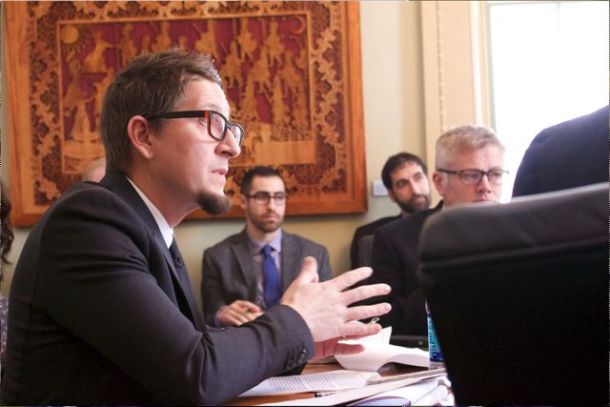
“Quite frankly, nobody knows the best way to tax marijuana,” said Beau Kilmer, a senior researcher for the RAND Corp. and co-author of a major report contracted by the Legislature last year. Kilmer presented a list of 10 factors he asked lawmakers to consider during his testimony to the Senate Finance Committee.
“It could be that you set up a system now, and in five years you’ll run into unintended consequences,” he warned.
In theory, Vermont is in a situation for a legal pot market. With New York City, Boston and Montreal nearby — there is a potential consumer market for the drug that is about 40 times the size of Vermont’s local market.
If a nearby state were to legalize as well, they could siphon tax revenue by undercutting Vermont with lower pot taxes. Kilmer recommended that lawmakers make the tax code flexible so Vermont can keep prices competitive.
“You really don’t want to lock yourself in,” Kilmer said.
Massachusetts is moving a legalization bill through the Legislature this session, but Massachusetts Gov. Charlie Baker has said he would not sign it.
If Vermont became an island of legality in the Northeast, Kilmer says tourists looking for legal pot could lead to “triple-digit millions” in tax profit.
Yet marijuana remains illegal on the federal level. States that have legalized marijuana rely on the goodwill of the Obama administration, not a law or a court decision.
The Department of Justice operates under guidelines that say the feds shouldn’t intervene if states work to keep marijuana out of the hands of minors, prevent revenue from going to criminal enterprises, and keep legal pot out of neighboring states where the substance is not allowed.
Concerns also remain about how to get rid of a black market. Kilmer estimated that a typical ounce of marijuana in Vermont costs about $300 to $350. Weed sold legally in Vermont would have to undercut that price to encourage people to buy from licensed retailers.
“Early on you might want to have a lower tax rate in order to drive out the black market,” he said. According the Colorado Department of Revenue, the size of the black market there is unknown.
Kilmer suggested that lawmakers include a sunset clause in the legislation so that lawmakers could re-evaluate the efficacy of legalizing marijuana.
Federal banks can’t take cannabis cash
Representatives from Washington and Colorado offered learned lessons during conference calls before the Senate Finance committee on Wednesday.
Rick Garza, director of the Washington State Liquor and Cannabis Board, said there is immense interest in his state’s legalization program. Eighteen U.S. states and six countries had inquired about Colorado’s trailblazing regulations.
In both states, marijuana regulations are similar – but more strict – than rules around alcohol.
Garza said edible cannabis products have been problematic in Washington. That’s an issue Vermont won’t have to deal with, as all legalization bills in Vermont keep edibles off the table.
Garza said he also expected a better law enforcement drug test to detect stoned drivers to emerge.
“We hear that in the next month or two, our two major universities — University of Washington and Washington State University — have both been working on providing law enforcement with a swab,” Garza said.
To keep pot out of legal states, Vermont would have to estimate the required amount of cannabis to grow each year to serve consumer appetite.
Larson Silbaugh, who serves on Colorado’s Legislative Council, said an average user in Colorado smokes 6.5 ounces per year, or 350 joints per person, a huge figure that helped the state bring in $70 million in one year.
“You can’t see the jaws hitting the table here,” Sen. Ashe responded to Silbaugh. “That’s a Cheech and Chongesque quantity.”
Much of the committee’s testimony surrounded banking, and the persistent problem that federally chartered banks won’t take money from an enterprise that remains illegal in the eyes of the feds.
Garza said Washington has set up banking through state credit unions, but acknowledged banking services remain “problematic for us.”
“We do have four state-chartered credit unions that provide financial services for licensees,” Garza said. “Hopefully there’s a statewide credit union that may go online in the next few weeks.”

“We’ve had better success than our friends in Colorado,” Garza added, referring to a failed attempt to start a credit union specifically for marijuana businesses.
Susan Donegan, the state’s commissioner of the Department of Financial Regulation, also pointed to uncertainty around federal involvement in banking.
Early in her testimony, she gave “today’s version of the answer.”
Donegan said the best option for legal marijuana businesses would be through a state-chartered credit union, pointing to the Vermont State Employees Credit Union’s dealing with medical marijuana business as a success.
“We are closely examining the business and the accounts and risk and we have not seen any sort of cause for concern,” she said about VSECU’s dealing in cannabis cash.
Donegan said federal banking agencies like the FDIC and NCUA would insure money in state marijuana accounts, Donnegan said, adding she had difficulty getting an answer until “we finally got a human being on the phone.”
While defending the precarious — but possible — legal banking path for marijuana retailers, Donegan acknowledged that the lax federal environment could shift following the 2016 election. The next president could easily impose new pot policy at the departments of Justice and the Treasury.
Christopher D’Elia, president of the Vermont Bankers Association, said his organization was not taking a position on legalization.
But on the subject of state or federally chartered Vermont banks taking in marijuana money, Delia said his members aren’t interested.
After D’Elia testified, Joe Bergeron, president of the Association of Vermont Credit Unions, offered a similarly bleak perspective.
“Today, you have the majority of credit unions, probably, that would have a similar sentiment, nationwide, to the banks,” Bergeron said, acknowledging he had not polled all his members.
He added that there remains “a smaller subset that feel they can attain some kind of comfort level,” referencing VSECU.
Nationwide, finding banking services for marijuana shops remains a major issue, said Taylor West, deputy director at the National Cannabis Industry Association.
“Every possible solution has been tried,” she said. “This is a nationwide, $3 billion, largely cash-only industry.”
Even if a credit union that was chartered in a state wanted to provide banking services to a marijuana shop, they would still need the stamp of approval from the feds to do everyday banking, West said.
“Some retailers have gone through 15 to 20 bank accounts. Individuals get their accounts shut down due to their involvement with the industry,” West said.
HEALTH AND LEGAL WEED
A wide-ranging study of the health effects of legalizing pot was presented to the Senate Health and Welfare committee on Tuesday.
“There’s a lot of things we don’t understand,” said Harry Chen, the state’s health commissioner, including how old people are when they start smoking, how many people are users, how many times a day or week they smoke and the potency of the pot.
The study synthesized 180 reports and concluded many health effects from marijuana, from cancer to sleep anxiety, aren’t well researched or determined.
Malik Burnett, a doctor at the Johns Hopkins Bloomberg School of Public Health, was encouraged Vermont was considering legalization.

“Vermont has a higher percentage of marijuana use compared to the U.S. for all age groups,” Burnett said. “Vermont’s current policy of prohibition to curtail marijuana use is a failure.”
Some educators don’t buy the legalization arguments. Tim Trevithick, a substance abuse counselor at CVU high school in Hinesburg said for him, it’s all about the kids.
“People continue to say our system isn’t working,” he said. “It’s not working perfectly, but something is working because the numbers are going down.”
While Vermont does have a higher rate of marijuana use compared to the rest of the country, 12- to 17-year-old Vermonters have cut back in recent years, from 14 percent in 2010/11 to 11 percent in 2013/14, according to a nationwide survey.
“We care about kids and we don’t want them to get it,” Trevithick said. “Legalization means increased access, increased access means increased ability.”
The counselor has seen serious problems from marijuana use, like acute psychosis. After one outburst, a student he mentored was hospitalized and put in five-point restraints — THC was found in his bloodstream, he said.
Margo Austin, Trevithick’s counterpart at Burlington High School, said she sees similar issues.
There is a serious problem, Austin said, about how kids view the drug. At the outset of the meeting, Austin handed out a list of the top 10 excuses she said showed complacency towards its dangers.
Austin passed her phone around the table displaying a picture of a shirt with a graphic of a marijuana leaf and text that read “Don’t Panic, it’s Organic”
“Kids will say all the time it doesn’t kill you,” she said. “And you know what, truthfully, it doesn’t. But neither does smoking cigarettes. What kills people from cigarettes? Secondary causes.”
Correction story., Jan. 26, 11:06 a.m.: A photo caption has been corrected. Beau Kilmer, a senior researcher for the RAND Corp. and co-author of a major report contracted by the Legislature last year, was misidentified in the caption in the original version of this story.
