


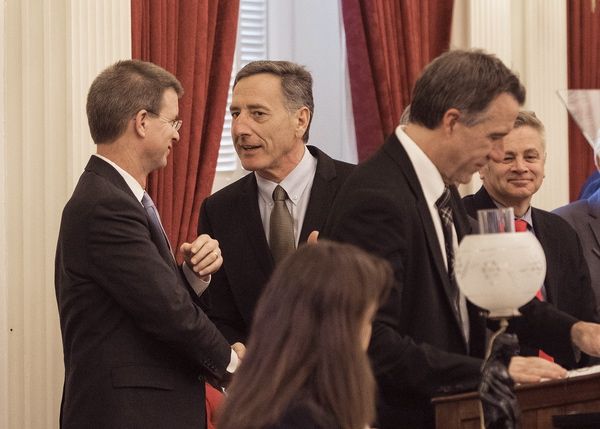
In his sixth and final budget address Thursday, Gov. Peter Shumlin told Vermonters that his 2017 budget proposal makes “tough choices.”
Speaking to a joint session of the House and Senate, Shumlin emphasized his commitment to keeping “with the long tradition of frugality and common sense that is the lifeblood of Vermonters.” He said his budget doesn’t raise income, sales, or rooms and meals taxes.
The governor’s $1.53 billion general fund budget for fiscal year 2017 would increase state spending by 3.1 percent, the same growth rate as anticipated tax receipts.
Shumlin’s short speech led with a defense of his fiscal policies over the past five years. The governor pushed back against critics and blamed the Great Recession and his predecessor, Gov. James Douglas, for the state’s long-running budget woes. For seven years in a row, the state has grappled with gaps in the tens of millions of dollars.
Shumlin took aim at the “prior administration’s phantom savings of $23 million from the failed Challenges for Change program that had been booked but never realized.”
He also touted his attempts through his years in office to expand the Medicaid program while putting new health care cost controls in place. Shumlin made a pitch for a deal he is seeking with the federal government that would allow the state to expand cost containment efforts.
For the first time since Shumlin took office in 2011, the budget he presented is in line with projected state revenues and relies on almost no one-time revenue.
The proposal fills a $68 million budget gap through a combination of $30 million in new revenues and $38 million in savings.

Shumlin plans to invest $2 million in security for state employees. He’d cover the cost of a $10.3 million Medicaid deficit from fiscal year 2016, known as the 53rd week, and would restore $400,000 to the Vermont Enterprise Fund, a taxpayer-funded cash incentive program for businesses.
He also would set aside $4.7 million for a state employee “step” pay increase. The appropriation is a prelude to a bill that will be introduced to the Legislature later this year, once the administration and the Vermont State Employees’ Association finish negotiations on the next contracts.
The new revenues would come from a doubling of annual fees on mutual fund registrations, from $600 to $1,200, and new taxes on dentists and independent physicians.
The mutual fund fee on approximately 22,000 funds registered in Vermont would generate about $13 million, according to Finance and Management Commissioner Andy Pallito.
The proposed 2.35 percent provider tax would raise $17 million, allowing the administration to boost reimbursement rates for doctors and dentists and draw down $20 million in federal money for the state’s strapped Medicaid program, which will be overdrawn by about $55 million in fiscal 2017. The state already taxes hospitals and nursing homes.
The budget counts on saving some $17.3 million in general fund dollars through “adjustments” within the Agency of Human Services. Though the specifics of the adjustments will not be public until department heads testify in House Appropriations, administration officials outlined some of the key cuts.
The remainder of the $38 million comes from a combination of pulling in additional federal money to the AHS and changing expenditures in the State Health Care Resources Fund.
Shumlin proposes to save money on the Medicaid program by changing policies on long-term contraceptives and lowering the income eligibility threshold for pregnant women.
The governor hopes to save $3.4 million when Medicaid beneficiaries go through an eligibility “redetermination” process — an effort the state is making now to review enrollees and purge those who no longer qualify.
The administration plans to push through a controversial change to the mental health system that would save a total of $5 million in “global commitment” money — about half of which would be general fund spending. The Department of Mental Health wants to speed up the timeframe in which the state can ask judges to rule on whether a patient can be involuntarily medicated. Previous attempts to change this rule, which opponents refer to as forced drugging, have failed.
Shumlin plans to save $1.8 million by cutting the Community High School of Vermont “field” programs and closing a work program at the St. Johnsbury correctional facility. It’s the second time the governor has proposed dropping the field education program. Last year, lawmakers nixed the idea.
The governor also counts $4.7 million in ongoing savings from an early retirement program, which saw 223 state employees leave the workforce in the current fiscal year.
Across state government, the budget would come out with 10 fewer state employee positions than currently exist. While the governor would add 48 employees to the child protection system and health care-related offices, he would cut 59 employees from the Department of Corrections and an eligibility unit in the AHS.
Steve Howard, executive director of the VSEA, applauded the governor’s efforts to improve workplace safety, but said the union will push for more staff in the child protection system and will resist proposals to eliminate the St. Johnsbury workcamp.
The governor’s proposal reduces the number of positions across state government by 10, which Howard says is a mistake.
“The lesson at DCF is that we need positions in order to keep children safe and in order to keep workers safe, and it’s true all throughout state government,” Howard said.
More details:
-
- The budget maintains a rainy day fund of $6.8 million and the stabilization reserves at the statutory level of 5 percent.
- Vermont has the lowest mutual fund registration fee in New England, according to Administration Secretary Justin Johnson. More than 10,000 funds are registered with the state each year. Massachusetts charges mutual fund companies $2,400 annually for each fund registered with that state.
- The governor proposes investing $10 million in child welfare programs. The budget would create 35 new positions to address caseload growth in the Department for Children and Families and the court system. Record levels of children are in state custody as a result of the opiate crisis, and high caseloads have led to a legislative review of child protection programs in the wake of two child deaths in 2014.
- Shumlin sets aside $2 million for new security investments. Half the money comes from the capital budget and would be used to upgrade facilities, and half comes from the general fund and would be used for operational costs associated with improving state worker safety. The killing of state social worker Lara Sobel outside the Barre DCF office in August has spurred the state to re-evaluate security.
Editor’s note: This story was updated Jan. 21, 2016, at 8 p.m.
