

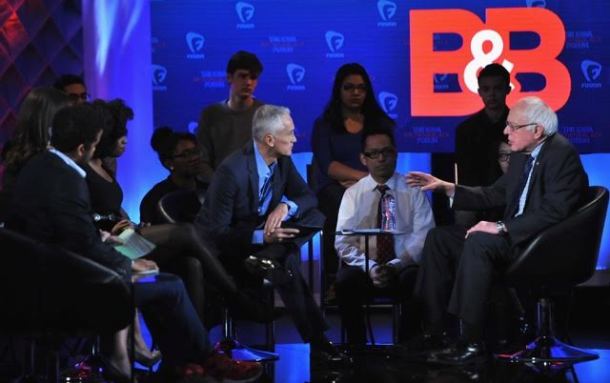
DES MOINES, Iowa — Democratic presidential hopeful Bernie Sanders discussed issues central to people of color during the Brown & Black Forum on Monday evening, hoping to win over constituencies not widely present in his home state of Vermont, where 95 percent of the population is white.
In the forum, sponsored by the Fusion Media Network, Sanders answered 30 minutes of questions at Drake University from journalists of color. Topics included criminal justice, immigration and education.
In classic Sanders style, he often tied racial issues to failures of economic policy.
On education, Sanders spoke of the need to boost money for public schools in poor neighborhoods, calling them “dropout factories.” He said public school funding should not continue to be tied to property taxes, because it means poorer neighborhoods face anemic funding.
He said real unemployment among young African-Americans is at 51 percent, a statistic he called a “national disgrace.”
To raise the money needed to support jobs and education, Sanders said the United States should redirect money away from prisons to educational efforts. He also discussed his plan to make public college tuition free, which would be funded by a tax on Wall Street transactions.
“We do not have the best-educated workforce” in the world, he declared.
As questions turned to police brutality and criminal justice, Sanders decried police violence and called for increased accountability.
“The truth is this has gone on for a very long time,” Sanders said. “The only difference is we didn’t have cellphones to video these crimes.”
Sanders said that as mayor of Burlington for much of the 1980s he focused on community policing. He called for police departments to better reflect the ethnic makeup of local residents.
“Do I think the black community has a right to be nervous and apprehensive about police? Absolutely,” Sanders said. “And I think we need some radical rethinking of police procedures.”
On immigration, Sanders defended his opposition to a 2007 immigration overhaul bill, saying he objected to a provision that would have facilitated mistreatment of low-income workers brought into the United States.
“Some of these guest worker programs were akin to slavery,” he said.
Sanders voted for the Dream Act in 2010, which would have given legal status to children born in this country to unauthorized immigrants. He also called recent deportation raids carried out by the Obama administration disturbing.
Near the end of Sanders’ time, moderators asked a series of quick questions, including this one from Alicia Menendez: “Is it off brand for a democratic socialist to live in a mansion like the White House?”
“Well, I would consider it more like public housing,” Sanders retorted, earning laughs and applause from the audience. He also said he considered anyone earning at least $250,000 a year to be rich.
Fellow Democratic candidates Martin O’Malley and Hillary Clinton also spent time answering similar questions and giving similar answers.
For answers from all the candidates, the forum can be viewed here.
Clinton said she would eliminate private detention centers for unauthorized immigrants while offering state-sponsored counsel to children in legal limbo. But, unlike Sanders, she stopped short of promising to stop deportations of children.
“I cannot sit here and tell you I have a blanket rule about who or who won’t be let into the country to stay,” she said.
O’Malley and Clinton also offered support of criminal justice reforms.
After the forum, the Sanders team dispatched a number of minority staffers and surrogates. They included Chicago politician Jesus “Chuy” Garcia, who mounted a strong challenge to incumbent Rahm Emanuel in the April runoff election for mayor.
Former Ohio state Sen. Nina Turner, who threw her support behind Sanders after initially endorsing Clinton, was also in the spin room.
Sanders staffers acknowledged issues around name recognition in black and Latino communities but said they were confident he would eventually get his name out in all the right places.
The campaign said Monday that Sanders will tour colleges in the early primary state of South Carolina with black activist Cornel West. Polling averages currently put Clinton 40 points ahead of Sanders in that state, 66 to 26 percent.
“We are relying on (an Iowa win) to bust it open and overcome the challenge of name recognition, because the Clintons have had two presidential terms,” Garcia said Monday in the spin room, adding that voters are becoming more interested in policy positions and less swayed by a familiar face.
“From here on in, I think people are going to begin focusing on the issues much more clearly,” Garcia said. “This is not any type of a beauty contest anymore.”
