


Editor’s note: This is the second of a five-part series of stories to appear weekly until Iowa’s first-in-the-nation caucuses Feb. 1.
[B]ernie Sanders once greeted a New York Times Magazine writer with the warning “I do not like personality profiles.” But the Vermont senator might have found a few complimentary copies handy when he brought his presidential campaign to this year’s raucous Netroots Nation convention.
The country’s largest annual gathering of progressive activists seemed tailor-made for the self-described democratic socialist. But Sanders no sooner stepped on stage in Phoenix when young Black Lives Matter protesters interrupted him with cries for racial equality.
“Black lives, of course, matter, and I’ve spent 50 years of my life fighting for civil rights and for dignity,” the surprised candidate grumbled in reply. “But if you don’t want me to be here, that’s OK. I don’t want to outscream people.”
Sanders’ response soon echoed nationally. The candidate “flashed with annoyance,” Time magazine reported, and “became frustrated,” the New Republic added.
“Sanders is understandably irritated,” Salon writer Joan Walsh opined, “that 50 years of work on civil rights — going back to attending the March on Washington with Dr. Martin Luther King Jr., fighting segregation with CORE in Chicago, endorsing Rev. Jesse Jackson’s presidential run in 1988 — don’t seem to count, especially with people who were born a generation after those events.”
But the Nation magazine contributor Joe Dinkin noted that Sanders “had the opportunity to rewrite his own narrative and broaden his own base” if he had only tossed his stump speech and spoke more personally — something his profilers are more comfortable doing than the candidate himself.
‘Everything except what I was supposed to’
Log on to Sanders’ campaign website, berniesanders.com, and you’ll see the first quarter-century of the 74-year-old’s life summed up in two sentences: “Born in Brooklyn, New York, he attended James Madison High School, Brooklyn College, and the University of Chicago. After graduating, he moved to Vermont.”
Search “Bernie Sanders” on the Internet and you’ll find 2.68 million news articles promising to fill in the blanks. They start by noting the way he speaks, as seen in a July 24, 2015, New York Times story headlined “Bernie Sanders’s ‘100% Brooklyn’ Roots Are as Unshakable as His Accent.”

“As Mr. Sanders draws large crowds on the campaign trail and enjoys an unexpected surge,” reporter Jason Horowitz writes, “his Brooklyn accent and upbringing in the heavily Jewish neighborhood of Flatbush off Kings Highway have become a particular point of pride for friends, former schoolmates and fellow progressives in the borough where he was born.”
Sanders’ father, a paint salesman named Eli, emigrated at age 17 from Poland, where he was one of the few members of his Jewish family to escape the Holocaust. His mother, Dorothy, cared for a three-and-a-half-room rent-controlled apartment near James Madison High School, where the candidate was a top long-distance runner, wrote for the school paper and served as class president before graduating in 1959.
“On the school’s crowded Wall of Distinction,” the Times story notes, “Mr. Sanders is no longer quite so overshadowed by such alumni as Justice Ruth Bader Ginsburg, Senator Chuck Schumer and four Nobel Prize winners, or, for that matter, Judge Judy and Cousin Brucie.”
(Or singer Carole King, who went there the same time as Sanders.)
Sanders was a 19-year-old student at Brooklyn College when his mother — who suffered a weak heart after a childhood bout of rheumatic fever — died at age 46. Press profiles don’t elaborate on his personal feelings. Instead, they springboard to the political.
“By the end of his year at Brooklyn College, Mr. Sanders was more than ready to leave for Chicago,” the Times story notes. “He paid less attention to his exams than to the books he brought back from the college library. He was particularly fond of a biography of John Peter Altgeld, a 19th-century progressive Illinois governor who championed child labor laws, supported striking workers and challenged the Democratic powerhouse of the time, Grover Cleveland.”
At the University of Chicago, Sanders read history, sociology and psychology — “everything except what I was supposed to read for class the next day,” he told National Public Radio “Morning Edition” host Steve Inskeep in a Nov. 6, 2015, interview.
In 1962, as an officer of the student Congress of Racial Equality, the 20-year-old led classmates in a multi-week sit-in — the school’s first such civil rights action — to oppose segregation in university-owned off-campus housing. Moving on to demonstrate against the city’s segregated public schools, he was charged with resisting arrest and fined $25.
“We were trying to support our friends in the South,” Sanders told NPR. “But we also wanted to take a look at the region that we were living in.”
‘He hasn’t changed in one respect’
In 1963, as an organizer for the Student Nonviolent Coordinating Committee, Sanders rode an overnight bus on his first-ever trip to Washington, D.C., where he heard Martin Luther King Jr. deliver his “I Have a Dream” speech.
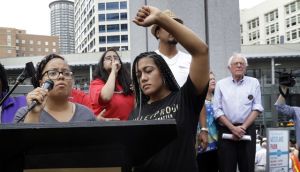
“Working in the civil rights movement, working in the peace movement, working with community organizations,” Sanders told NPR, “did a lot to influence the politics that I now have.”
But as the University Of Chicago Magazine would learn, getting Sanders to elaborate isn’t easy.
“I discover once we begin the interview, he hasn’t changed in one respect: he’s still frustratingly irascible in the presence of journalistic profilers,” Rick Perlstein wrote in a January-February 2015 profile titled “A political education.”
“He hates talking about himself,” Perlstein wrote. “He thinks it’s a distraction from what journalism should be about: serious issues, not, as he puts it, gossip. Most of his sentences in response to my questions on his college career devolve into incomprehensible mumbles. He looks at his watch. He gazes imploringly at his press secretary. (‘We’ve got a vote at what time, 5:30?’)”
Such impatience can be a stumbling block on the campaign trail. Just before Netroots Nation, when NPR’s David Greene asked Sanders about the phrases “Black Lives Matter” versus “All Lives Matter,” the candidate bristled.
“It’s too easy for quote-unquote liberals to be saying, ‘Well, let’s use this phrase,’” he said. “We need a massive jobs program to put black kids to work and white kids to work and Hispanic kids to work. So my point is that it’s sometimes easy to worry about what phrase you’re going to use. It’s a lot harder to stand up to the billionaire class and say, ‘You know what? You’re going to have to pay some taxes. You can’t get away with putting your money in tax havens, because we need that money to create millions of jobs for black kids, for white kids, for Hispanic kids.’”
Then came the convention, which sparked a torrent of news stories and commentary, including a Salon interview with Van Jones, a former Obama White House advisor and current political commentator.
“I’ve been warning the white populists in the party, behind the scenes, for several months, that their continued insistence on advancing a color-blind, race-neutral populism was going to blow up in their faces,” Jones told columnist Elias Isquith. “Bernie Sanders should know better. How can you be a politician of his age and standing, and want to be president of the United States, and in a part as diverse as [the Democratic Party] and then give speeches that sound like they come out of the 1930s when it comes to race?”
‘I should have been more sensitive’
That said, Sanders is evolving. The New Yorker staff writer Margaret Talbot offered an example this fall after noting his Netroots Nation problems in an 8,000-word candidate profile.
“A week later, in his Senate office, Sanders sounded chastened,” Talbot observed. “‘The issues these young people raised are enormously important,’ he said. The video showing the arrest of Sandra Bland, the African-American woman who died in a Texas jail, had just been released, and Sanders seemed shaken. ‘It impacted my night’s sleep,’ he said. ‘I don’t sleep that great, and it made it even worse.’ He went on, ‘It’s hard to imagine if Sandra Bland was white she would have been thrown to the ground and assaulted and insulted.’ Sanders, speaking more broadly about police violence directed at black people, said, ‘I plead guilty — I should have been more sensitive at the beginning of this campaign to talk about this issue.’”
The New Yorker observed that, when the candidate addressed the Southern Christian Leadership Conference’s subsequent annual convention in Baton Rouge, “his tone was friendlier than usual” and he folded in a quote from Martin Luther King, Jr., “which worked well for him: ‘Now our struggle is for genuine equality, which means economic equality. For we know that it isn’t enough to integrate lunch counters. What does it profit a man to be able to eat at an integrated lunch counter if he doesn’t earn enough money to buy a hamburger and a cup of coffee?’”
The magazine went on to list all the issues Sanders wants the media to report.
“In August, Sanders’s campaign issued a racial-justice platform that recommended police reform, federal funding for police body cameras, a ban on for-profit prisons, and the elimination of mandatory-minimum jail sentences. The platform also included a broad defense of voting rights. (Among other things, Sanders proposes making Election Day a federal holiday.) The document is divided into sections called ‘Physical Violence,’ ‘Political Violence,’ ‘Legal Violence,’ and ‘Economic Violence,’ strongly echoing the language and priorities of Black Lives Matter. At the same time, the platform reasserted Sanders’s core philosophy: ‘We must simultaneously address the structural and institutional racism which exists in this country, while at the same time we vigorously attack the grotesque level of income and wealth inequality which is making the very rich much richer while everyone else — especially those in our minority communities — are becoming poorer.’”
Black leaders are listening — and liking what they hear.
“He’s shown tremendous character in his willingness to engage and grow and change,” Jones told the New Yorker, tagging the candidate as “a reliable civil-rights vote, but not somebody who has been connected to these communities, to these kids and their neighborhoods. He’s not showing up to the funerals.”
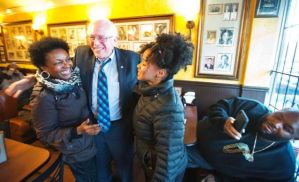
Even so, Sanders is popping up in some unlikely places. As the Washington Post revealed in November:
“ATLANTA — They arrived together late Monday afternoon at the Busy Bee, a soul food restaurant here, looking like quite the odd couple: Bernie Sanders, the Vermont senator seeking the presidency, and Killer Mike, the famous rapper who towered over him.
“They slid into a corner booth together, ordered some chicken at Killer Mike’s suggestion, and proceeded to discuss family, the shortcomings of the media and their mutual appreciation for the work of the philosopher Noam Chomsky, among other things.
“‘It was just a conversation between two angry radical guys, one 74 and white, one 40 and black, finding common ground,’ said Atlanta-native Michael Render, a.k.a. Killer Mike, part of the duo Run the Jewels, a social commentator and an aspiring politician himself …”
This time, Sanders put down the microphone and picked up some Coca-Cola and cornbread.
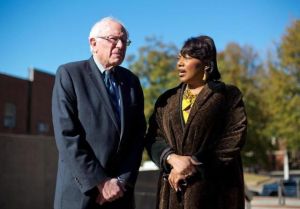
“Sanders’s bromance with Killer Mike — whom he called ‘quite a rapper’ — was among several signs of his efforts to reach out to black voters in recent days,” Washington Post reporter John Wagner continued. “Sanders made a trip to the King Center here, where he met with Bernice King, the daughter of Martin Luther King Jr., and toured the civil right leader’s crypt. Sanders told reporters afterward that King had been ‘an inspiration to me for my entire life.’”
One that, for a moment, came full circle.
(Coming in part three: The national press often compares Bernie Sanders’ presidential campaign to the 2004 bid of fellow Vermonter Howard Dean. But why hasn’t it explored a more surprising political connection that hits even closer to home?)
