


Just not his.
Yes, Amestoy could write plenty about his four-decade judicial career, be it the fact he was a Republican appointed to the court by a Democrat (former Gov. Howard Dean) or that he composed the state’s historic 1999 ruling that same-sex couples are constitutionally entitled to the rights and benefits of marriage.
But when Amestoy — who earned a master’s degree at Harvard University’s John F. Kennedy School of Government in 1982 and later served as a fellow at its Center for Public Leadership and Institute of Politics — retired from public service, he turned his attention to a teenage Harvard dropout who took to the sea before returning home to fight like a swashbuckler for the common man.
Just not now, but nearly two centuries ago.
Amestoy’s new book, “Slavish Shore: The Odyssey of Richard Henry Dana Jr.,” tells the true tale of a 19th century son of Boston high society who grew up to quit school, witness unspoken abuse, report it all in a memoir and go on to help sailors, slaves and eventually President Abraham Lincoln.
“On an August day in 1834 a slight, nearsighted boy boarded a ship he had never seen before, joined a crew to whom his aristocratic family would have never spoken, and sailed where few Americans had ever been,” Amestoy writes in the introduction.
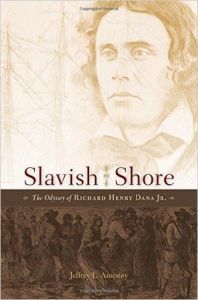
“Richard Henry Dana Jr.’s classic, ‘Two Years Before the Mast,’ immortalized the harrowing voyage from Boston around Cape Horn to the remote coast of California. But when Dana witnessed the sadistic flogging of his shipmates, it prompted more than one of the most compelling scenes in American literature. It was the genesis of his vow to stand for justice.”
Amestoy remembers first reading Dana’s memoir as a student decades ago. Published in 1840, the title has never been out of print. But that doesn’t mean today’s youth know about its author.
Amestoy, wanting to revisit and revive the legacy, wrote a 2010 article titled “The Supreme Court Argument that Saved the Union: Richard Henry Dana, Jr., and the Prize Cases,” which won publication in the Journal of Supreme Court History as well as the Supreme Court Historical Society’s Hughes-Gossett Award — given personally by U.S. Chief Justice John Roberts.
That sparked Amestoy to read thousands of archived letters and 20 years of daily journals to write his 365-page hardcover published by Harvard University Press.
“The drama of Dana’s remarkable life arises from the unresolved tension between the man he became at sea and the Brahmin he was expected to be on shore,” Amestoy writes in his book. “The qualities — courage, integrity, and a sense of justice — that led to his acceptance as a common sailor before the mast were the traits least valued by his peers.
“Dana first broke with convention when he left Harvard to ship as a common seaman,” Amestoy writes. “He represented sailors, angering Boston’s ship owners. He defended fugitive slaves and their rescuers when the ‘best people’ believed opposition to the Fugitive Slave Act was treasonous. His brilliant argument before the U.S. Supreme Court preserved Lincoln’s authority to carry on the Civil War. He was the special prosecutor who indicted Jefferson Davis for treason — and prompted the president to end the prosecution.
“No lawyer of equivalent standing did as much on behalf of fugitive slaves and those who aided them, nor paid a higher price for doing so,” Amestoy writes. “Dana was socially ostracized, boycotted, and nearly murdered.”
The resulting book is sparking praise from several national publications.
“Amestoy,” Harvard Magazine opines, “is the ideal extra-literary biographer.”
His work, the Wall Street Journal continues, “excellently reveals how Dana wrested from the text of the U.S. Constitution the acknowledgment that the African-American slave, a kind of property as far as the traditional reading went, also had rights.”
Amestoy is set to speak at Phoenix Books in Burlington on Jan. 14 and its branch in Rutland on Jan. 20, with more information available at the store’s website, www.phoenixbooks.biz.
Pointing to current unrest involving people who are poor or facing prejudice, the author says his work’s historic themes are nevertheless the stuff of today’s headlines.
“I don’t consider this an academic book — I think it’s really a fresh perspective not only on Dana but also on northern society. Dana is worth remembering for his life and spirit, remarkable integrity and courage.”
Kevin O’Connor, a former staffer of the Rutland Herald and Barre-Montpelier Times Argus, is a Brattleboro-based writer. Email: kevinoconnorvt@gmail.com
