


Editor’s note: Erin Mansfield and Elizabeth Hewitt contributed to this report.
While other candidates for governor issued statements to the media in response to Gov. Peter Shumlin’s State of the State address Thursday, Lt. Gov. Phil Scott reached out to digital natives in a livestreamed speech to supporters (and issued a comment to the press).
Scott, a Republican candidate for governor, took a page from his campaign speech and spoke directly into the camera for about 10 minutes and then engaged in a question and answer session with Yvonne Garand at his campaign headquarters in Middlesex.
The livestream was held at the same time as Donald Trump’s rally in Burlington. State Republicans aggressively distanced themselves from the New York City candidate for president who they have described as a “bully and a bigot.”
The lieutenant governor briefly outlined his personal history and talked about his “Everyday Jobs Tour” before he launched into his stance on issues.
Scott underscored his own platform for revitalizing the economy instead of countering Shumlin’s speech directly, which was a rundown on the governor’s accomplishments and did not broadly address economic issues the state faces.
Scott said he would rebuild the manufacturing sector, which employs about 10 percent of the state’s workforce and pays 31 percent higher than the average wage. He ticked off a list of obstacles for manufacturers, including high electricity costs, high taxes and an unpredictable regulatory environment, that he would address. In addition, Scott would restore a 30 percent research and development tax break for manufacturing companies.
The Legislature’s interest in a carbon tax, Scott said, would drive away businesses from the state.
“It has the same feeling as the single payer conversation, which was allowed to continue for too long,” Scott said. He described the carbon tax as a distraction from lawmakers’ focus on the state’s fiscal foundation. “We need to stop it in its tracks now,” Scott said.
The state has enjoyed significant benefits from the renewable energy industry and captive insurance, he said. “Imagine if we had a governor’s office that treated every sector in the same way,” Scott said.
He pointed to the state’s stagnating population as an issue he would address head on. Scott said he wants to encourage 5,000 people in the 25 to 40 age group a year to move to the state with targeted investments in programs for working families and first-time homebuyers.
Scott criticized the Legislature and the governor for increasing the state budget too quickly. “When they say balance the budget, what they’re doing is just raising taxes,” he said. “Last year they raised taxes and spent more money.”
The state must keep budget growth in check, he said. “I would build budget by looking at what the growth was last year, and I won’t sign a budget that grows faster than the previous year,” Scott said.
Response from Lisman, Minter and Dunne

Bruce Lisman, a former Bear Stearns executive who is running against Scott for the Republican nomination, said in a statement that Shumlin “did his best” to “put a positive spin” on the changes to education and healthcare that have happened under his watch.
“But Vermonters know the reality is different, because they see it in their own lives,” Lisman wrote. He challenged Shumlin’s record on job creation, and criticized Act 46.
Matt Dunne, a Google executive who is seeking the Democratic nomination to replace Shumlin, listened to Shumlin’s speech in the lobby in front of the entrance to the House.
“I think what Gov. Shumlin has outlined is what he has made his signature, which is coming out with bold positions particularly on social issues,” Dunne said. He cited Shumlin’s proposals on divestment and marijuana legalization.

Dunne said the caps included in the Act 46 education law were a “distraction” and said he was glad the governor wants to repeal or delay them.
Sue Minter, the former secretary of the Agency of Transportation, is running against Dunne for the Democratic nomination for governor. She said she agrees with the governor’s decision to highlight economic development in his speech, nodding to his Step Up proposal that would provide one semester of college education to low-income Vermonters.
“As we grow the economy, we have to understand how the economy is supporting our working families,” Minter said.
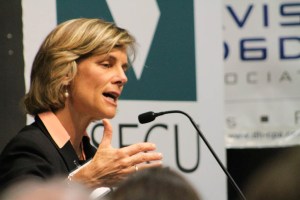
Meanwhile, Minter said that she stays firm on her position on marijuana legalization, emphasizing the need for a system of regulation, an education and prevention component, and driver safety.
With regard to Shumlin’s proposal to limit the number of opiate painkillers doctors can prescribe for minor procedures, Minter said she is “cautious about telling doctors what they can and cannot do” but that she recognizes “that our opiate challenge is huge.”
Democratic candidates for Lieutenant Governor react
Sen. David Zuckerman, D/P-Chittenden, is seeking the Democratic nomination for lieutenant governor. He called for marijuana legalization in 2015 and introduced a bill that no Senate committee took testimony on.
Zuckerman said he generally supports Shumlin’s proposal to legalize marijuana, but the main difference is that Zuckerman wants marijuana edibles to be legalized at some point, and Shumlin said they should remain illegal “at first.”
Zuckerman four of the five caveats that Shumlin said need to be included in a legalization bill are in his bill: keeping marijuana from minors, funding law enforcement to keep adults from driving under the influence, taxing marijuana at a low enough rate to wipe out the black market, and using revenue to prevent addiction.
He said marijuana edibles are “a topic we need to discuss. Whether it’s delaying it or prohibiting it entirely, that’s up for discussion. I do think if we’re talking about bringing an underground economy above ground and regulating it properly, we might just be kicking the can down the road on that one.”
Zuckerman described four main ideas for directing revenue from marijuana legalization: treating opiate addiction, funding local law enforcement, funding higher education, and a creating special account to fund capital projects. He said the state should not depend on marijuana revenue to fund regular operations.
Zuckerman called himself one of the leaders in the movement who suggested to Bill McKibben, the founder of 350.org, that the state divest its own funds. “There’s no moral or economic value to remaining invested in (fossil fuels),” he said.
Rep. Kesha Ram, D-Burlington, who is running against Zuckerman for the Democratic nomination, said she thought Shumlin’s address was “far-reaching.” She supports many of his proposals but said he did not spend enough time talking about property taxes.
Ram said she supports his call to divest state pension funds from the coal industry and his plan to legalize marijuana with five caveats that include putting revenue toward addiction treatment and keeping marijuana away from minors.
Ram recently put in a request for drafting a bill on divestment from coal, and had “no idea that the governor was going to lend his support to that,” she said. With regard to marijuana, she said, “It’s time to have that conversation.”
