

[W]riter Kurt Vonnegut says most stories take shape in one of two universal ways.
Boy Meets Girl or Man in Hole.
Ron Deuso, three-time convicted burglar, pain pill junkie, is a Man in Hole.
Out of jail since October, clean for nine months, he’s trying to climb his way out and not fall back in. By his own account, he’s dug his own grave and knows better than anyone this is his last, best shot to get out of the hole and back on firm ground.
Deuso lives at Phoenix House in Barre. He spends his days looking for work, an apartment, tries to scrape together a few bucks, all in hopes he can reunify with his youngest son, who like many of Ron’s children, has been in and out of state custody and lives with a foster family pretty close by.
Every day is a challenge, whether he’s trying to convince an employer and a landlord he’s trustworthy, not to mention all the meetings, drug counseling and otherwise, required in order for him to be free.
He’s under curfew, has no car, no driver’s license, and never has many minutes left on his phone. He has pawned his few possessions and needs to borrow tools for small jobs he gets. It’s rare that 24 hours goes by and he isn’t tested for drugs, sometimes as often as three times a day.
Deuso begins each day just before 5 a.m. when he catches the bus near Phoenix House. The sign on the bus says SPECIAL. He rides a circuitous route to the drug maintenance clinic in next-door Berlin, where he gets his daily dose of 4 milligrams of buprenorphine. A “bouncer” makes sure he actually swallows the bupe. Then, Deuso usually returns to Barre, where he has breakfast at one of the churches with his oldest son, Josh, where he sometimes volunteers as a cook, before heading out to look for work, to maybe make a few bucks.
Deuso’s day typically ends with a three-hour evening group counseling session in Berlin, then it’s back to Barre (an easy drive, a pain-in-the-neck hitchhike). There, he does his chores at Phoenix House, mopping the bathroom and cleaning, before hitting the hay in a small room he shares with two other men. There’s a bunk bed, a single bed, and just enough room for two bureaus.

Hanging over his head every day and at night is the black cloud of fear that he won’t make it, won’t find a job, an apartment, won’t be able to reunite with his 14-year-old son. He knows it’s hard to claw your way out when the load you’re carrying includes a serious criminal record.
Tapping on his shoulder every day, every moment, at every corner, is temptation, the lure of drugs, the urge to use, the easy money from selling. Dozens of times every day, Deuso says he’s offered opportunities to get high or buy drugs as he pounds the pavement in Barre, which he likens to a Zombie movie because of all the stoned addicts walking the streets.
Deuso is trying to stay positive, but he says it’s stressful. He not only carries the smell of cigarettes, but an unmistakable whiff of fear and frustration. Sometimes he has faith, sometimes he feels it’s all futile. On a form for a treatment program he went through, he described himself as “a good friend” and “loyal.” In a text, he said: “I’m a warrior.”
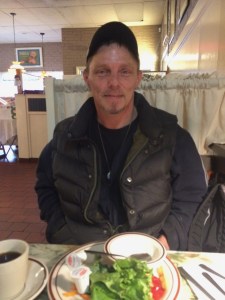
“I’m struggling,” Deuso said, looking down into the black coffee he cups in his small, calloused hands at Barre’s Soup n’ Greens restaurant.
“Some days it feels almost impossible. I’m convinced I’m done doing drugs, but I’m not totally sure I’m going to make it. Sometimes I feel like I just have to survive the day, the hour, sometimes it’s just the next few minutes.”
A few minutes later, he said: “I’m going to make it. I have to.”
THE MOTIVATION
Ronald C. Deuso, DOB: 12/2/70, just turned 45. He has a boyish look but after decades of hard living, drug and alcohol abuse, he looks older. He spent seven of the last 10 years in prison since the motorcycle accident in 2005 that he said precipitated his full-blown addiction to painkillers, and the burglaries to feed his habit.
“I’m all jammed up with no room for error,” he said. “They say relapse is part of recovery. That scares the absolute shit out me. If I step back in that circle again, it’s over. The first time, if I ever did it again, I don’t know what I’m going to do. It’ll be over.”
There is the temptation, he said, to just say screw it, use again, “relieve some stress’’ and go back to jail for the week or so you pay when you test dirty the first time. But he said he has to stay clean.
“My mind is set to not do drugs. I’ve never wanted something so bad in my life,” he said. “I probably got a thousand relapses in me but I don’t have any more recoveries. You know what I mean, that’s the part, I don’t have it. Relapse is easy, it’s easy to go down that road, but it’s hard to step back out of it. So, it’s getting easier. Am I tempted sometimes, does it cross my mind, yeah. I try to play it out like a movie, you know, if I was to get high right now, where is that bringing me,” he said.
These days, Deuso’s biggest motivation to stay out of trouble is his intense desire to live again with his teenage son, his youngest child, and prove to himself and his family that he can finally be a positive role model.
“If I can walk the walk, maybe my footsteps won’t be so deep for them to follow in, you know what I’m saying,” he said. “I’ve been in and out of their lives for a long time and the footsteps they’re trying to follow in are pretty damn deep and you know any normal man, I think any normal man would have drowned in them.”
Ron is also highly motivated to stay clean to be a model for his second oldest son, Tyler, who has a year left to serve on his own burglary conviction. He just turned 22.
Ron and Tyler were father-son cellmates in St. Johnsbury and later Newport. They were together the day Ron got down on his knees before the prison pastor, decided to go straight and make one last try to rebuild his shattered life and family.
For two years, from 2011 to 2013, in between his second and third burglary convictions, Ron lived with the teenage son he hopes to reunite with now that he’s out. During that time, their caseworker at the Department for Children and Families was Lara Sobel, the social worker who was murdered this summer.
Just before he got out, Deuso was part of a corrections department work crew and helped bury Sobel, who he initially eyed with suspicion but grew to admire. Sobel gave him parenting advice, he said, more as a mother than as a caseworker strictly applying the DCF rules.
“That lady touched my heart in a way not a lot of people have. There was part of an angel in there. I could feel the good in her,” Deuso said.
Recalling the day he helped dig her grave, he said: “I felt like, what’s the word, honored to help.”
When the crew returned a few days later to do work for the headstone, he left behind a small token of affection, respect and appreciation.
THE HIGH LIFE
Ron Deuso grew up in Williamstown and Graniteville in a family he described as drenched in alcohol, a wild pack of brothers – biological, half, and step – who were “a bunch of ruffians” with frequent keg parties. Deuso said his father was a functioning alcoholic who worked a variety of jobs, including as a foreman, at Vermont Castings and then at Capitol Candy. His mother, he said, took off by the time he was 8. He started sneaking cups of beer when he was 12, smoking pot daily at 15. He dropped out of school when he was 16, got married for the first time at 19. His first son was born about a year later.
His 20’s and 30’s were a life of heavy drinking, serious drugs, using and selling, though only an occasional pain pill, which at the time were not really his thing.
“That’s the way I was raised, I like to party,” he said, adding: “I have an addictive personality. I’m addicted to everything, work, fun, adrenaline.”
And living the High Life.
During the good times, in the mid-1990s, Deuso said he made money buying and selling used cars but made thousands of dollars a week selling drugs. He said he could go to Hartford, Connecticut, pick up heroin for $2 a bag, come back to Vermont, cut it with other substances to stretch it, turn that one bag into two, and then sell each one for $30. He said the demand was unlimited.
“And I just blew it, eat out every day, buy drugs, whatever I fucking wanted,” he said. “It was just an easy way of living. A nice car, pay the bills no problem,” all the premium cable channels instead of just basic.
Trouble with the law really kicked in the early 2000s.
Deuso said another dealer owed him money for marijuana so he broke into his house and robbed him. He was sentenced to 18 months to 10 years in prison.
In 2002, shortly after he got out, his house was raided and police found drugs. Deuso avoided being charged because he said authorities didn’t know he was out of jail. The courier mistakenly brought the drugs into the house instead of the usual practice of hiding them in a tightly sealed canning jar placed in a hole dug in the yard and covered with a rock. Even though he wasn’t charged, Deuso said he had to lay low and give up dealing.
THE DOWNFALL
A key turning point in Deuso’s life happened in 2005.
One afternoon in Chelsea, Deuso lost control of his motorcycle, crashed into a guardrail and severely broke his left wrist. Pins, infections, multiple surgeries, finally fused, his wrist today is a road map of slashes and scars.
“It was all downhill from there,” he said.
When the accident happened, he was prescribed Methadone and took 100 milligrams a day for the pain and Percocets for when it became severe. It didn’t take long before he was hooked, loved the Methadone and was soon crushing the Percocets to intensify the high.
“They made me feel like I was 20 years old again,” he said, “That stuff should be for like end-of-life drugs. I’m a pretty strong person, but it’s amazing how easy it was to get addicted.”
Methadone, he said, was unlike any drug he’d done, the fuzzy warmth, the numbness, the energy it provided. Deuso said of all the drugs he did, Methadone was his favorite.
Within a few months, he couldn’t get any more from doctors and started buying painkillers on the street.
“I pretty much couldn’t do anything without them,” he said. He was buying and selling, hustling however he could to pay for his habit.
In 2006, Deuso broke into someone’s home whom he suspected had drugs, but ran when he opened a bedroom door and the owner woke up. Deuso fled on foot. The owner came out and ripped off the front plate of the getaway car before Deuso’s girlfriend could drive away. He was arrested after police matched the plate.
This was his second burglary conviction, and the dwelling was occupied, resulting in a more serious charge. He was sentenced to 3 to 12 years in prison.
In 2009, Deuso was about to be released after he served the three-year minimum when he said he intentionally got into enough trouble to be shipped to a Kentucky prison Vermont once contracted with to handle an overflow of inmates. Deuso believed a Vermont prisoner at the Beattyville facility had hurt one of his children, but when he got to Kentucky, the prisoner was already back home. He served a year in Kentucky, then another back in Vermont, and never got back at the inmate. It was, he says, “a total waste of two years.”
He was released on March 13, 2011.
For a year or so, he said things went okay. He made money fixing up and selling cars. Then he got divorced and said he started taking painkillers heavily again.
“Once we got done, it was game on, so I would just get all fucked up just to drown it all out,” he said.
Deuso admits a weakness for women. He has seven children with two different woman, one of whom he married. A third woman — they didn’t have children — he married twice. He is estranged from most of his children; he spends the most time with Josh, 24, who is the oldest. He’s not been in contact with his teenage son and isn’t sure the boy wants to live with him again. He wonders if he might be better off with his new family, knows even the idea of jail visits was tough. (The boy’s mother has a documented history of mental illness and several of her children have been taken into state custody, including a teenaged daughter she padlocked in a shed overnight four days in a row.)
In 2013, again on the hunt for drugs and money, Deuso committed the third burglary he would serve time for. He broke into a residence in East Corinth. He didn’t find drugs as expected, he said, but he stole a pillowcase full of gold and other valuable coins. A random traffic stop a few days later, where the officer turned around on a remote stretch of road between Hardwick and Craftsbury, led to a search of the trunk of his 1995 Chevy Cavalier and questions about all the coins.
A few days later, Deuso was on his Kawasaki Vulcan 1200 motorcycle talking to a friend in a downtown Barre parking lot when police came to question him. He took off, ditched the blue lights and sirens, riding the yellow line during rush hour, drawing in state police and officers from departments across the county. Deuso eluded police for 45 minutes before hiding his bike at a friend’s place. Police caught up with him a few days later. He was arrested and then charged in connection with the burglary.
Deuso went back to prison on December 7, 2013. At first, he was facing a minimum of 12 years, which he knew if he got, would be the end. It took 14 months to settle the case, but this past February, Deuso caught a huge break — a plea bargain offer with a minimum of only two years and credit for time served. (He soon settled the motorcycle chase charges, too.)
The biggest miracle, however, was yet to come.
JAILHOUSE CONVERSION
It was March 27th of this year. Deuso was in St. Johnsbury. Tyler was his cellmate, a source of comfort and shame.
“It’s hard. You’re thankful to be with him and watch over him. But I was embarrassed, too. A father and a son, cellmates,” Deuso said, slowly shaking his head. “He tells me, ‘This isn’t your fault, Dad, I made my own decisions.’ But his opportunities could have been a lot better if I was paying attention. It’s one of the reason’s I’m paying attention now.”

And trying to stay out of trouble.
“I’m hoping if I can do it, he can do it, too,” he said.
Deuso said he and Tyler would attend the prison ministry program just to get out of their cells. But on this March day, almost nine months ago, Pastor Rick Menard gave a profound sermon and some tough love advice.
“He told me instead of just lying there, why don’t you get down on your knees, and I did it. You know how when you’re doing something deep down. I dug deep down and prayed,” Deuso said. “Truthfully, I had an awakening.”
And decided to go clean.
“I was at the end of my rope. I figured what do I have to lose. So I decided to get down on my knees and say: Help me with my life, help me get through it. I prayed for my kids, loved ones, lot of things,” he said.
Pastor Rick has been preaching to prisoners for 22 years. He admits he’s heard a lot of jailhouse conversions.
“I would say that the majority of the men that get what people would call jailhouse religion the majority of them, it’s kind of like a foxhole, we call it a foxhole conversion, I’m in trouble, God if you get me out of this, I’ll be a good boy the rest of my life and most of them don’t,” he said. “But there are some that do and the some that do are the ones that we need to hang our hat on and we talk about and continue a relationship with. It’s a wonderful thing once in awhile.”
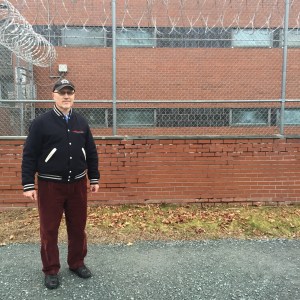
Pastor Rick became a Born Again Christian after his life “imploded like the Twin Towers.’’ He never knew his own father. He wrote a book called “As a Son with His Father.” He’s witnessed maybe three cases of fathers and sons serving time together, that “it’s jarring to see” and because of his own past, and the need sometimes for fathers and sons to reconcile, it touches him deeply.
Pastor Rick had planned to preach about another topic, but instead gave a sermon about Fathers and Sons. Deuso thought Pastor Rick was talking to him.
Changing the subject. Changing a life.
The pastor was thrilled to hear this week that Deuso was clean.
“Please ask him to call,” he said.
WITHDRAWAL AND RELEASE
Throughout his time in prison, Deuso said it was easy to score drugs. Some guards would sell, visitors would sneak some in, and another technique was to have a cohort on the outside mix a drug like Suboxone in with non-toxic glue, which could then be used, for example, to stick items in a greeting card. The inmate would pull off the attachments and eat the glue/drug mix. Another technique was to iron certain drugs onto a yellow piece of paper where they blend in and can not be detected.
“People say it’s easy to quit in jail. It’s not. You’re kind of in there and feel like what do I have to lose,” he said.
Deuso said after Pastor Rick’s message, the good luck that had started the month before with the plea deal continued. He qualified administratively to have his sentence reduced even further. Then he became eligible to join the work camp in Windsor. He’s convinced the praying worked.
“So many things happened, I couldn’t ignore it any more,” he said.
In the meantime, he went through severe withdrawal in St. J. The pain in his legs, he said, was excruciating. He tried to kill time sleeping but couldn’t. He had no interest in eating.
“It was torture. Did a lot of praying, a lot of thinking. What’s the word when you stay away from everybody,” he said. “Tried to get into a routine, worked out a lot, started feeling better.”
He became eligible for release in August and got out in October when he secured a spot at Phoenix House, a 16-bed facility that is part of the transitional housing program run by the Department of Corrections. The idea was Phoenix House would provide programs and a more supportive, structured environment to stay off drugs than other more standard housing programs offered by the corrections department, including sometimes even hotels.
Deuso wonders if he made a mistake signing up for Phoenix House, where he is in the RISE program (Recovery in an Independent, Sober Environment). He is unsure the treatment regimes are any good and said fellow residents frequently use drugs and are sent back to jail. Most of all, he is worried he missed a better chance at more permanent housing by not opting for another program. He’s frustrated and believes he might have to go back to prison to qualify for another way to get an apartment.
“I feel sometimes like I’m trying to get to the third floor, but I’m walking down the stairs to the first floor,” he said.
THE CORRECTIONS MACHINE
Former Corrections Commissioner Andy Pallito stared out the window as he nursed a cup of coffee at the small table at Capitol Grounds and talked about the balance between protecting the public and effectively helping people who commit crimes because they are addicted to drugs.
Pallito started in Corrections in 2001 and became commissioner in 2008. He said the approach of the past may have put too much emphasis on public safety rather than focusing on fixing the drug problem that leads to the crime.
The Department of Corrections, he said, is “a machine’’ designed to keep the community safe, but “now we choked it with so much stuff,” such as treating drug addiction and creating programs for people with mental illnesses. In the past, he said, prisons tried to change criminal behavior. Now, echoing arguments heard from the schools, the prison system is being asked to not only correct criminal behavior but to take on issues such as addiction as well.

“What my instinct tells me is we took that machine, in the 90s, and we just started pushing people though it, just pushing, pushing, pushing, to a point where people with a complicated history,” including crimes motivated by addiction, were being kept away from the public but not receiving the help to prevent reoffending.
Pallito was not familiar with Deuso, but said his case was remarkably typical. Some 80 percent of prisoners, in Vermont and across the country, are fighting an addiction, drugs or alcohol, he said.
“It’s about as embedded into the DOC population as crime is,” he said.
“Burglaries aren’t really his issue. It’s the addiction stuff that’s his issue. So is this machine, the right machine to put him through?” Pallito said. “And what we’ve basically decided at a policy level is that the crime is more important than the addiction.
“So we’ve asked the DOC, okay, you guys create a high school, you guys create addiction programs, you guys bump up mental health programs in jail. When I was running the department, you’d sit there and say: Why am I doing this, creating this, these mirror programs for a population that really what we’re after isn’t the criminal part,” he said.
The soft-spoken Pallito continued: “For someone with six sexual assaults on a minor, you’re damn right they’re going through, but for somebody who has an addiction issue, who’s committing burglaries, trying to feed that addiction, is this really the best place to put them? I think we’re getting to the point where we generally agree it may not be, but getting there is a bit of a culture change. We’re making progress,” he said.
In the meantime, “there’s no silver bullet for a guy like this,” he said.
THE SOCIAL WORKER WITH A HEART
Ron Deuso didn’t like Lara Sobel the first time he met her. After all, she was a DCF worker and he figured she had only one mission.
“At first we didn’t see eye to eye. I had my blinders on, just thought she and DCF wanted to take my kids away,” Deuso said.
But that changed over time. Deuso had gained custody of his son after his release and they were living together in Middlesex. During the visits, Deuso said Sobel treated him with respect.
“I thought maybe her intentions are good. It’s not black and white. I’m assuming she thinks I’m a bad person and will look down on you,” he said. “She never looked down on me. She never pussy footed around with me. She told it like it was.”
“She gave me good advice. Our interactions were different. It definitely changed my outlook,” he said. “She genuinely cared about (my son), whether I had to admit or not.” He was reluctant to share the specific advice she gave, but “it was more like a mom than a social worker.”

He was saddened by the news of the murder. Soon after, on an August day, Deuso was part of the half a dozen or so on the work camp crew who went to Green Mountain Cemetery in Montpelier. A small excavator had scooped out most of the dirt for a rectangular grave in the Jewish section right next to Route 2. The buzz among the crew was the grave was for that social worker that got killed. Deuso said he and two others took shovels and went down in the hole to finish the digging and square off the sides.
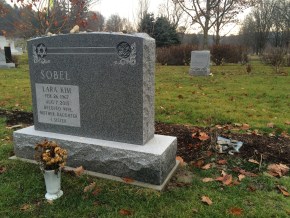
A few days later, when the crew returned for the headstone work, Deuso left behind a small plastic red rose at her grave. He explained and then asked to not reveal how he got it.
“I still feel emotional about it,” he said, recalling the day at the cemetery. “She was a good lady that genuinely cared. It takes a certain kind of person, to take care of other families.”
“She really took it to heart and put it out there with her heart,” Deuso said.
AT THE DOOR OF SUCCESS OR FAILURE?
After getting out in late October, Deuso had three weeks of work installing windows at a local ski area condominium project, but said he quit because the conditions, 55 feet in the air, felt unsafe.
He says there’s not a store in Barre where he hasn’t applied.
“Working hard is ingrained in me,” and despite his record of stealing, he said he can be trusted. But it’s a hard sell: “No one wants to hire a felon, no one wants to rent to a felon.”
“I know it’s not right, doesn’t make it okay, but I looked at it as not as bad, I was ripping off drug dealers,’’ he said. “They made one out to be Joe Community, but they weren’t,” he said. Echoing bank robber Willy Sutton, Deuso said he targeted dealers because, well, they had the money and the drugs he wanted.
Pallito says someone like Deuso would not be automatically kicked out of Phoenix House at the end of the six-month program if he is progressing. He added, however, the extension is not typically for months and months. Other offenders are waiting for those precious beds, he said, particularly ones with addiction-related programs. Deuso is supposed to pay $75 a week and is already behind.
The key right now, Pallito said, is for Deuso to get work, any kind of job, save some money and then get an apartment.
Most people, he said, make it.
In between bites of hamburger, fries and cottage cheese, Deuso said: “I’m going to find a way. I don’t know how yet. I just have to think positively.” He paused, adding with a smile: “Life is a struggle, I guess.”
“Really, he’s at success’s door, not failure’s door,” Pallito said.
When Josh came to pick him up at Soup n’ Greens, Deuso repeated his anxiety that he’d have to go back to jail to ultimately get into another housing program. He and Josh were planning that afternoon to strip some tires off a Blazer a friend gave Deuso to turn around and make a few bucks.
“I swore to myself to myself I’d never walk through those doors again, but if I have to take a step back to go forward, if that’s what I have to do, then…,” he said, trailing off, clearly discouraged, another small slurp of his coffee.
Josh tried to pick his spirits up, but was clearly worried.
“You can’t go back. You’ve been away from us too long already,” he said. “I have nightmares about you going back.”
A few moments later, Josh put his arm around Ron. Father and son then walked out the door. One step forward. One step at a time.
The Man in Hole had for now stopped digging.
