

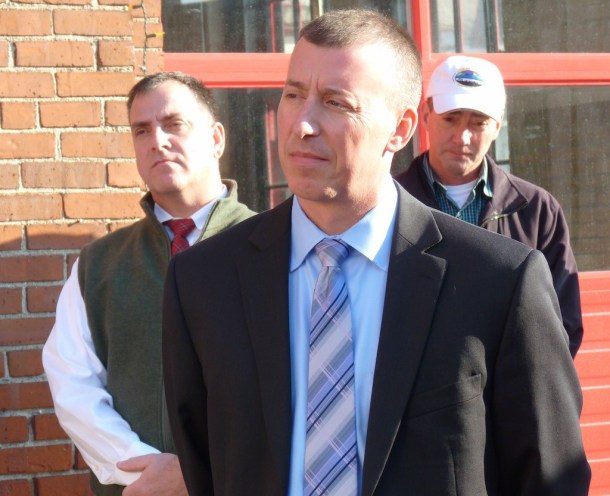
[B]URLINGTON — Steven Locke has been a jack-of-all-trades for the Town of Hartford, serving as director of public safety, fire chief and most recently as the interim town manager.
Now he’s poised to take on a new challenge: Burlington Fire Chief. Locke is Mayor Miro Weinberger’s selection to replace longtime Chief Seth Lasker, who retired at the end of October. Weinberger will ask the City Council to approve the appointment at the Dec. 21 meeting. If approved, Locke would take over in February.
“One thing that gives me confidence that Steve will be able to handle the responsibility of a larger department is he’s been asked to take on additional responsibilities that go beyond what we typically think of as a fire chief at a couple key moments in the town’s history,” including coordinating Hartford’s response to Tropical Storm Irene, Weinberger said.
Burlington has more than four times the population of Hartford, a town of less than 10,000 on the New Hampshire border. Locke, a 23-year veteran of Hartford’s Fire Department, said he welcomes the challenges that will come with leading Burlington’s 79-person department.
“This is the largest organization in the state, the busiest organization in the state, and for me it presents a lot of challenges and opportunities that I can deliver better services,” Locke said.
The work that fire departments do nationally is changing, Locke said, with greater emphasis being placed on the delivery of emergency medical services. At the same time, every department has to be prepared to deal with catastrophic fires, he said.
Locke will preside over the buildout of Burlington’s paramedicine program, with the eventual goal of sending paramedics out on every medical call. Currently the city relies on emergency medical technicians (EMTs), who are adept at providing prehospital medical care, but have less training and are more limited in the medicines they can use in the field.
Locke’s hiring followed a lengthy nationwide search. There were 19 qualified candidates, according to city officials and six finalists. Weinberger said the city followed the the equal employment opportunity hiring process.
“This is probably the most difficult position to recruit a diverse candidate pool, and I think that’s a real problem,” Weinberger said, “It’s a problem that I want our next chief to engage head on.”
Weinberger said that nationally “something like 97, 98 percent” of firefighters are men, which matches Burlington’s experience where there is only one female firefighter. There is also only one firefighter of color in the department, and that person was recently hired, according to a memo on diversity the mayor provided the City Council earlier this week.
While Locke does not bring greater diversity to the Burlington Fire Department, Weinberger said he hopes that Locke will leave the department more diverse than he found it.
Locke echoed the mayor’s comments that it’s difficult to recruit a diverse fire department, and suggested that it will be important to start with “the kids in the schools” to let them know what opportunities there are in firefighting.
“This is not an easy fix this is not going to be a quick fix, and moreover we have to really set with that as a priority, but again we have to continue to hire qualified people…there are cities that have done it, but we have our work cut out for us,” Locke said.
Curtiss Reed, with the Vermont Partnership for Equity and Diversity, is working with Burlington to increase diversity throughout city government. He agreed with Weinberger and Locke that firefighting is a particularly challenging area to increase diversity.
“Firefighting is one of those legacy professions, where a lot of times your father was a firefighter and your grandfather was a firefighter,” he said.
Reed has recommended that the city reach out to national minority professional associations when hiring for leadership positions, but there aren’t any for firefighters, Reed said. Reed agreed with Locke, that increasing the diversity in Burlington’s Fire Department will require creating a career ladder for young residents of color.
“They have to plant the seeds now in the hopes that 10 to 15 years from now they will in fact blossom,” Reed said.
Another challenge presented by Burlington’s growing diversity is that the department increasingly serves new Americans, Weinberger said. Close to 8 percent Burlington’s population are refugees, immigrants or asylum seekers, and 11 percent speak a language other than English.
