

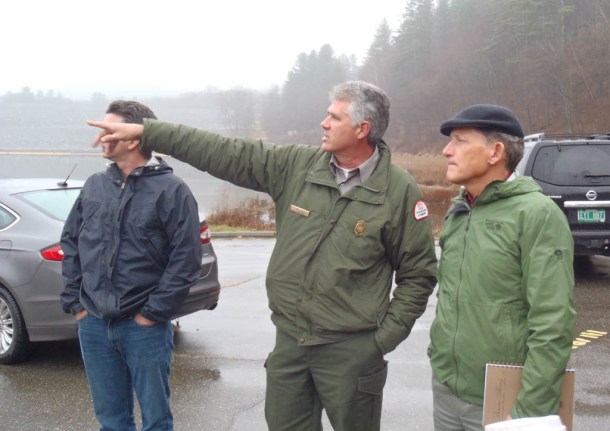
So Friday morning was an anomaly as the board’s tiny meeting room in Greenfield, Mass., was packed with three Townshend residents and two state lawmakers concerned about chronically low tax-loss payments and perilously low water levels at Townshend Dam.
There was some good news for the Vermont visitors: The commissioners agreed to call in the U.S. Army Corps of Engineers, which operates Townshend Dam, to discuss Townshend Lake maintenance issues and other questions.
But on the money front, it’s clear that there is no additional funding headed for Townshend – or any other Vermont town that hosts a flood-control dam – anytime soon. Commissioners cited a lack of cash and a lack of authority, and not long after Friday’s Townshend discussion ended, they approved the latest round of payments in lieu of taxes with no changes.
“We have no authority to say to Massachusetts or Connecticut, ‘You will give (more) money to Vermont and New Hampshire in compensation for tax loss,’” said Bob Grimley, a New Hampshire representative on the commission.
In a sense, Townshend’s two concerns about the Army Corps Dam are very different.
From a maintenance standpoint, ongoing sedimentation problems have reduced Townsend Lake to a depth of 1 feet to 2 feet in most spots, greatly diminishing recreational opportunities and aquatic life.
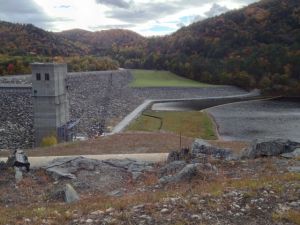
On the financial side of the debate, Townshend officials are unhappy that they get just $5,656 annually as compensation for hosting approximately 1,000 acres of untaxable federal land that has been valued at $1.1 million by the town.
In their presentation to the flood control commission on Friday, however, Townshend officials did their best to tie the two concerns together. If recreation is one way the town is supposed to benefit economically from the dam, officials argued, that benefit has nearly vanished due to the condition of the lake.
“You can walk across it,” Townshend Selectboard Chairwoman Kathy Hege said. “There is no recreation. There are no fish.”
The audience for Hege’s argument on Friday was a commission formed in 1953 as the federal government developed plans for controlling flood damage on the Connecticut River and its tributaries. The Connecticut River Valley Flood Control Commission’s compact sets up a system by which Connecticut and Massachusetts annually compensate their northern neighbors for tax losses and property losses caused by dams like Townshend’s.
The problem is, the commission hasn’t changed those reimbursement rates since 1982, and Connecticut and Massachusetts together pay less than $55,000 each year for upstream tax losses. Townshend officials on Friday urged commission members to end that rate freeze, but commissioners cited a lack of resources as one reason for denying that request.
“One thing you’ve got to remember about this commission: This is an itty-bitty commission. We have no money. We get a little bit of money from the four states,” Grimley said. “To have somebody go through an extensive study in terms of compensation … would require a substantial amount of money we don’t have.”
The commission took a pass on other aspects of the payment question. In addition to Grimley saying the group could not unilaterally order downstream states to pay more, Connecticut Commissioner Denise Ruzicka said the flood-control organization doesn’t decide how much money each town gets.
“Our obligation as downstream states is to pay the upstream states,” Ruzicka said. “And how the upstream states deal with those payments and allocate those payments is really up to the state governments.”
State Rep. Emily Long, D-Newfane, was not necessarily discouraged by those answers.
“If there’s recognition by this commission that this is an issue, and if this commission is acknowledging the challenges that we are facing, it helps,” said Long, who attended Friday’s meeting along with Windham County Democratic Sen. Becca Balint.
Long said the questions raised by Townshend touch multiple jurisdictions, and she told the flood control commission that “we’re not going to be able to come up with a solution if we’re not working together.” And in one respect, the commission pledged its help by calling on the Army Corps to answer questions about the condition of Townshend Dam.
That pledge came after extensive discussion, and after the commission viewed a collection of dam photos brought by Townshend resident Bob DeSiervo.
The Army Corps undertook a relatively small-scale dredging operation at Townshend Lake in 2013, and officials have not ruled out future dredging (https://vtdigger.org/2015/11/20/federal-officials-pledge-help-with-townshend-dam/) though they have cited funding and the ongoing sediment flow as obstacles. It was clear on Friday, however, that some on the flood control commission had concerns after seeing the state of the lake.
The Army Corps will be asked to speak at still-unscheduled commission meeting in March. After that meeting, commissioners said, the flood-control organization may send letters detailing Townshend’s concerns to the Army Corps and possibly to federal lawmakers as well.
“This commission is composed of members from four states, (and) four states have a vested interest in this flood-control system,” Massachusetts Commissioner Michael Misslin said. “So there’s the potential, in Washington, for things to not get lost if they cross the desks of eight senators and numerous representatives.”
Gary Moore, a Vermont representative who on Friday was elected the flood control commission’s new chairman, called Friday’s session “the most interesting meeting we’ve had in years.” The Bradford resident promised to continue working on Townshend’s questions.
“I think you’ll find everybody at the table here would like to be able to solve the problem,” Moore said. “For the most part, I think we’re looking for a way we can do something.”
