


[F]ormer Gov. Jim Douglas stood in the middle of the packed Sheraton Conference Center ballroom. Moments before, Phil Scott had kicked off his campaign for governor in a sea of Mountain Dew-green, awash with rousing supporters, blaring music and helium-filled balloons, introduced by his Mom and a perfectly polished biographical film, all projected on two enormous big screen TVs to hundreds holding drinks and hors d’oeuvres.
Douglas, the most popular Republican in Vermont, had just delivered a full-throated, much appreciated endorsement. Afterward, as he discussed Scott’s strengths — building consensus, crossing party lines — and the challenges he faced, namely a heavily Democratic Vermont electorate, a reporter asked the former four-term governor what political issue he would most closely identify with Lt. Gov. Scott.
Douglas, a Middlebury College graduate, a sharp wit and articulate public speaker, and a big Fan of Phil, repeated the question back, before saying, sheepishly: “Uh, you’ve stumped me.”
On Wednesday morning, a little more than 12 hours removed from his well-organized, successful campaign rollout, Scott sat at the plain L-shaped desk in his small, unassuming office at Dubois Construction, the Montpelier company he owns and where his daughter, Erica, is the cheerful gatekeeper at the front desk.
A small, knowing smile curled across the broad face of the 57-year-old Scott, the all-time winning driver at Thunder Road racetrack, long before a reporter reached the finish line to the Douglas anecdote.
He saw it coming, like a potential pass on the inside groove picked up in the sideview mirror.
Scott, second-in-command for the past five years, a state senator for 10 years before that, knows the knock: that he doesn’t take strong positions, sometimes changes his mind and doesn’t have a signature issue that defines him politically.
“I know that, but my governing style is different. I actually govern. I actually do things that are practical,” he said. “I have to maintain who I am and I will do so with a positive campaign about what I can do and what I can bring to the table and that’s all I can do.”
Discussing his leadership style, Scott used a football analogy, saying he was more like the even-tempered Joe Gibbs, the former coach of the Washington Redskins and race car team owner, than Vince Lombardi, the Green Bay Packers coach known for the saying: “Winning isn’t everything. It’s the only thing.”
Coach Gibbs, he said, “didn’t drive his team into submission, which some people do, he led by example and he led them to be the best they can be and they wanted to follow him. There are others that would be more confrontational and keep driving and driving and driving their people and punishing their people. They’re going to get the same results but not having a fun time along that way.”
Scott, popular, down-to-earth with a nice-guy reputation and big-toothed smile, says he is not a “flashy” politician, doesn’t “leap too fast” and can admit mistakes. Like Coach Gibbs, as well as his father, a double-amputee who died when Scott was 11, Scott says he rarely gets angry and deals with others’ mistakes fairly and firmly, though he added with a smile, “you might hear differently if you walk around the yard.”
Scott stresses his desire to listen and build consensus, and touts his ability to “see both sides,” which he acknowledges can seem indecisive. Scott calls it being open-minded and says it’s often a benefit. He pointed to efforts to build support to dump the troubled Vermont Health Care Exchange as an example of consensus building. He also said he worked on less high-profile issues such as removing “pork” from the capital budget when he was chair of Senate Institutions.
“Maybe that’s healthy, maybe we need someone that governs and listens and maybe tries to build consensus, instead of trying to drive consensus. We’ve seen a lot of the driving mentality in the past six years. I think sometimes we need somebody who pulls people together and finds common ground and moves forward,” Scott said.
For example, Scott insisted he had not flip-flopped or waffled and not made a mistake when he called for a “pause” in allowing Syrian refugees to come to Vermont and a week later said he was satisfied enough safeguards were in place.
‘IF IT’S NOT ME WHO IS IT’
Scott has said repeatedly throughout his political career that running for governor was not a life goal. He admits to previous ambivalence and still has moments of doubt.
“It certainly is a hurdle, to be perfectly frank,” he said.
“It’s a whole life change for both you, your family and your business and everyone you’re surrounded with. So there are times, again, that I ask myself, that I’ve had to ask myself, is this the right path for you,” he said, “but I come back to the same answer and I just feel as though: ‘If it’s not me, who is it?’”
“And I feel as though I’m so connected with people, connected with what I think Vermont needs and that I really have a clear view of the challenges that we face. And I think we need someone who comes from, his or her roots are based in the working class of Vermont, and that’s me. I sense their pain every single day. And I have a deep amount of respect for people that work really hard and strive to make their families normal and give as much as they can to those that are surrounding them,” he said.
He also points to his blue-collar background, owning a business and his time in the political barrel as a powerful combination. Scott is also a native Vermonter who was born in Barre and graduated from Spaulding High School and the University of Vermont.
“I think we need someone that’s sitting in all corners…and can see things from different perspectives. I can see both sides of issues and I’m willing to listen and work with others and strive toward a common result,” Scott said.
One thing he’d have to “unfortunately” give up if he won is racing at Thunder Road. (Scott’s signature green #14 car was parked in the corner inside the conference center at the announcement, waiting for those seeking a selfie.)

To the Democratic Party, which put out a statement questioning Scott’s skills, he has “failed to show much leadership or take a position on most issues.” They also challenge whether his construction company will stop taking state jobs and whether he will “fall in line” with the views of the Republican presidential nominee, particularly if it were Donald Trump or Ted Cruz, who have a reputation for outspokenness and a particular brand of conservatism.
Political analyst Eric Davis agrees Scott is not identified with a particular political issue, other than his call for “affordability,” which he hasn’t specifically explained.
“I think he’s always thought of himself more as an advocate for constituents, whether they are individuals, small businesses, municipal governments, interest groups, etc., than as someone who is in politics to accomplish a set of policy outcomes,” Davis said. “Also, as a state senator and as lieutenant governor, he has not been in a position where he has had to exercise executive leadership in a complex organization.”
Davis questions what making Vermont “affordable” means, what budget cuts or tax changes Scott would support and how Vermont would absorb the population increase Scott and others believe would boost the Vermont economy.
Scott says specifics will come and “they’re going to evolve” throughout the 11-month campaign.
“I hear the criticism of myself, but I would contend that we can evolve. Real leadership is showing that you’re willing to do things differently, that you don’t have your mind made up all the time and have all the answers,” he said. “The danger is when you don’t evolve and don’t admit that you were wrong about something.”
One issue Scott says he initially got wrong was death with dignity, which came up when he was in the state Senate. He said he initially supported it because of a libertarian streak and because he looked at it though his own “selfish” lens, but changed his mind, in part, because of the experience with his father, who went though extraordinary pain after he was injured on D-Day and had both legs amputated, but persevered, and had three children with Phil’s mother, Marion: Phil, his older brother, Kevin, and his younger brother Chuck.
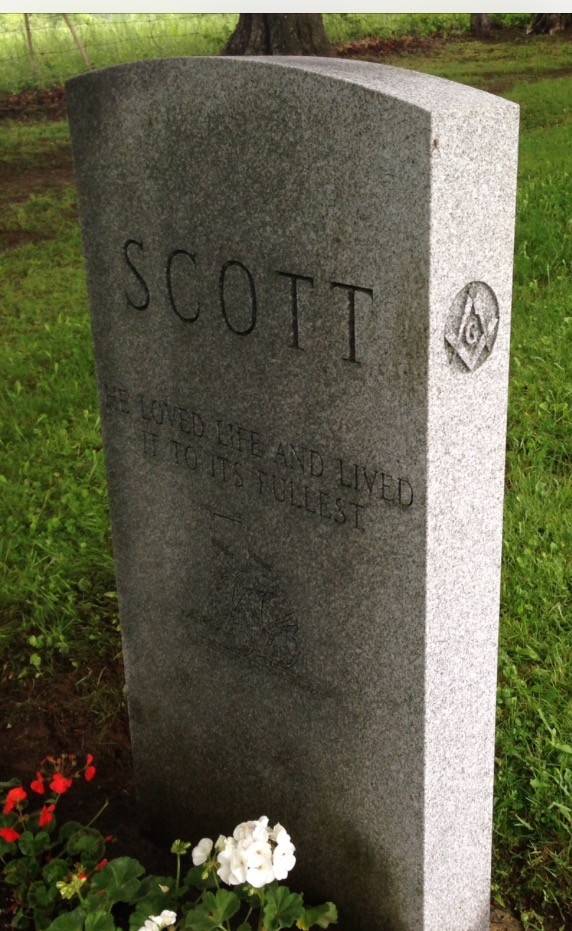
“My life hasn’t been easy and we all have our stories to tell,” he said.
Scott made it clear that while he knows how to “listen, learn and lead,” he can also be decisive. Discussing his father, Scott said he helped funeral director Bruce Judd pick the casket, choose the music for the ceremony and decide whether the burial could happen at the Maple Hill Cemetery in nearby Washington because of the cold. Recalling that moment, Scott remembered it was the anniversary of the day his father was buried, December 2, 1969, looked down, frowned, and briefly paused, before the next question came in, this one about politics.
THE CHALLENGE
One Democrat who attended Scott’s announcement speech said Scott would benefit from what she believes is a swing too far politically to the left by the Democratically controlled Legislature. She said they are spending too much time on non-money issues and haven’t focused enough on issues such as choking property taxes.
Scott, with strong name recognition from racing and politics and three statewide races under his belt, would appear to have the pole position at the start of this race. Whether he keeps that position in the polls until next November, winning the political checkered flag, depends on various factors.
His biggest advantage, perhaps, may be more personal than political. Scott may attract voters because of who he is rather than what he stands for. He has won increasing percentages in each election, going from 49 percent in 2010, to 57 percent in 2012 and was elected with 63 percent in 2014.

“I think Scott’s advantages going into the campaign, assuming he wins the primary, are that he is approachable, likable, and someone who has empathy for the concerns of Vermonters in their day-to-day lives,” Davis said. “He also comes across as a man who is without guile. In both of those respects, he represents a big difference from Peter Shumlin, and that may be Phil Scott’s biggest advantage of all.”
Former Gov. Douglas agreed Shumlin’s unpopularity would benefit Scott if he’s the nominee and after ticking off a laundry list of problems, Douglas said “the state is going in the wrong direction.”
Davis warns that while Scott is clearly the favorite to win the Republican primary, that former Wall Street executive Bruce Lisman should not be dismissed lightly.
Sen Peg Flory, R-Rutland, says Scott’s greatest asset is his integrity.
“You absolutely trust him and he’s earned that trust,” she said. When Scott’s company headquarters burned to the ground several years ago, he said other construction company owners, even competitors, left him the keys for trucks, some worth as much as $150,000, to use if he needed.
Friend and supporter, Cathy Lamberton of the Associated General Contractors of Vermont, spoke of Scott’s willingness to listen, his thoughtfulness and his “focus on the fundamentals of good government.”
“I’m looking for a governor who listens more than talks,” she said.
(Wednesdays’s campaign kickoff at the South Burlington conference center was done in conjunction with the annual meeting of the Associated General Contractors. Scott says it was his idea to combine the events and have a built-in crowd of supporters. It was by far the biggest crowd of all the candidates running for governor.)
Flory, who attended the gala, said Scott’s biggest challenge is himself.
“He’s so self-deprecating,” Flory said. “He doesn’t blow his own horn, and it’s going to be hard for him to go and blow his own horn. That’s up to us because he can’t do it. Phil, he’s the Everyday Man, one of the most decent people I’ve ever met.” For example, Scott started a successful program, Wheels for Warmth, that allows people to get donated tires inexpensively, raises money for charity and has likely resulted in fewer old tires being illegally dumped.
Gov. Douglas and analyst Davis said Scott’s biggest challenge may be how blue the state is politically. A female Republican lawmaker said privately that Scott’s biggest problem may be a push to elect women to higher office, namely Democrat Sue Minter, who’s running for governor, and Hillary Clinton, the Democratic Party presidential candidate.
Scott agreed Minter would pose a difficult challenge if she’s the Democratic nominee and admitted he had awkward moments, not wanting to be appear too aggressive, when he ran against Cassandra Gekas in 2012.
“Some Vermonters believe it’s time for a woman to be governor again and it’s a difficult argument to have with anybody. It makes it tough,” he said.
Scott said he was disappointed Speaker Shap Smith had dropped out of the race. Scott was not only concerned for Smith’s wife, who has cancer, but said he would have rather run against Smith, in part, he said, because Smith would have run an issue-oriented race. Democrat Matt Dunne, a former state senator who has run two statewide losing campaigns, is a more aggressive campaigner, Scott said.
Over the din of the music and conversation after the announcement, Douglas said: “Everybody likes Phil.”
“People have a tremendous regard for his ability to bring people together and to act without regard to party affiliation and do what is right for the state,’’ Douglas said.
The next morning, in the office that’s a far cry from the Montpelier Pavilion’s fancy Fifth Floor, Scott agreed with Flory and others that his biggest challenge was whether the Man in the Mirror, now that he’s convinced himself to run, could win over skeptics that “I have the resolve to do this, show I actually do have the skills necessary to bring people together and lead Vermont.”
“I think I do,” he said, “but I need to convince others.”
