



[D]istinctive branding and economies of scale emerged as keys to increasing locally produced food consumed in Vermont.
Those were the views that emerged at a forum hosted by food service giant Sodexo Wednesday.
Some 85 people, largely Vermont growers and food producers, attended the “Vermont First” event at Castleton University.
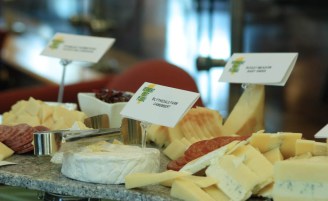
The gathering represented part of the company’s publicly stated and state-endorsed commitment “to support the production and purchase of local food across Vermont,” as well as holding yearly meetings such as Wednesday’s to review the initiative’s progress.
According to Vermont Agriculture Secretary Chuck Ross, the 2009 to 2014 period witnessed the creation of over 4,000 jobs in Vermont’s agriculture and food sector. Meanwhile, Vermonters’ purchasing of local foods increased by 89 percent between 2010 and 2014, he said. While acknowledging the role of the state’s political leadership in that trend, he also extolled “leadership by action, [which] is happening here today.”
Calling the Sodexo program “a model that I think can be repeated across the country,” he said, “it’s going to help sustain that landscape … that we call Vermont.”
Sodexo’s Vermont First program coordinator, Annie Rowell, cited her own optimistic numbers on the growth of local food sourcing, but she also pointed out how far Vermont lies from food self-sufficiency.
Among the 20 top purchases that Sodexo makes for its Vermont kitchens, Rowell reported, 51 percent of all apples and 47 percent of the yogurt are local. However, only 11 percent of whole potatoes had local origins, and none of the chicken breast and thighs are sourced in the region.
Sodexo considers any food produced in Vermont or within 30 miles of the borders local, according to Rowell.
The speakers, including several Sodexo employees as well as representatives of Vermont distributors like North Springfield’s Black River Produce, stressed the need for branding. In practice, that means imbuing a product with a distinctness valued by consumers, so as to overcome the sticker shock that Vermont-produced foods often generate in purchasers — whether institutional kitchens or supermarket shoppers.
When Bill Suhr of Shoreham’s Champlain Orchards questioned how local producers could compensate for the price gap with cheaper good with distant origins, Sodexo’s John Stewart emphasized the value of marketing.
“Brands, brands, brands,” Stewart said. “Say, ‘I have better soil!’ We’ve got to start de-commoditizing ourselves. Become a brand. Create a story.”
However clever the branding, though, constraints exist on what Sodexo can — or will — do for Vermont agriculture. Asked during a break whether his company was prepared to buy Champlain Valley rice that retails for $4.50 a pound, almost four times what organic Arkansas rice sells for at Costco, Stewart told VTDigger, “That might be too high.”
During his presentation, Stewart noted that the food service giant buys locally to fulfill its local obligation, but patronizes national suppliers to level out its costs. He added that Albany, New York-based Sysco, Sodexo’s biggest supplier, only purchases a third of its merchandise locally.
Get big or get out?
Several speakers spoke to a need to integrate small-scale production into large-scale distribution. “Production efficiency,” Sean Buchanan of Black River Produce termed it, during a panel discussion. “There’s something to be said for scale.”
If dealing with an industry leader like Sodexo means “get big or get out,” there are also plenty of requirements for food safety, for example, that a producer must meet. In particular, the company tries to steer growers to utilize distributors, rather than direct sales to kitchens, so that ordering 15 different vegetables doesn’t mean having 15 different pickup trucks lining up at a kitchen’s receiving dock.
Whatever the hurdles, though, Vermont “localvores” can cite plenty of progress for their cause in recent decades. Discussion panelist Bonnie Kelsey, who does business as All the Best Local, a Rutland food distributor, called the hoop-jumping required to get Sodexo’s certification as a distributor “a very difficult process.
She added, “our company is growing because of Sodexo. We’ve helped a lot of producers come into prime time because of Sodexo.”
One attendee told VTDigger that Sodexo’s Vermont First pledge, which rolled out in 2014, made a difference. Timothy Hughes-Muse of Pawlet’s Laughing Child Farm, said he had sold to Sodexo a couple of years ago, “but it was a little bit of a nightmare … There was a lot of optimism up front, but when it came to selling potatoes, phone calls weren’t returned.”
“It seems like their attitude has changed,” Hughes-Muse said. He credited Rowell, who heads the program, with the shift.
The fact that Sodexo, in Vermont, primarily serves college kitchens also bolsters the prospects for its local sourcing. For a college food service, as for any restaurant or cafeteria, the price of the food it buys is only a small fraction of what the served food sells for, leaving more options for keeping the latter price reasonable, while the consumer – a college student, typically – may express more demands for local sourcing than, say, most supermarket shoppers would.
And, of course, this is Vermont, which, in the words of panelist Kevin Edmonds, of Massachusetts-based meat distributor Dole & Bailey, “started the local movement.”
However, as Rowell’s statistics illustrated, Vermont’s university kitchens remain a long way from abandoning California lettuce or Washington state apples or Arkansas chicken. The Castleton get-together offered numerous producers the chance to talk with a big buyer about their tomatoes or sweet potatoes, but, in the words of attendee Jon Slason of Westminster’s Harlow Farm, “The devil is in the details.”
