

[E]llen Stimson was living in the Midwest almost two decades ago when her husband surprised her one December evening with a bottle of port, a block of cheese and the 1945 film “Christmas in Connecticut.”
“We watched it and imagined living on a farm in New England,” she recalls today. “The idea of a romantic sleigh ride pretty much sold us on the eventual move right then.”
By 2003, they had relocated from the Gateway city of St. Louis, population 318,172, to the Green Mountain town of Dorset, population 2,031. They soon bought a two-century-old general store. Tried to “improve” things. (“You moved the bread from where it used to be,” one longtimer sniffed.) And less than five years later, facing bankruptcy after sales plummeted 70 percent, sold what was left of the business for half its original purchase price.
That’s when the self-professed “flatlander” (“Real Vermonters are calm and sensible — they would have never bought the store,” Stimson now says) began to write a book. Her memoir, “Mud Season,” came with a subtitle as long as winter: “How One Woman’s Dream of Moving to Vermont, Raising Children, Chickens and Sheep, and Running the Old Country Store Pretty Much Led to One Calamity After Another.”
It also launched a second career — and a new way for neighbors to look at the state.
Stimson sold her manuscript to prestigious New York publisher W.W. Norton, which released the 256-page hardcover through its Countryman Press of Woodstock in 2013. The 5.5 million-circulation Reader’s Digest soon ran an excerpt. The 1,500-member American Booksellers Association pushed the title as a top recommendation nationwide. Seemingly everyone else responded with a question.
“They all would say to me, ‘What happened next?’” Stimson recounts. “I said, ‘Oh, good grief’ — and thought, ‘What a great title.’”
And so Stimson has turned misfortune into a memoir series. Her second book, 2014’s “Good Grief,” started where the first one finished — beginning with the lesson she learned after decorating her dining room table with autumn leaves (“they would seem to have just drifted down from the limbs overhead, somehow missing the roof”), lighting the candles (“so that they could burn down — you know, just a little — you don’t want your candles to look like they just came out of the box”) and leaving minutes before it all went up in flames.
“Just as a point of interest, do you know how to work a fire extinguisher?” she went on to write. “No? Neither did I. And what I’m sure they never told me was that you can’t read that little print on the side of the extinguisher when everything all around you is billowing smoke, either.”
“It was not perfect”
Think a newcomer should be seen and not heard? Stimson tells all. On page 57 of “Good Grief,” she shares the true story about a backyard bear. And on page 92, the police car that pulled her over. And on page 156, the rare heart arrhythmia that killed her ex-husband.
“So, what if the guy you were married to for about 15 minutes when you were barely 22 died and left you in charge of his estate?” she says in the YouTube trailer for her second book. “Then, what if your beloved current husband — you know, the one you married for life — delivered his eulogy? And then, what if your son handed you his ashes? What exactly does one do with their ex-husband’s ashes?”
Stimson stored them in her utility closet, next to the vacuum.
“I know, I know,” she would write. “It was not perfect.”
A year later, her family scattered them in the nearby Mettowee River.
“With tears streaming down our cheeks, we watched Steve, or what had been Steve, swirl away. It was beautiful, really.”
Such juxtaposition of honesty and humor has led the Boston Globe to note that Stimson “reads like Erma Bombeck meets E.B. White (with a dash of Elizabeth Gilbert thrown in). She’s a natural storyteller and openhearted lover of her family, her animals, her big chaotic life.”

Which leads to her latest book, “An Old-Fashioned Christmas: Sweet Traditions for Hearth and Home,” a 288-page confessional/cookbook that mixes recipes for “Pig Candy” (chocolate-covered bacon) with sweet and savory remembrances.
“An old-fashioned Christmas may be a bit about magic, but it can also be at least a little bit about old-fashioned strife and new resentments,” she writes in the just-released hardcover. “Christmas is big and roomy. It can hold it all.”
It can even hook an endorsement from “A Prairie Home Companion” host Garrison Keillor.
“I’ve been a little uneasy about Christmas for a long time and now I shall stop,” Keillor wrote Stimson after receiving a draft of her take on the holiday. “A big party. Cut out the stuff you don’t enjoy. And a whole raft of stimulating recipes and a good snowstorm. Wonderful.”
“A couple of tips”
Stimson’s books aren’t the first to chronicle the chasm between Green Mountain natives and newcomers. Such stories began long before Frank Bryan and Bill Mares penned “Real Vermonters Don’t Milk Goats,” the state’s all-time best-selling humor book, in 1983. But three decades later, Stimson’s work is nonetheless a rare breed: An explosive exposé of a “flatlander” fired off by the target herself.
“If you’ve ever taken a kid to the beach or Disney World and had to explain, at the end of a long, happy, sunny day, that we can’t always be on vacation, then you are one step ahead of me,” she writes in the prologue to “Mud Season.” “We never left. We still love it. But if you find yourself planning to move here, I maybe could offer you a couple of tips.”
Disregard, for example, Stimson’s goal when she settled in the state with her husband and three children: “We aimed,” she writes in her first book, “for supper beside a stream and our morning coffee in the woods.”
The author, depending on where you were born, sounds to be as much a daydream believer and/or delusional when introducing readers to Vermont.
“A little blue state known for its hippie ice cream, beautiful views, and liberal politics,” she writes in “Mud Season.” “Big-box stores are rebuffed in favor of little village country stores, where you can still get everything from a light socket to bird food to local cheese, while you find out the baseball scores and argue local politics. There are no roadside billboards in Vermont. And it’s a state with way more cows than people.”
Forget the fact that the latest census counted 135,000 cows versus 626,562 people. Stimson told her real estate agent to find her a historic home with “four or five bedrooms, a big gourmet kitchen, and lots of porches — cheap.” When she stopped at Peltier’s, the local market since 1816, she decided to buy that, too.
Stimson, then a big-city book wholesaler, figured it would be easy to remodel a small-town 1830s farmhouse and even more historic business into her vision of bucolic bliss. Then she hired an out-of-state home construction crew — from Missouri — and moved the store’s central bread shelf to make way for merchandise like alpaca socks, pistachio paste and, every Thursday, crab cakes with mango salsa.

“Just the way it is”
It didn’t help when Stimson cellphoned 911 after discovering almost a dozen cows blocking the shortcut to her manicurist. Or when, waking one especially wintry morning, she discovered the store’s boiler overflowing, draining the downtown water supply and turning the street into an ice rink.
That’s when Stimson had two revelations.
One: “We were not Vermonters,” she writes in “Mud Season.” “This was perhaps the most damning of all truths.”
Two: By confessing such sentiments publicly, she could turn lemons into lemonade.
Stimson began writing less for locals and more for the millions of out-of-staters harboring similar fantasies. But with her national appearance tours always beginning at her local Northshire Bookstore in Manchester — coming public readings are listed on her website, www.ellenstimson.com — she knows plenty of neighbors are eyeing her work.
“Silent Cal” types may think the author reveals too much. But she’s nonetheless a rare breed — a newcomer willing to dig in and shovel alongside the natives, all while saying what everyone else won’t.
As Stimson acknowledges in “Mud Season,” she doesn’t live in a typical town, but “a high-end little picturesque village in Vermont filled with people who moved here from somewhere else.”
“We are not farmers,” she continues. “Most of what I know about farming comes from the See ’N Say I had when I was about one.”
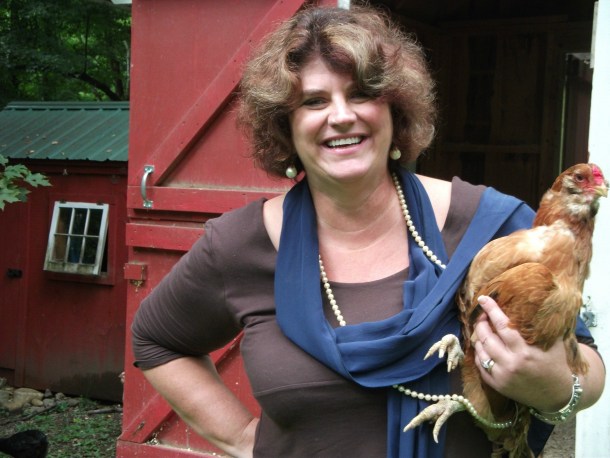
Even so, the author’s learning. She cares for chickens, dogs and cats in the backyard and is considering adding a pig. But that’s the extent of her current wish list.
“Vermont is perfect just the way it is,” she now tells visitors. “That’s why you came here, remember?”
Kevin O’Connor, a former staffer of the Rutland Herald and Barre-Montpelier Times Argus, is a Brattleboro-based writer. Email: kevinoconnorvt@gmail.com
