

[V]ermont political leaders decried Friday’s terror attacks in Paris that left 129 people dead, expressing sadness and sympathy for the victims while gauging the next steps in a conflict that seems to be gaining momentum.
Flags were lowered to half-staff in the state, and the nation, until Thursday to pay respect to the victims of the violence that killed at least 129 people.
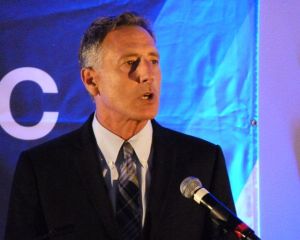
Gov. Peter Shumlin said Vermont stands in solidarity with France, and renewed his support of Syrian refugee resettlement in the Green Mountain State.
“The refugees from Syria are no different than the refugees from anywhere else in the world,” Shumlin said at a news conference in South Burlington. “They are families, moms, dads, children, escaping a horrid situation.”
Shumlin said the state was helping “seven or eight” Syrian refugees settle in the state, adding that the U.S. State Department works diligently to screen refugees.
“It takes months to get through, it’s a rigorous process and we will root out folks who should not be here,” Shumlin added.
At least 12 states have said they will not accept refugees following the Paris attacks, including Massachusetts.
“No, I’m not interested in accepting refugees from Syria,” said Gov. Charlie Baker, according to the Boston Globe. “My view on this is, the safety and security of the people of the Commonwealth of Massachusetts is my highest priority. So I would set the bar very high on this.”
President Barack Obama on Monday called the state decisions to shun refugees “shameful” and Shumlin said “governors who are taking those actions are stomping on the qualities that make America great.”
University of Vermont economist Art Woolf has suggested that Vermont could accept as many as 5,000 Syrian refugees. When asked if he thinks the state can support that number, Shumlin said, “I’m not an expert on the numbers, I know that Vermont can take more than seven.”
Vermont’s congressional delegation also expressed compassion for the victims while re-evaluating what role America has in defeating a group of extreme radicals that appear to be shifting focus toward Western targets.

Sen. Patrick Leahy, D-Vt., called the attacks by ISIS “repugnant and perverse” while Rep. Peter Welch called them “absolutely horrific.” In the second Democratic presidential debate in Iowa on Saturday, Sen. Bernie Sanders said he was “shocked and disgusted” by the coordinated killings.
“Vermonters and all Americans, and people of goodwill the world over, stand shoulder-to-shoulder and heart-to-heart with the people of France in sorrow and solidarity,” Leahy said Saturday, adding the attacks “have no place in the civilized world.”
The Vermont delegation expressed concern over Obama’s decision to put 50 military advisers in Syria in late October, with each member reluctant to endorse a ramped-up military mission in the region that could creep into a full-scale invasion.
All in the delegation have also stressed the importance of diplomacy to curb instability and terrorism in the Middle East, while also agreeing that regional powers must take a leading role in the fight against radical extremism.
And while the delegation has not backpedaled on these position, the Paris attacks showed an emboldened ISIS not afraid to directly attack the West. French President Francois Hollande called the attacks “an act of war.”
In the wake of the death and destruction on Friday, the three-person delegation is reevaluating the right approach to the Middle East.
None of the members of the delegation believe that isolation or containment alone is the right tactic when it comes to ISIS, and all now appear to believe the group must be wiped out entirely, and quickly.
While Sanders recently said the crisis in Syria must be resolved diplomatically and not militarily, he adopted a more hawkish tone in the Democratic debate Saturday.
Sanders agreed with former Secretary of State Hillary Clinton that the U.S. must play a role in defeating ISIS, while also casting the decision to invade Iraq, a move Clinton supported, as “one of the worst foreign policy blunders in the modern history of United States.”
“The United States cannot do it alone,” Sanders said, referring to a total defeat of ISIS. “What we need to do is lead an international coalition.”
Sanders said America and others must come together to “destroy” ISIS.
“We can do that,” Sanders said.
Welch said Obama’s initial decision to put boots on the ground in Syria raised “serious questions about the administration’s strategy in the region.”
Monday, Welch reasserted his position that the United States is already effectively engaged in a war, and that Congress should consider and delegate a set of war powers for the current conflict, not simply defer to the congressional authorization following 9/11.
“The fact is we have been engaged in what can be called a war,” Welch said. “We’ve been engaging in air strikes, we lost a soldier who was on a rescue mission in Syria.”
“Congress has to debate an authorization to use military force,” he added, acknowledging that military action must be taken, but that a long-term U.S. occupation was not the answer.
Leahy has been especially vocal in his calls for regional powers, such as Saudi Arabia, to take the lead in the fight against terrorism.
David Carle, a Leahy spokesman, said on Monday he hadn’t spoken to Leahy since the attacks. But he said he imagined Leahy would continue to push for more coalition-building against terrorism.
“I don’t believe his views on strong coalitions are likely to change in any way,” Carle said.
Welch also said the t existential threat from ISIS has to “ultimately be solved in the Middle East, where the Sunni-Shia divide continues unabated.”
Like Shumlin’s regional support for refugees, Leahy is also focused on the migrant crisis. He has released a bipartisan plan to bring refugees to America, which might now be in peril.
Leahy and his aides have been making a big push over the past few days for passage of the Middle East Refugee Emergency Supplemental Appropriations Act, a bill co-authored with Sen. Lindsey Graham (R-SC).
The bill, which could resettle as many as 100,000 refugees over two years, is facing pushback following the Paris attacks, with governors from around the country saying Monday they would not welcome refugees from Syria following the Paris attacks.
The Leahy-Graham bill would require the establishment of a security vetting process for those admitted to America, and Leahy aides said they hoped to get the bill passed as part of the larger appropriations bill for fiscal year 2016.
“The disaster in Syria dwarfs anything we have seen for decades, with millions of people uprooted and seeking safety in other countries,” Leahy said following the introduction of the bill in October. “It is a humanitarian emergency of staggering proportions, and we need to do more. Our bill would make that possible.”
Editor’s note: Morgan True contributed to this report.
