

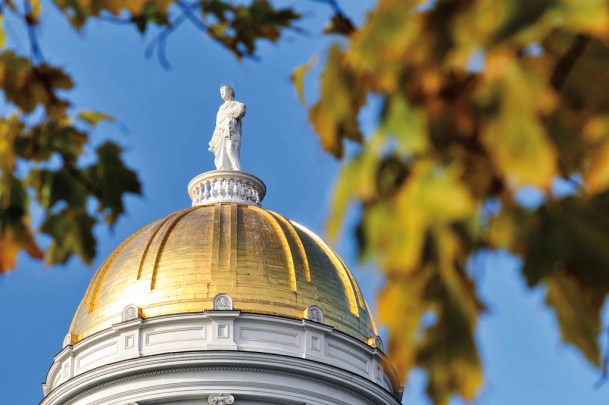
[F]or decades, Green Mountain fourth-graders have learned the Vermont State House is topped by a statue of Ceres — “in Roman religion, goddess of the growth of food plants,” the Encyclopaedia Britannica says.
Most, however, don’t know the rest of the surprisingly rotten story.
In 1858, Brattleboro sculptor Larkin Mead was commissioned to create a wooden figure to cap the dome of the capitol, then under construction in Montpelier. State leaders so appreciated the result — deemed by the artist simply as “Agriculture” — they doubled his pay from $400 to $800.
Mother Nature wasn’t as kind. By the Great Depression of the 1930s, the statue was riddled with fungus and decay. The Legislature called for a replacement, but then Sergeant at Arms Dwight Dwinell cringed at the cost — so much so, he and two janitors carved another one themselves.

“The new statue is not a replica,” historian Nancy Price Graff reports in the new book “Intimate Grandeur: Vermont’s State House.” “It is folk art, not fine art, and yet it reigns over the State House, as the original did, a steadfast symbol of Vermont’s agrarian roots.”
That’s just one of many strange but true tales in a 120-page glossy color volume — in the making nearly a decade — by Graff, State Curator David Schütz and photographer Jeb Wallace-Brodeur and published by the nonprofit Friends of the Vermont State House.
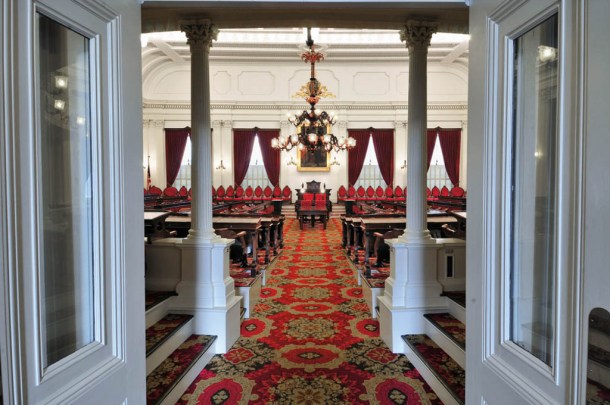
“It is the most important building in Vermont,” journalist Tom Slayton writes in the foreword, “and in addition to its political and governmental functions, is a repository for and an expression of our history as a state and a people.”
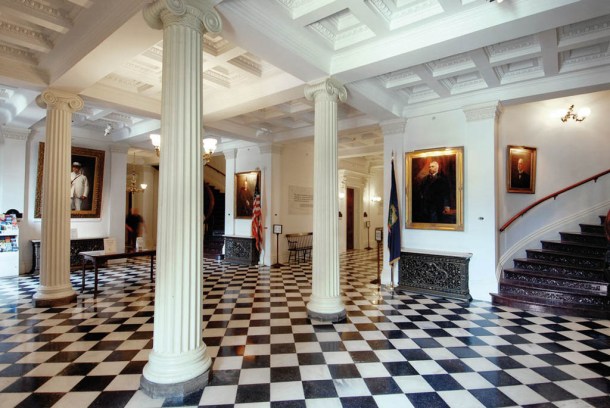
You could say the story rewinds back 480 million years, as the black and white marble quarried from Isle La Motte for the entrance lobby floor contains small, swirling fossils from the world’s oldest known reef — “evidence of the tiny creatures that lived on the bottom of a sea many eons ago,” Slayton notes.
But Graff and Schütz begin with the founding of the nation’s 14th state in 1791, when lawmakers met in 14 different towns (including Charlestown, New Hampshire) before deciding to build a capitol in Montpelier — first a $9,000 wooden meetinghouse in 1808 and then a $132,000 granite replacement in 1838.
The present structure was born on the cold, dark night of Jan. 6, 1857, when fire gutted the second building. Locals rescued some furnishings, including an 1837 portrait of George Washington, originally controversial for its seemingly high $300 price and now a centerpiece over the House speaker’s rostrum. But they lost most of the framework, save the six portico columns that welcome visitors today.
“Approximately a million bricks had been salvaged from the second State House, and each was meticulously cleaned and mortared into the new building,” Graff writes. “Granite blocks arrived daily from quarries in Barre, a tortuous 18-hour round trip by oxen straining against their yokes.”
The $150,000 citadel was finished in 1859. But the state was only beginning to fill it with new mementos and memories. Mead, for example, would go on to sculpt a marble statue of Ethan Allen and bust of Abraham Lincoln in the era of Reconstruction. Workmen would replace the gas chandeliers with electric lights in 1898, then reduce the number of House seats from 246 (one for each community, regardless of population) to 150 with court-ordered reapportionment in 1965.
The book spares no detail in elaborating on what Schütz terms the small yet elegant structure’s “intimate grandeur.”
“My revelation in researching and writing this book,” Graff told a crowd at the book’s recent launch reception, “is how personal the State House’s history is, how much its grand design and smallest details truly reflect Vermont and its people.”
Take the story of the capitol’s largest treasure. Back in 1861, Julian Scott, a 15-year-old Johnson boy, lied about his age so he could join Vermonters fighting in the Civil War. Wounded after receiving the first U.S. Congressional Medal of Honor ever awarded for bravery on the battlefield, Scott returned home and, at age 23, created the wall-size painting “The First Vermont Brigade at the Battle of Cedar Creek.”
The book also chronicles smaller moments.
“In 1947 Representative Reid Lefevre, of Manchester, brought his circus to Representatives Hall,” it notes, “and for one night, ponies and an elephant performed where the House clerk usually sits.”
Some might question how that differed from what usually happens there. But all the legislative clamor occasionally can lead to change.
“Vermont’s heroic response to the Civil War; struggles over women’s suffrage and other battles for equal rights; debates over temperance and the course of education, agriculture, and the environment; the plight of the poor; and the unending struggle to maintain its authentic way of living while bringing this rural and remote part of America into the contemporary life of the rest of the nation — all of these issues and many more have been addressed within the walls of this lovely little building,” Slayton writes.
(“Its size,” the journalist adds, “tacitly encourages open government.”)
The Vermont State House is the oldest capitol in the nation that houses its legislature in authentically restored chambers. But that only came to be after maintenance workers found a gas chandelier removed from the Senate in 1935 and forgotten until the Naugahyde and drop-ceiling days of 1979.
“The newly organized Friends of the Vermont State House used the discovery of the Senate chandelier to draw attention to the aging building’s decline,” Graff writes. “Its restoration with the use of private money and skilled craftspeople proved that the group’s larger goal was attainable: the Friends used the rededication ceremony to launch a campaign to restore the building to its 19th-century glory.”

The book illustrates the capitol’s original construction and recent restoration through old and new photographs — you can see the dome was painted red for decades until covered in gold leaf in 1906 — before concluding with a few words about how such history informs the present and future.
“Perhaps it is a fanciful notion to think that the events of the past are still alive today,” Slayton writes in the book’s coda. “Yet they shape Vermont and Vermonters still. And the building in which those causes and events were articulated, debated, defined, and resolved is still very much alive.”
More information about “Intimate Grandeur: Vermont’s State House” — priced at $24.95 soft cover and $39.95 hardcover — is available at www.vtstatehousefriends.org.
Kevin O’Connor, a former staffer of the Rutland Herald and Barre-Montpelier Times Argus, is a Brattleboro-based writer. Email: kevinoconnorvt@gmail.com
