

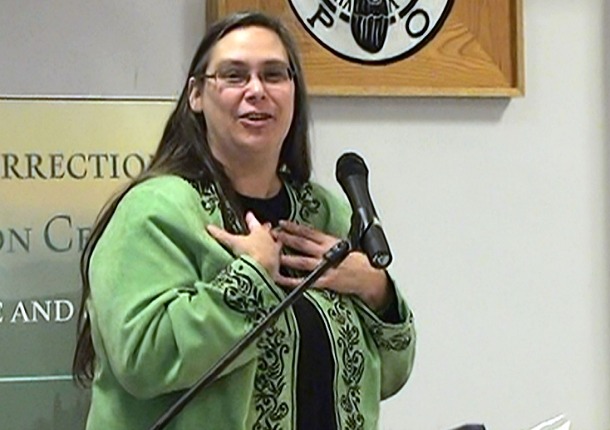
[L]isa Menard may have a new office, but the new job that came with it is unlikely to come with many surprises for the Department of Corrections veteran.
Reserved in manner, with waist-long dark hair and a firm, alto voice, Menard spent more than half a decade in the deputy commissioner’s office, sitting on the sidelines during legislative committee hearings as former commissioner Andy Pallito took the spotlight.
But few people in state government know the DOC so thoroughly as Menard. Before landing at the helm of the department last month, Menard worked at just about every tier of Vermont’s correctional system — all the way back to her start as a correctional officer at a Chittenden County prison in the mid-1980s.
Menard took the top job in October, after Pallito left to head the Department of Finance and Management in the Shumlin administration.
But while the veteran of the department has extensive knowledge of what goes on inside the corrections system, she takes over at a time when the state is grappling with aspects of incarceration that happen outside the prison walls: the controversial out-of-state prison program and the challenge for communities and inmates to find a place to live after serving time in Vermont.
Between 150 and 200 inmates are in prison long after they have served their minimum sentence because they do not have an adequate place to live. There is no other place for them to go where they can reliably meet the requirements for their release, Menard said, so they remain incarcerated.
Transitional housing is a priority issue for the DOC and lawmakers to resolve together, Menard said.
“We need to continue to look at what we have for transitional housing,” Menard said. “Do all the housing sites really meet the current needs of the offenders we have?”
The shortage of housing for offenders leaving prison links to a shortage of affordable housing across the state in general, according to Menard. Vermont’s low vacancy rates for rental housing make it even more difficult for people with a criminal background to find a place to live, she said.
“That is exacerbated on a correctional level because not only are there less rentals but you have a felony conviction trying to get that rental,” Menard said.
Prisoners who have served their minimum sentences often stay incarcerated for some time longer because there isn’t housing available to them.
“Unfortunately, because many of them are convicted of sexual offenses it’s very difficult to find community placements for these folks,” Menard said. “There just isn’t a place for them to go.”
Placement of offenders is complicated by factors aside from their rap sheet. Many people incarcerated in Vermont’s prison system also have substance abuse and mental health issues that make living on their own in the community a challenge.
That’s different from when Menard was a C.O., she said.
“I think we probably didn’t have the complexity of the inmates we have now,” Menard said. “Because there has been a lot of work on reentry and diverting people from the system, I think we’re getting to a point that what remains are the complicated cases.”
Accommodations both inside and outside prison are increasingly a challenge for the department as Vermont’s incarcerated population ages. For older inmates with terminal illness, the department may consider putting them on furlough status and sending them to live with a family member. But that is not an easy fix either.
“Many of these folks don’t have those family supports that can do that,” Menard said. Then the department may look to place a person in a nursing home, but many nursing homes have been reluctant in the past to accept inmates.
Menard also sees the potential to close down Vermont’s out-of-state prison program in the coming years.
The out-of-state prison population has steadily declined in recent years, from nearly 500 in fiscal year 2013, to 270 in October 2015.
“They’re Vermont inmates,” Menard said. “We would prefer they be in Vermont.”
Menard said that while she does not have overwhelming concerns about the conditions at the privately run North Lake Correctional Facility in Michigan and there are means of oversight within the department, she does not have a personal relationship with the facility or the supervisor there.
“The placement we have now, I don’t have qualms about safety or security or anything like that, but it’s not drivable for me in an hour,” Menard said.
While Menard remains aligned with Pallito on many of the department’s priorities, she diverges from her predecessor when it comes to the matter of decriminalizing drugs.
In June, Pallito told Seven Days that he believes that possession of all drugs should be decriminalized.
Menard agrees with Pallito “that it’s a conversation that we should be having” — the discussion around decriminalization prompted broader contemplations about justice, she said. But she has reservations.
“I don’t know if we’re at a point yet where the state’s really ready,” Menard said. “I don’t know that the conversations have happened for people to say, ‘yes, you’re right, this is a public health issue versus a public safety issue.’”

