

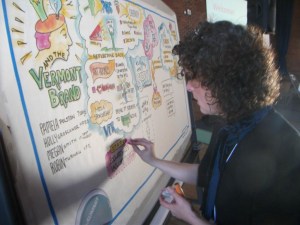
“This conversation is much bigger than just the arts — how do we embrace and embolden the whole creative sector?” council executive director Alex Aldrich said Wednesday to kick off a two-day conference. “The issues are big, the opportunities are enormous, the challenges are even more enormous.”
The nonprofit council was founded in 1965 as part of what’s now the National Endowment for the Arts. To celebrate its 50th anniversary, it’s forming the Creative Network to unite not just painters, poets, dancers and designers but all imaginative, inventive people statewide.
“I envision an opportunity for a broad variety of Vermonters to come together for a single purpose of using creativity as the vehicle for making life better for all,” Aldrich said.
More than 7,000 Green Mountain State residents are employed by arts and cultural enterprises that total nearly 5 percent of all businesses, the Agency of Commerce and Community Development reports. The state, the U.S. Census Bureau adds, ranks third in the nation for artists as a percentage of the workforce, second for fine artists and writers, and eighth for musicians and photographers.
But although creative people abound — there are 33 percent more as a proportion of total Vermont employment than nationwide, statistics show — they often work more independently than collaboratively. That’s why the council is working to found the arts equivalent of Vermont agriculture’s Farm to Plate Network, all to help individuals and institutions grow audiences, promotional efforts and financial support.
The council has spoken with two dozen “thought leaders” representing government, commerce and culture as well as 750 residents at more than a dozen community forums. It also is conducting an online survey asking such questions as “When you think about the future and about a positive outcome for creativity in Vermont, what one change, in your estimation, would bring the arts, culture, and creativity success?”
The summit, taking place at the Vermont College of Fine Arts in Montpelier, is brainstorming ways to collect people (“from 2 years old to 102,” said council board member Reeve Lindbergh), organizations and communication tools from face-to-face conversations to Facebook.
“We wanted to get everyone in the same room to talk about advocacy,” Aldrich said. “In the best of all possible worlds, what are we trying to get to? What do we want to happen?”
Summit participants spoke about the need for more inclusiveness, involvement and attention not only to finished products but also the processes that lead to their creation.
“I’d like to see the Vermont brand known for cultivating genius,” one man voiced to the rest of the audience.
The council hopes to use the results of its survey and summit to finalize a strategic plan for establishing the network this winter, assisted by Common Good Vermont, Champlain College’s Emergent Media Center, the Vermont Department of Libraries, state Agency of Commerce & Community Development’s Downtown Program and funding support from the Vermont Community Foundation.
“I don’t think about the creative economy as a thing — to me, it’s what happens when arts and culture are allowed and encouraged to thrive,” Aldrich said. “If so, it is far more likely there are good schools and profitable businesses in that place. To me, the creative economy is a system of back and forth, give and take to make a community as attractive as possible. If you accept that, how do we build that?”
Kevin O’Connor, a former staffer of the Rutland Herald and Barre-Montpelier Times Argus, is a Brattleboro-based writer. Email: kevinoconnorvt@gmail.com
