

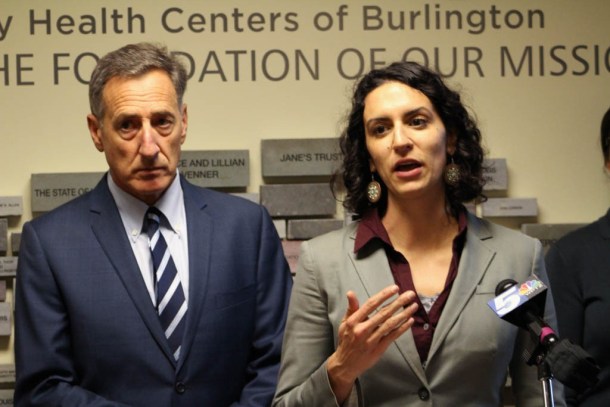
Shumlin made announcement at a news conference at the Community Health Center of Burlington, flanked by representatives from the Department of Vermont Health Access, the Department of Health and several front-line workers who help Burlingtonians understand health insurance.
Vermonters can start signing up for health insurance through the Vermont Health Connect exchange Sunday. The website has 20 plans offered by Blue Cross Blue Shield of Vermont, the state’s largest insurer, and MVP HealthCare, a popular company in New York. Blue Cross’ premium rates are up 5.9 percent, and MVP’s rates are up 2.4 percent from 2015.
“Subsidies went up higher than the cost of plans,” Shumlin said. “Fourteen of the 20 available will see a (net) premium decrease. Obviously, there will still be some bumps.”
More than 60 percent of the 33,000 Vermonters who use the exchange to buy private insurance get help from the federal government to pay for their plans. About 50 percent qualify for extra help from the state. Vermonters with very low incomes may qualify for Medicaid, and they will make up the majority of exchange participants if the website is completed.
A couple earning $50,000 pays $455 per month for a mid-level health plan right now when subsidies are included, according to Shumlin, but will save $20 per month for the same plan in 2016. A single person earning $30,000 this year pays about $197 per month for a mid-level plan this year but will save about $10 per month in 2016, the administration says.
Shumlin said every state that built their own exchange under the federal Affordable Care Act “have struggled, every single one of us.” He also said that many of the lingering issues could have been fixed at the federal level if Republicans in Congress hadn’t spent so much time voting to repeal the Affordable Care Act altogether.
Shumlin praised the exchange for helping Vermont dramatically reduce its number of uninsured, down to 3.7 percent at the end of 2014. Vermont is just behind Massachusetts for the lowest uninsured rate in the country, Shumlin said, and has the lowest uninsured rate for children in the country.
“We virtually have universal coverage,” he said. “These are real people with real lives who used to have to make horrific decisions. I want to thank Barack Obama for the courage to take on universal (health care).”
He also said health care generally is unaffordable, despite the increased subsidies on the exchanges, because the health industry is “spending money like a bunch of drunken sailors.”
Call times reduced, other issues persist
Vermont Health Connect, which Vermont launched in 2013 in accordance with the federal Affordable Care Act, is managed by the Vermont Department of Health Access and has a two-year history of poor user experience, billing problems and frustrated customers.
The website just met two technology implementation deadlines that the Shumlin administration announced in March. Now, the managers of the website no longer have a backlog of more than 10,000 people waiting for account circumstance changes, and the site has the technology needed to let people go online or call up starting Sunday to make changes to their plans.
In 2013, when the exchange first launched, Vermonters spent hours gathering their income tax data, waiting on the phone for a staffer to answer their call, and spending time either with a support worker or over the phone to manually fill out applications for new plans. Only about 53 percent of their calls were answered in less than four minutes, according to a report the administration sent to the Legislature last week.
In the open enrollment season that began in 2014, the second year of the exchange, Vermont Health Connect received 120,000 calls from people who waited an average time of 40 seconds, the report said. Ninety-eight percent of the calls were answered in less than 4 minutes, and 83 percent were answered in less than 30 seconds, the report said.
In September, Vermont Health Connect staff answered about 27,000 calls — 77 percent of those within 30 seconds — according to the same report. Staff were also able to resolve about 89 percent of the calls received without transferring them to another person at the call center, the report said.

There are several other issues that need to be addressed, according to the report to the Legislature this week and recent comments from insurance companies. The state needs to finish moving about 143,000 Vermonters who qualify for Medicaid because of their income over to the exchange.
As of last week, about 60,000 of those Medicaid recipients need to be moved to Vermont Health Connect. Cassandra Gekas, the director of operations for Vermont Health Connect, said Thursday that those people will be moved over to the exchange in the next 12 months, and she is aiming for a rate of 3,000 per month.
Vermont also continues to operate under a waiver from the federal government that lets small businesses enroll directly through insurance companies — in this case MVP HealthCare or Blue Cross Blue Shield of Vermont, which each have 10 different plan options on the exchange.
Originally, states were supposed to set up a small business exchange called “SHOP,” but that has never come to fruition, and, two years later, no outside technology company has been identified to help build that part of the exchange, according to the report to the Legislature.
Miller and Shumlin said Thursday that letting businesses sign up directly through insurance companies is the best option for Vermont. The state wants to continue operating without the “SHOP” feature of the website, with permission from the federal government, for as long as possible, officials said.
“It works beautifully,” Shumlin said. “Everyone would just as soon have SHOP stay the way it is.”

