


Building off of a model of Vermont Works for Women known as Rosie’s Girls day camps for middle school girls, Vermont Technical College offered a summer camp for ninth- and 10th-grade girls last summer and is continuing to further their exposure to skilled trades by connecting participants with mentors.
“There was nothing for girls older than 8th grade in the state and we saw a chance to extend STEM activities and keep young women involved,” said Laurel Butler, who runs the STEM outreach program for Vermont Tech. So, the Randolph Center school joined with Vermont Works for Women (VWW) to start a five-day overnight camp called Rosie’s Girls STEM Leadership Camp and targeted it to high school-aged girls.
“Here’s the fabulous part of the ninth- and 10th-grade pilot project: we got almost 50 applications. I was absolutely amazed at the response,” Butler said.
While there was only enough funding for 16 girls last summer, organizers raised more money so that they can offer two camps next year.
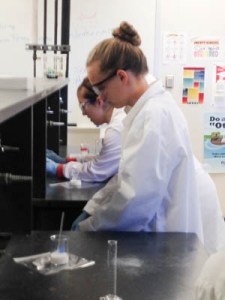
At the camp, girls had a chance to try out trades and have hands-on experiences with STEM activities. They worked in teams to build bridges, create Web pages, learn about construction management, dabble in chemistry and experiment with civil engineering.
The hands-on aspect of the camp was a “big positive” for the students, said Page Spiess, program director at Vermont Tech.
The next step was obvious to Butler and Spiess – to keep momentum going they crafted a mentorship program and paired each camper with a STEM professional in the field in which she has the most interest. Sixteen matches were made and mentors were invited to a half-day workshop to prepare them. The students and mentors met each other at the Women Can Do STEM conference last week.
“This is about education and career pathways and what direction you might take. Mentors can share how they got into what they are doing,” Butler said.
Organizers hope the girls will build lasting, supportive relationships with their mentors who plan to expose them to good-paying careers that might not have been on their radar before. The mentors will be on hand as the girls consider colleges and training programs after high school to help them make informed decisions.
“I’ve had a couple of mentors and I still feel that they are among the most important people in my life,” Butler said. “They helped shape me in ways that gave me confidence, they believed in me. I think we just need someone standing behind us to give us the feeling that yes, you can do it!”
Spiess, a former researcher in pulmonary toxicology and adjunct science professor at Vermont Tech, is also a mentor. She has been matched up with Alex Reilly, 15, who is interested in becoming a scientist.
“I think it will be really good because I’m thinking about what college I want to go to and I think Page can really help me with that,” Reilly said. “She will have good advice about what schools will be good for science.”
“Just seeing her excitement was really validating for me in terms of being a woman scientist and passing on that excitement to the next generation,” Spiess said.
Reilly is interested in biology and seems to be leaning toward either marine biology or neuroscience. She believes that having a mentor like Spiess will help her navigate the right path to college and a career.
“Just knowing there is someone who I can ask about science and about what classes I need to take to get into different colleges will be great,” she said.
Spiess plans to connect Reilly with other women in the field as well as guide her toward the necessary coursework and the best academic centers to further her studies.
“This is such a big time in the lives of women,” Spiess said. “They tend to grow so much at this time and showing them that they can do and be anything they want will really be key at this time in their lives.”
As the school year comes to a close, all the mentors and mentees will meet at an event with a guest speaker and more interactive activities. Here, Butler and Spiess hope the girls will share what they have learned and what their next steps are going to be. But they don’t expect this to be the end. Spiess plans to continue to stay in touch with her mentee as she grows.
“A few of our campers from the first class might want to come back as junior counselors for summer camp and learn how to mentor younger students themselves as well as being mentored by those of us who are slightly older. We’ll just keep growing the tree of knowledge and interconnected women in the STEM field,” Spiess said.
Butler says that in the next few years they should have had more than 50 girls go through the program. She would like to continue to follow them and keep them on a STEM or trades path.
Vermont Works for Women created the Rosie’s Girls day camps 15 years ago. The STEM-Leadership camp for high school girls at Vermont Tech was made possible with a Vermont educational grant. The mentorship program is being supported by the J.Warren & Lois McClure Foundation, the Vermont Women’s Fund and the Vermont Community Foundation’s Access to Higher Education Fund.

