


[O]n Wednesday morning, Judge James Crucitti settled into his chair in Courtroom 2B in the criminal division of the Vermont Superior Court with six arraignments on the docket.
Three miles away in South Burlington, Arthur Barnier, who is accused of resisting arrest and violating conditions of release, entered an office in the Chittenden Regional Correctional Facility and appeared in front of a video screen for his turn before Crucitti.
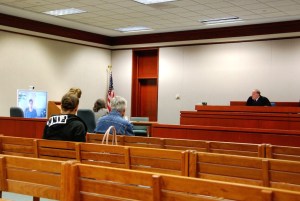
Barnier’s remote arraignment was part of a pilot project Vermont’s court system is testing and that could one day be the norm around the state. Each Wednesday, Chittenden County arraignments are now done via video link.
Nine weeks in, as the system is still working through growing pains and glitches, some observers are optimistic that it could result in long-term savings, while others remain skeptical.
In the courtroom, the arraignments proceeded much as they would any other day.
Crucitti asked the defendant for his name, the public defender entered the plea and then haggled with the state’s attorney over conditions of release. Barnier’s father stepped forward to say that he would take his son into custody.
After that, Crucitti raised his voice slightly and addressed the 52-inch, white-framed TV screen standing in the corner of the courtroom.
“If he gives you directions as to how to follow orders, you’re going to pay attention to him?” Crucitti asked.
On the screen, Barnier replied quickly, “Absolutely.” The court moved on to the next arraignment.

The video arraignment pilot is the result of a cost-saving measure proposed by the judicial branch earlier this year as lawmakers scrounged to maximize the state budget.
Video arraignments, the court says, will save the state the costs involved with transporting detainees from the correctional facility to the court — a process typically carried out by county sheriffs.
While in Chittenden County, the drive from the prison to the courthouse is only a couple of miles, the distance is considerably greater in other counties.
The savings will likely become more significant later this fall. The judiciary expects to set up a second video portal in the Northwest State Correctional Facility in Franklin County, another prison that frequently houses detainees whose court dates are handled in Burlington.
Eventually, the system could be expanded further, according to Jeff Loewer, chief information officer for the judiciary.
It’s not the first time the court system has sought to save money through remote arraignments. An ill-fated video arraignment project in Chittenden County a half-decade ago resulted in disgruntled public defenders, who felt the system did not allow for adequate attorney-client conferencing. The system was also uncomfortable for detainees, who would await their turn while shackled in the prison’s visitation room.
The 2015 pilot is off to a smoother start, in part because of the technology, said Scott Carbee, who is overseeing the implementation of the program for the judiciary.
The Cisco equipment in use today is very similar to the teleconferencing equipment found in business conference rooms around the country. Also, more people are familiar with this type of technology than they were five years ago, he said. If someone can work Skype on their home computer, they would likely be familiar with this technology, Carbee said.
Another difference is that the pilot was implemented with collaboration from the courts, public defenders, prosecutors, the Department of Corrections and others, Loewer said.
While the implementation of the pilot seems smoother than previous attempts, the technology is not without glitches.
On Wednesday, as the judge conversed about substance treatment with a woman who was being arraigned on drug possession charges, the video cut out, replaced by a dark gray screen. Carbee stepped out of the room to call the jail. The judge called a short recess.
Officials with the judiciary branch are quick to emphasize that the pilot is still in its early stages. They also said that it was the first time that a hiccup in the Internet connection disturbed proceedings.
Within 10 minutes, court proceedings were again up and running.
From the perspective of public defenders, video arraignments can add more challenges to representing clients, Stacie Johnson, managing attorney for the Defender General’s Office in Burlington, told VTDigger after the hearings.
Many defendants are overwhelmed and confused before they appear for a criminal arraignment, she said. Public defenders can help them understand the process.
“They’ve been detained and they’re concerned and upset and have all kinds of questions, so the face-to-face contact is invaluable,” Johnson said.
She was part of the process in developing the pilot, and along the way raised concerns about ensuring that public defenders and clients have adequate privacy and means of communication.
Johnson recalls the previous attempt at video arraignments, and concedes that the technology today is a vast improvement. However, she still has concerns.
Instead of answering a defendant’s questions during the proceedings in a whisper, attorneys need to ask for a break so they can step into a back room and speak privately with their client over the video system.
During one arraignment Wednesday morning, Johnson twice interrupted the defendant when he was talking about his case because she worried he was saying too much and could hurt his case.
The system equips defense attorneys with a mute button to use in such situations. However, Johnson said. In court, a lawyer interrupts by placing a hand on the defendant’s shoulder.
“The video arraignments just take so much away that is so hard to measure but from our perspective is pretty important,” Johnson said.
The new arraignment system is also confusing for some people facing criminal charges.
Instead of being shackled and transported by the local sheriff to the courthouse, they are called one-by-one into a 12-by-12-foot caseworker’s office down the hall from the cell where they were being detained.
“They don’t know why they’re not going to court. They think they did something,” said Scott Guerin, the corrections service specialist who oversees the pilot at Chittenden Regional.
While the video arraignments reduce workload for some players in the system, like the sheriffs, it created new work for the DOC.
Guerin processes all defendants’ court paperwork at the prison — a process that can take a couple of hours. That means that a defendant might need to hang around the correctional facility longer than they would at the courthouse before they are released.
Ruthie Holmes, living unit supervisor at Chittenden Regional, said she also has concerns about releasing people directly from the prison in South Burlington, where public transit is scarce.
The pilot is still in an early stage of development, Loewer, the judiciary official, emphasized, and officials are working the bugs out of the video arraignment system.
The judiciary has not yet determined what metrics will be used to evaluate the success of the pilot.
