

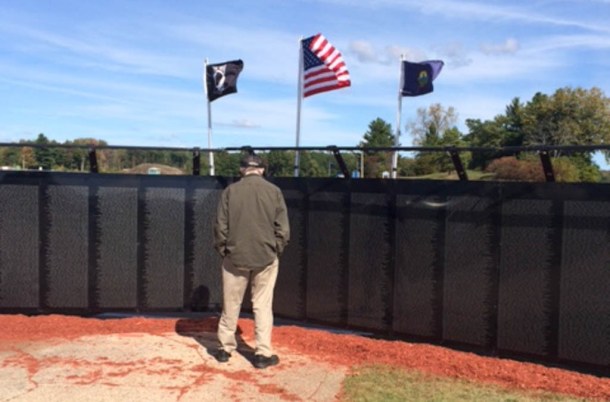
ESSEX JUNCTION – You can still see the pain in Moe Remillard’s face 45 years later.
The white-bearded, soft-spoken St. Albans veteran was among those at the opening ceremonies in Essex Junction Thursday for a mobile version of The Vietnam Veterans Memorial Wall in Washington, D.C.
The moving series of black granite panels – dedicated in 1982 – contains the names of all 58,307 Americans who died or are missing in action in Vietnam, where Remillard served, including 138 from Vermont.
The Wall That Heals is an aluminum replica of the original monument, exactly half the size, but for veterans that distinction hardly mattered. While the original wall reaches 10 feet high at the apex where the two sides converge, veterans say the wall’s power comes not from its size but seeing all those names in one place, an experience that leaves veterans and non-veterans proudly moved, many speechless, and some in tears.
Of his first visit to the Washington site, Remillard, a two-time Purple Heart recipient, said he remembered “it was serene.”
“You have feelings of why you’re standing there, the wall is there, and you’re not on it,” he said. As for the Essex Junction replica, he said: “If people are using their patriotic feelings when they are coming out to pay honor to friends and soldiers who fell, the (size) shouldn’t make a difference.”
Among the names Remillard found Thursday at the replica, which was set up at the Champlain Valley Exposition, was his brother-in-law who died the year before Remillard went to Vietnam.
“For all the people that thought it was a disgusting war, I can relate this: my family, especially my sister, didn’t feel that way,” he said.
He, like other veterans and political leaders that spoke Thursday, said veterans were treated poorly when they came home and that it took decades for their service to be honored and recognized.
For Les Pike of Stowe, who came back to Vermont from Vietnam in 1971, it took until 1999 – when he walked into a veteran’s group meeting in St Albans – to feel he been really welcomed home. A few years later, he was moved when a hardware store employee, after giving him a veterans’ discount, said: “Welcome home.”
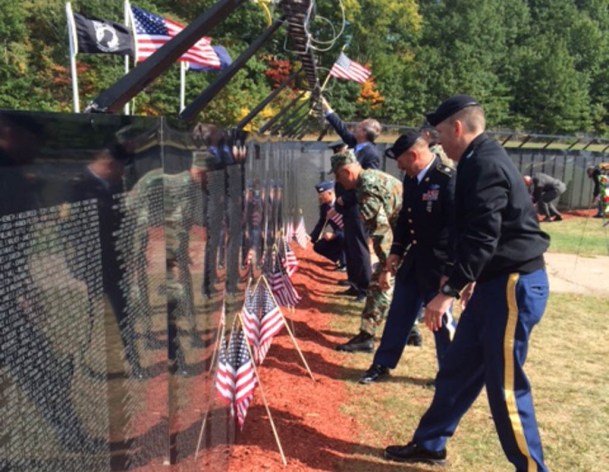
Like many, Pike was originally unhappy with the design of the wall in DC, with the path going downhill as you moved from each end to the center, and with the architect, Maya Lin, an American of Chinese descent, who many had incorrectly believed was Vietnamese.
“It sounded like it was going to be underground. It just seemed like another slap in the face to the veterans,” Pike said. But when he visited, he said he was impressed and struck by how moving, beautiful and powerful the exhibit was.
He and his wife, Louise, came to the exhibit on Thursday between chores on their dairy farm. Pike said he was fortunate, came home “without a scratch” in 1971 on an emergency leave he was granted when his father lost both of his legs in a farming accident. When he landed in San Francisco before heading back to Vermont, he said the reception was frosty to those in uniform. “If looks could kill…,” he said.
Pike said he was lucky that he didn’t lose any buddies in his unit, that the few names he knew on the wall were people he knew growing up.
“They are all my friends. They are all my brothers,” he said.
Gen. Richard Schneider, the president of Norwich University, spoke at the ceremony, about the first time that one of the Traveling Walls came to Vermont, to Norwich, 20 years ago. He warned the local VFW that they will “need to build another room” to hold all the artifacts people will leave behind before the exhibit is packed up at the end of the weekend.
Noting the names of 22 from Norwich etched on the wall, Schneider said, “This wall is very important to me, very important to our generation,” as he pounded the podium. “This is powerful stuff that’s going to happen to our community here and they need it.”
Schneider said the Traveling Wall when it came to Norwich, which is similar to The Wall that Heals, allowed a cadet to get his father to open up about his Vietnam experience.
He also said The Traveling Wall has helped Americans better understand and honor those that served and has been among the reasons he said there has been a change in attitude towards Vietnam veterans and those that wear the uniform.
As an example, Schneider said Thursday morning, he and Gen. Gordon Sullivan, the chair of the Norwich University Board of Trustees, had their breakfast bill picked up by a stranger at a nearby diner.
“Gang, that would not have happened in 1969,’’ Schneider said. “That is how America has changed.”
Governor Peter Shumlin said the lesson learned from how poorly Vietnam vets were treated has brought Americans to better understanding today that, one can oppose a particular war, but support the troops. As for Vietnam, he said: “We blew it on this one.”
Gen. Sullivan, who went to Vietnam in 1962 and was later Chief of Staff of the US Army, named his three Norwich classmates who died in battle.
“I think about them often. They were good men. They were good men and they were doing what they thought was right,” Sullivan said.
“There was a lot of focus on the misdeeds of a few when the honorable service of the many should have been praised. When we came home we were sometimes denigrated when the troops should have been recognized. It was a national shame,” Sullivan said.
“God Bless those of you that remember names like Hamburger Hill, Danang, Rock Jaw, Saigon. It rolls right off your tongue. You can smell it. It’s in the air. The pope said when he was here, you can’t be a shepherd unless you can smell the sheep. You can’t be a soldier or a Marine unless you can smell places like that,” Sullivan said.
The exhibit is open around the clock at the fairgrounds, at 105 Pearl St., in Essex Junction. Organizer Tim Tetz of the Vietnam Veterans Memorial Fund said the 24-hour access would allow some veterans who want to visit the wall to come at a time they know they can be alone. Plus, with the lights and red bark mulch underneath, he said “It’s spectacular.”
“It heals because it allows you to see people who made a sacrifice, to recognize what that cost is…to reflect on the names of friends and buddies and classmates and people from their community and realize that ‘I’m lucky’ and these people got me here…and I have to live their legacy forward,” Tezt said.
