

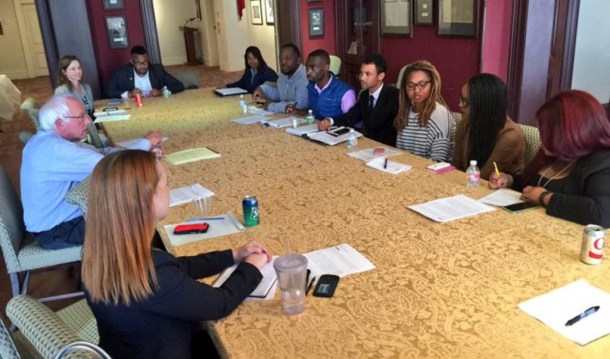
[A] few weeks ago, Sen. Bernie Sanders sat across from a group of black activists at a long table in Washington, D.C. He was seeking input for his racial justice platform, which critics said wasn’t as comprehensive as the one introduced by former Maryland Gov. Martin O’Malley, another Democratic presidential hopeful.
The activists liked Sanders’ recent rhetoric around socioeconomic and criminal justice issues affecting African-American communities, but they urged him to make some revisions.
The hour-long meeting included talk on poverty, the wealth gap and how to effectively implement job creation bills. Activists challenged the notion that stepped up policing is central to safety.
Organizers pushed Sanders, and he pushed back.
“We weren’t pushing against certain things, we were pushing for greater specificity,” said Brittany Packnett, an activist and member of President Barack Obama’s Task Force on Policing who attended the meeting.
But what I appreciated was @BernieSanders‘ willingness to be pushed & consider new ideas abt policing, safety & addressing systemic racism.
— Brittany Packnett (@MsPackyetti) September 16, 2015
While Sanders didn’t accept every argument made at the meeting, activists said the conversation was candid and respectful, and Sanders listened. “It was a productive meeting in that he was open to being pushed on some thinking and it was productive in that hopefully there will be more conversations,” Packnett said. DeRay Mckesson, one of the activists who attended the meeting who is part of a police reform organization called Campaign Zero, tweeted out that he got Sanders to talk about civil forfeiture.
& we pushed @BernieSanders to address civil asset forfeiture & I think he heard us. I anticipate that he may address it in his platform. — deray mckesson (@deray) September 16, 2015
Over the past couple of days, Sanders’ platform was updated to acknowledge the impact of civil forfeiture laws on the black community.
The platform now reads: “So-called civil asset forfeiture laws allow police to take property from people even before they are charged with a crime, much less convicted of one.”
Sanders’ D.C. meeting with Black Lives Matter leaders and the subsequent policy change is representative of the presidential candidate’s new interest in listening to leaders of the minority movement, which is bringing awareness of African-American issues to mainstream politics.
The organizers have protested in the streets, created a thriving conversation on Twitter about racial justice, and are now developing policy proposals for lawmakers like Sanders.
 “We have had episode after episode of police doing things with minority suspects that they wouldn’t do to you and me,” said Michael Briggs, a Sanders spokesman. “He’s becoming conscious of those issues and speaking out on them.”
Sanders offended Black Lives Matter leaders early in his campaign. He was dismissive of activists who interrupted him at the Netroots Nation conference in July and at a Seattle speech in August.
“He has an opportunity with his platform to show us how much learning he has done over the course of the campaign,” Mckesson said. “And how that has formed his understanding of race in ways his experiences as a legislator might not have.”
Before Sanders met with Black Lives Matter leaders, he was indignant about protesters interrupting his speeches at campaign events.
“I was especially disappointed because on criminal justice reform and the need to fight racism there is no other candidate for president who will fight harder than me,” Sanders said after the Seattle event.
Sanders was initially defensive when he was challenged on issues of racial justice, and he pointed to his efforts to curb housing segregation as a student at the University of Chicago. He also cited his presence at Martin Luther King Jr.’s 1963 March on Washington.
But in his decades-long political career in Vermont – a state that is 95 percent white — Sanders has rarely discussed racial issues. Archived television and debate performances are virtually free of any talk about race.
In his first months as a presidential candidate, Sanders claimed his economic justice prescriptions would lift up minority communities, and he had no specific proposals related to black justice.
But shortly after the shutdown of his Seattle speech in August, Sanders shifted away from his past rhetoric and began looking to the voices shaping the debate today.
Mckesson said that while Sanders’ economic proposals were progressive, he didn’t address the particular issues and federal policies that affect minority communities.
Now that he’s had an opportunity to talk with the senator, Mckesson said his view of Sanders has changed.
“We did have a really candid and open conversation about a host of issues,” Mckesson said. “Sanders said what is true and I will always be in favor of people who say the truth.”
Marcus Ferrell, the African-American outreach coordinator for the campaign, has been Sanders’ secret weapon in reaching out to activists for input. He also hired Symone Sanders, a respected African-American activist involved with the Black Lives Matter movement who also serves as the National Youth Chair of Campaign for Juvenile Justice.
“Symone brings some personal passion and is able to speak with great authenticity on these issues,” Briggs said. “And Marcus is doing a tremendous job talking on and off the record to these folks.
“I think it has been a good, civil back-and-forth on everybody’s part, and he’s learning from it,” Briggs added.
Sanders has held a number of meetings with the activists, and he posted a racial justice platform on his website in August. He has also reached out to other black activists and artists, receiving endorsements from cultural philosopher Cornel West and politically astute rapper Killer Mike.
“just off the phone with Sen. Bernie Sanders (@BernieSanders ) great Convo, Great Man, will be a great POTUS!” #FeelTheBern #HeIsAnAlly
— Killer Mike (@KillerMike) September 10, 2015
I’m looking forward to discussing the major issues facing our nation with @CornelWest this weekend in SC #BernieinSC https://t.co/ISUQf25nma — Bernie Sanders (@BernieSanders) September 12, 2015
Many of the activists have not endorsed candidates yet, and some are asking for more specificity in policy proposals before they make a decisions. But while no outright endorsements have come from the Black Lives Matter leaders, activists said they appreciated that Sanders was now listening.
“I think he does seem genuine and I do think he is listening,” Packnett said. “I think the question is: How will listening translate into action?”

