

[E]ven the most committed environmentalist might consider a book titled “The Yin and Yang of Climate Crisis” to be “out there.” But its author, Vermonter Brendan Kelly, is confident as he points to his person and explains how it starts “in here.”

“Virtually everything we hear about climate change is from our usual, Western perspective,” he says. “Most of the discussion about the crisis of global warming focuses on external issues: calls to reduce greenhouse gas emissions, increase carbon sequestration, buy and eat locally, and challenge continuous economic growth.”
Kelly doesn’t contest the science, commending fellow Vermonter Bill McKibben for writing the first book about global warming for a general audience a quarter-century ago. But the Burlington acupuncturist and Chinese medicine specialist is focused less on treating outer symptoms than on targeting their inner causes.
“If we were to look at climate change from a different vantage point, we can see how what is happening in the environment around us is also happening within us,” he says. “In particular, we can understand that the severity of climate change speaks to deeper and more wide-reaching philosophical and spiritual issues.”
In response, Kelly has spent the past decade crafting his new 248-page paperback, just published by North Atlantic Books of Berkeley, California, and set for debut at coming public readings at Burlington’s Phoenix Books and Shelburne Farms.
“Part of the motivation for writing the book,” the author said in an interview, “is to show how our personal well-being is intimately connected to our cultural and environmental well-being.”
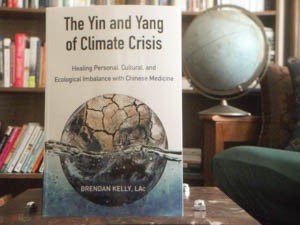
Kelly is published by North Atlantic Books of Berkeley, California. Photo by Kevin O’Connor/for VTDigger
Kelly, co-owner with his wife of Jade Mountain Wellness, was a herbalist for 10 years before he began studying Chinese medicine in 2005. Unlike American health care providers who aim to pinpoint and isolate problems, Eastern practitioners view everything as connected, be it internal organs, the body and mind, or humans and the rest of nature.
“Symptoms are the branches that extend to the physical, surface level,” Kelly writes in his book’s introduction. “The underlying causes, however, are internal, stemming from roots deeper below.”
That’s why when Tropical Storm Irene swelled the Winooski River that, in turn, flooded his office parking lot in 2011, he wasn’t satisfied with meteorological explanations about how moisture-laden air lifted over the Green Mountains, intensifying condensation and the resulting rain that fell onto already saturated soil.
“The typical approach to our increasingly dramatic weather,” he says, “is to examine the science of what is occurring and the public policy issues related.”
Instead, Kelly turned his attention inward.
“Here in the United States, our individual overemphasis on newness, having more, and doing more is a reflection of what is happening with the climate on a global scale,” he says. “How can we hope to decrease greenhouse gas emissions, stop deforestation, and halt the melting of permafrost, ice sheets, and glaciers if we’re not clear how these same dynamics play out in our lives and our view of the world?”
Kelly’s book offers such expected suggestions as curbing fossil fuel use. But it also presents several more unique recommendations for slowing down a “dramatically and unsustainably overstimulated” society.
Consider, for example, unplugging from the constant need to connect through an iPad, iPod or iPhone.
“When we’re in such close proximity to electronic devices that we use for many hours each day, they absolutely impact our well-being,” he writes, “not only in terms of the type of communication they promote or the electricity that’s used to power them, but also in the radiation they release.”
Kelly also calls for Americans to stop drinking the “staggering” 450 million cups of coffee they collectively consume daily.
“Our climate is warming as a consequence of our too-busy culture,” he writes. “Regularly ingesting a hot, stimulating substance while living in an overly busy and overstimulated culture adds fuel to the fire.”
Kelly knows some people would rather throw cold water on such advice.
“Change doesn’t merely mean political changes — ones that help bring more solar panels to our rooftops and more electric cars to our roads,” he replies. “It isn’t just economic changes, either — ones that recognize the folly of the quest for continuous growth. True change also includes understanding that our rapidly warming climate is mirroring our rapidly warming internal environment.”
The author is scheduled to elaborate Wednesday at 7 p.m. at Phoenix Books at 191 Bank St. in Burlington and Oct. 14 at 6 p.m. at Shelburne Farms at 1611 Harbor Road in Shelburne.
“Rather than being like fish that can’t see the water all around them, in applying Chinese medicine to climate change, we have the opportunity to examine clearly the imbalances arising from how we view the world,” he says.
“This is good medicine not only for the well-being of the climate but also a potent remedy to help lead us back to health.”
Kevin O’Connor, a former staffer of the Rutland Herald and Barre-Montpelier Times Argus, is a Brattleboro-based writer. Email: kevinoconnorvt@gmail.com
