

[E]lectric vehicle sellers, owners and state officials converged Wednesday to extol the virtue of plug-in cars at a test-driving event that offers Vermonters the chance to take a fossil fuel-free vehicle out for a spin.
Electric vehicles made by BMW, Chevrolet, Ford, Mitsubishi, Nissan, Smart, Toyota, Volkswagen and Tesla will be on display at the Vermont Teddy Bear factory in Shelburne on Wednesday afternoon and evening.
The event, which starts at 4 p.m., is part of Drive Electric Week, a national effort organized by EV advocacy and environmental groups.
The promotion follows Gov. Peter Shumlin’s morning announcement that 20 businesses, including Vermont Teddy Bear, which will soon be opening an EV charging station, have signed onto the state’s “Drive the Dream Vermont” commitment.
Modeled after a program in California, businesses agree to install electric vehicle charging for employees, offer incentives for their employees to buy or lease EVs, or agree to use EVs in their corporate fleets. The move is part of a greater effort to build up the state’s infrastructure for electric vehicles, Shumlin said.
“The business leaders joining this campaign are making investments that will encourage more Vermonters to buy and lease electric vehicles (EVs),” Shumlin said in a statement.
“Adding more EVs to our roads will reduce our carbon pollution, improve air quality and enhance our economy and energy independence by sending fewer dollars out of state to import fossil fuels,” he said.
Vermont businesses are “often at the forefront” of the state’s efforts to build a “clean energy economy” he added.
When it comes to consumers, EVs still have a long way to go.
Of the 575,214 cars registered statewide in 2014, electric cars comprised 0.17 percent of all vehicles owned, or 943 total, said David Roberts, a program coordinator at the Vermont Energy Investment Corp., a nonprofit that works to reduce the “economic and environmental costs of energy use.”
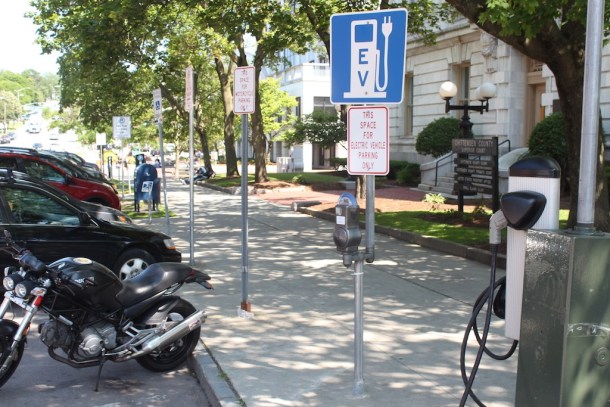
With 73 EV charging stations scattered around the state – 21 in South Burlington and Burlington alone – the availability of charging stations was at a ratio of 1:13, or one charger for every 13 EV drivers.
The ratio of petroleum stations, by comparison, is 1:883, according to figures from the Vermont Petroleum Association, with each station containing three to 12 gas pumps.
A spokesman for the Vermont Petroleum Association, which lobbies for gas stations statewide, said that one of the hard things about trying to build infrastructure around electric cars is adapting to slow recharging times.
“The model doesn’t work,” said Joe Choquette a spokesman for the association. “If you think about how a gas station is arranged, it’s on high volume, typically you’re there for five or 10 minutes, and then you move out.”
“Right now it takes a long time to recharge them, and when you recharge you can’t go very far,” he said. “I know that that’s changing, but it’s changing very slowly. So there hasn’t been a commercial reason for anybody to do it yet.”
Outside the Vermont Energy Investment Corp. offices in Burlington, where Roberts works, a bank of charging stations and electric cars sat in the sun on a recent Friday afternoon.
Hooked up to the cord, which looks just like a gas pump, the vehicles’ front-oriented charge ports stay plugged in for hours, unattended, since it can take about four hours to fully charge an electric car. Newer pumps, and newer car models, are able to use high-speed charging stations to reach 80 percent power capacity in half an hour. A system on the VEIC pump notifies the owner that the car is full and the owner lets other coworkers know the charger is free.

The website PlugShare, which maps EV charging stations, both privately owned and public ones, also offers the free/busy capability for networked stations.
About 1 percent of new vehicle sales are for plug-in vehicles, Roberts said. While Vermont ownership of EVs is higher than the national average, it’s lower than California, he said, and rates of adoption aren’t actually clear nationwide, so it’s hard to really tell where we stand, he said. (His numbers are based on auto manufacturers’ sales data on zero-emissions vehicles.)
It’s also unclear how much the 73 charging stations are used. The electricity use isn’t measured uniformly, except by the host property – unless they are hooked up on a network by the utility.
“We’re still at a very early stage of the market,” Roberts said. “Some of these charging stations, even if they aren’t being used regularly, they’re important because they fill a need for people who are maybe making a longer trip now and are worried about being able to get where they need to go.”
Roberts said that the biggest impediment to getting more EV buyers is the cost. New EVs currently range from $20,700 for a Smart to the $85,000 Tesla.
Buyers of EVs are eligible for up to $7,500 in federal tax breaks, but in some states buyers can receive cash incentives from $1,000 to $5,000, he said.
Vermont piloted an incentive program last year and used up all of the $500 incentives, of which 75 were available. Roberts said it wasn’t enough to motivate new buyers to try EVs.
“We’d love to do something similar in the future at a higher incentive level,” he said.
In 2014, Rep. Peter Welch, D-Vt., introduced legislation, that was not enacted, to raise the federal tax credit, making it easier for people to buy electric cars.
The lack of a used market for EVs is another issue that is hampering sales, but Roberts said that would change over time.
“The owners are generally really enthusiastic about the cars, they love them and really want to share their experience with others,” he said.
Two-thirds of the vehicles at the Shelburne test-drive will be supplied by private owners he said.
Drive Electric Week began in 2011, started by Plug In America, The Electric Auto Association and The Sierra Club.
