

Editor’s note: This article is by Tommy Gardner of the Stowe Reporter, in which it was first published Sept. 10, 2015.
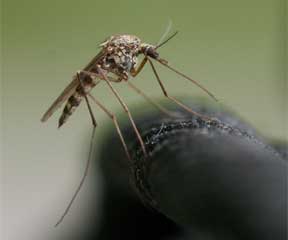
The Vermont Department of Health reported last week that three samples of the summertime pests collected from a site in Stowe contained mosquitoes that tested positive for West Nile virus. It is the first time scientists have detected the disease in local mosquitoes, during a wet, warm summer when the state has tested more towns than ever before.
“We’ve detected it in 9 of 14 counties, and that’s never happened before,” Alan Graham, the state entomologist, said this week.
According to Jenna Paige, an infectious disease epidemiologist with the Vermont Department of Health, this time of the year is prime for the spread of West Nile. A 76-year-old North Carolina man Tuesday became the first person in 2015 to die from the disease. Although no one in Vermont has ever died from West Nile, and there have not been any reports of anyone contracting it this year, state health officials are recommending vigilance. Paige said the risk of getting it is low, but the disease is “widespread” throughout Vermont.
“We consider all of Vermont for there to be potential,” Paige said. “The message for the public is difficult to get across, because we’re not seeing it, but the danger is still there.”
Graham knows his mosquitoes — all 45 different types that buzz around Vermont — and so far this year his colleagues in the Vermont Agency of Agriculture Food and Markets have looked at some 110,000 of the winged pests. And they do it by hand, with tweezers and microscopes, after freezing the little buggers to -85 Celsius.
The agency has tested more than 3,000 samples, little vials called “pools,” taken from 72 towns in all 14 counties, from Addison to Williston — the most comprehensive testing ever. Of those, they’ve found 41 batches of mosquitoes that test positive for West Nile.
In Stowe, all three sites the agency has been monitoring contained the virus-carrying insects, according to the latest sample collected Aug. 27. Stowe is the only Lamoille County town in which the agency found infected “Culex” mosquitoes, the main culprit for spreading West Nile virus, although sites in Morristown, Cambridge, Hyde Park and Eden have also been tested this summer.
“I think people in Stowe just need to use caution,” Graham said. “If the mosquitoes are aggressive, reach for a repellant that works.”
Widespread virus
For all the focus on mosquitoes, West Nile virus is actually carried within birds, and spread by mosquitoes that suck the birds’ blood. Mammals are a “dead-end host,” where the virus can’t replicate. Luckily, for humans, dead-end doesn’t usually mean dead. Horses, on the other hand, succumb to the disease far more easily.
According to the Center for Disease Control, about one in five people bitten by a mosquito carrying West Nile virus will show symptoms that include fever with other indicators such as headache, body aches, joint pains, vomiting, diarrhea or rashes. Most people recover completely, but fatigue and weakness can last for weeks or months.
Only about 1 percent of people will develop a neurological illness, like encephalitis or meningitis, and about 10 percent of them will die from it. People over the age of 60 are more susceptible.
According to CDC data, between 1999 and 2014, there were 1,765 fatalities in the United States attributed to West Nile virus, 4 percent out of 41,762 cases reported. Paige said since the fatality rate is so low, and since the disease isn’t contagious, there is no vaccine or cure for it. Most people, she said, get the flu-like symptoms, which eventually just go away.
Some people have contracted the disease and didn’t even know, Graham added. He said one Vermont woman found out when she gave blood and the blood bank wouldn’t accept it because it contained the virus. The woman recalled being sick earlier, but is an athlete with a healthy diet and recovered quickly.
“Who knows? Vermonters eat a lot of kale,” Graham joked.
Instead of working on a cure for the disease, Paige said the best tactic is to try not to get bit by a mosquito in the first place, especially this time of year. And even better, help your neighbor. Culex mosquitoes are known as urban or residential pests, breeding in places like bird baths, stacks of car tires, and other standing pools of water on peoples’ properties. And boy, do the Culex breed.
“They can breed in a cup of water and have adults in five days or less in the heat of the summer,” Graham said.
West Nile virus tends to spread and break out in waves, emerging in larger-than-usual numbers every 10 years or so. It was first discovered and isolated in 1937 in Uganda, and popped up in the 1940s in Egypt, the 1950s in India, and the 1960s in Europe. It was first discovered in North America in 1999 in New York City, and has since spread to New England and the Atlantic seaboard.
And, said Graham, “It’s here to stay.”
Testing the water
The state Agriculture Agency does not divulge exactly where it does its testing in each town, to protect property owners’ privacy, and to make sure people don’t disrupt the test or, on the other hand, avoid a place because of the stigma West Nile virus carries. Graham wouldn’t say where the tests have been conducted in Stowe this summer, but he said there are prime spots that testers look for.
The two types of insects they are on the lookout for are the Culex, which distributes blood tainted with West Nile virus, and Ochlerotatus, which carries the far more nefarious Eastern Equine Encephalitis (EEE), a neurological disease that is far more deadly.
“We haven’t found any EEE this year, which is very encouraging,” Graham said.
There are three types of tests conducted in each town, and in Stowe, all three traps pulled out Aug. 27 and tested last week contained West Nile-carrying mosquitoes:
• A CDC “light trap” is set up as a kind of reconnaissance device. The light in the trap attracts all manner of mosquitoes and gives entomologists a good overall sense of what kinds of mosquitoes are in an area.
• “Gravid” traps incorporate a stinky mix of nutrients that female urban and household mosquitoes find irresistible. In the mosquito world, females are the only ones that feast on blood; the males sip nectar. The females will lay their eggs in this trap, and they and their eggs get sucked into it.
• “Passive” black box traps are placed in potential sites, particularly acidic hardwood forests, where Ochlerotatus like to hang out. Mosquitoes that have recently had a “blood meal” go there to rest afterward, like any human after Thanksgiving dinner. Graham said the passive traps don’t catch the volume of the other two, but the specimens they do catch tend to be the mosquitoes they’re looking for — or hoping not to find, as the case may be.
Graham said although he won’t say where the traps are set, he hasn’t had anyone from Stowe complain about them going on their property.
Vermont started testing for West Nile-carrying mosquitoes in 2001, but really stepped up its efforts in 2012. Graham gives particular credit to Patti Casey, an agency animal health specialist who has logged more hours in the field than most over the past few years.
Last year was a banner one for testing, with samples taken from 12 counties. This year, the whole state is being covered. With the 110,000 mosquitoes identified this year — of all types — the state now has a database of more than 1 million individual bugs.
“Up until 2012, there was one person looking for mosquitoes in Vermont, and that was me,” Graham said. “That’s like asking one person to keep track of all the deer in Vermont.”
