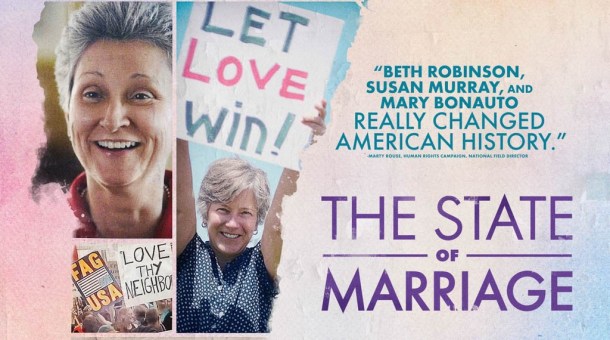
“The State Of Marriage” — a new documentary spotlighting the locals who struggled for two decades to win same-sex couples the freedom to wed — can boast its world premiere at the Provincetown International Film Festival and coming screenings in such cities as Boston, Indianapolis and Santa Fe.
But an in-between showing this weekend promises to be special, too: “The State Of Marriage” will finally be seen in the state where the film was made.
The movie, released one week before the U.S. Supreme Court affirmed a nationwide right to wed in June, is set to make its only scheduled Green Mountain screening Saturday at Burlington’s Main Street Landing performing arts space. Proceeds will benefit that city’s Pride Center.
Back when producer and director Jeff Kaufman hosted a daily radio show in Middlebury from 1995 to 2000, he didn’t know he’d go on to become a Los Angeles filmmaker — or that the conversations that led Vermont to become the first state in the nation to adopt same-sex civil unions in 2000 and to approve full marriage rights by a legislative vote in 2009 would turn into fodder for his latest project.
“It was incredible to see an intense, personal, statewide conversation take place about LGBT rights — that had really never happened before,” Kaufman says today. “How often do you have the opportunity to witness events that changed the whole country and the world?”
The hour-and-a-half documentary taps archival video and present-day interviews to tell the story of how Vermont lawyers Susan Murray and Beth Robinson partnered with fellow New England attorney Mary Bonauto to build a campaign in support of marriage equality not only for the state but also for the country.
Starting with a few hundred dollars and a handful of volunteers, Murray and Robinson created the Vermont Freedom to Marry Task Force in 1995, all while joining forces with Bonauto, the Boston-based civil rights project director for Gay & Lesbian Advocates & Defenders.
The group recruited three same-sex couples to apply for Vermont marriage licenses in 1997, then filed a lawsuit (Stan Baker, et al. v. State of Vermont) when town clerks rejected the requests. That led the Vermont Supreme Court to rule in favor of same-sex rights in 1999 and the state Legislature to adopt civil unions a year later.
“We had every reason to celebrate, but we weren’t done,” Robinson says in the film. “I knew we had to keep working however long it took to get to full equality, full inclusion — civil marriage for same sex couples.”
And so they toiled until 2009, when the Legislature adopted full marriage rights by overriding Gov. James Douglas’ veto by a required two-thirds vote.
The documentary features personal stories told by Vermonters both for and against the proposals, as well as commentary by national Freedom to Marry founder Evan Wolfson, Tony Award-winning playwright Terrence McNally and civil rights legend U.S. Rep. John Lewis, D-Ga.
The Hollywood Reporter has hailed the movie as “an indispensable addition to the filmed history of the marriage equality movement,” while Entertainment Weekly included it on its map of “Hollywood’s road to marriage equality, from The Golden Girls to Modern Family.”
Kaufman and his producing partner, Marcia Ross, are working on a schedule of future area appearances and DVD distribution. But for now, the only way to see the film is to attend the Burlington benefit Saturday, which will feature a 5:30 p.m. reception, 6:45 p.m. screening and 8:15 p.m. panel discussion set to include the producers, Murray, Vermont House Speaker Shap Smith and Hinesburg Rep. William Lippert, with more information available at the “The State Of Marriage” Facebook page.
“We wanted to have a showing in Vermont,” Kaufman says, “that gave us a chance to say thank you.”
The filmmakers originally had other intentions as well. Raising money online for production, they expressed their hope that the finished product “will be the center of a national and international outreach campaign to advance full and inclusive LGBT rights.”
That was before the U.S. Supreme Court affirmed a nationwide right to wed a week after the film’s premiere. But Kaufman, who has produced programs for the Discovery Channel, History Channel and Learning Channel, still sees reason to proceed.
“We always felt it was important to preserve and pass on this story, as history slips away and its lessons can, too,” he says. “There’s still a long list of work — employment and health care and housing protections — and a long way to go. This can motivate people for the next big movement.”
Kevin O’Connor, a former staffer of the Rutland Herald and Barre-Montpelier Times Argus, is a Brattleboro-based writer. Email: kevinoconnorvt@gmail.com