

Editor’s note: This article is by Olga Peters, of The Commons, in which it was first published on Sept. 2, 2015.
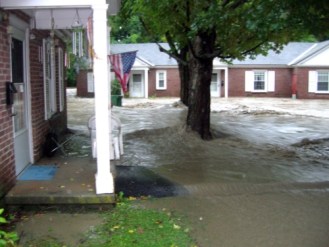
[B]RATTLEBORO — Almost four years ago to the day, as Tropical Storm Irene whooshed through Vermont, residents, staff and emergency services scrambled to evacuate Melrose Terrace as the storm’s heavy rainfall contributed to flash flooding statewide.
When the storm waters receded from one of the town’s largest public housing areas, Brattleboro Housing Authority Executive Director Chris Hart and the Housing commissioners stood in the mud and examined the extensive damage.
Built in 1965, the 80-unit Melrose, nestled next to the Whetstone Brook in West Brattleboro, housed 150 elders and disabled adults with low and moderate incomes.
The site predates federal flood maps, which since assigned much of the housing estate’s property to a flood hazard area.
Hart and the commissioners were faced with a quagmire of 60 damaged units, pressure from regulators looking to move people out of the floodway, and short-term and long-term problems to solve.
How could the Housing Authority — since renamed Brattleboro Housing Partnerships (BHP) — quickly and safety rehouse its residents in the short-term? Where could they permanently move Melrose residents?
On Aug. 31, as she stood on the dry 2.8-acre patch of land on Fairground Road that will soon blossom into the new 55-unit Red Clover Commons, Hart praised the BHP’s commissioners.
Their commitment to the regulators: allow the authority to temporarily rehouse people at Melrose, and they would find new housing within three years, Hart said.
It took four years, but they’ve otherwise kept their promise, she said.
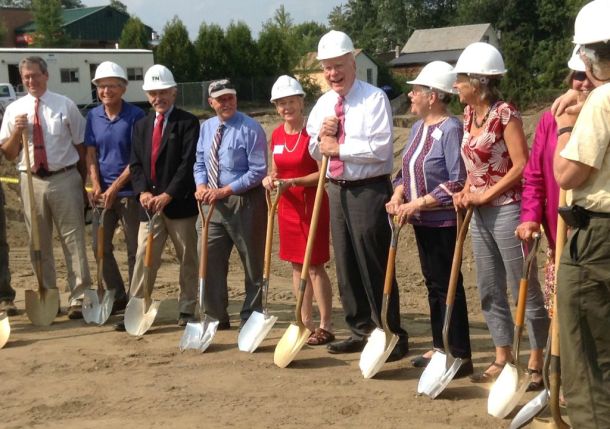
Local, state, and federal dignitaries attended the groundbreaking for Red Clover Commons.
The three-story building will have energy-efficient affordable housing for seniors and adults with disabilities. Residents will also have access to a common kitchen, dining area, community gardens, and on-site services through the Support and Services at Home (SASH) program.
The $15.9 million project represents a joint effort between the BHP and Burlington-based Housing Vermont. Local, state, and federal agencies banded together to wade through the thicket of regulations and funding rules that have accompanied the project.
Funding a large and involved project requires multiple funding sources, with $5.5 million of the project’s funding coming from a federal Community Development Block Grant Disaster Recovery (CDBG-DR) grant from the U.S. Department of Housing and Urban Development. The Vermont Agency of Commerce and Community Development (ACCD) administers the funds.
CDBG-DR grants are part of $40 million in federal funds Vermont received after Irene. Vermont’s congressional delegation played a major role in getting these funds.
Sen. Patrick Leahy, who attended Monday’s groundbreaking, led the charge to acquire the funds after Irene, supported by U.S. Sen. Bernie Sanders and U.S. Rep. Peter Welch.
People’s United Bank has also provided $7.5 million in equity funding, a loan of $1 million, and a construction loan totaling $7.2 million.
Vermont Housing and Conservation Board (VHCB) is providing $590,000. Housing and Urban Development’s HOME program through the VHCB is providing $875,000. Efficiency Vermont is providing $90,750.
The Vermont State Housing Authority will provide housing assistance vouchers to all units, which will help keep the apartments affordable for those with low incomes.
According to Housing Vermont, to qualify for Red Clover, residents must have an annual income of less than 50 percent of the HUD area median. Here, that’s $22,950 for a single person and $26,000 for a two-person household.
Opening day for Red Clover is next fall. The project is phase one of a three phase project.
Red Clover replaces only some of Melrose’s housing. Phase two of the project will replace the remaining 25 units and BHP offices with a second housing project at a location to be chosen.
Phase three will determine what to do with the Melrose property.
Leahy remembered touring Brattleboro and other places in Vermont after Irene’s flooding with Gov. Peter Shumlin and then-Adjutant Gen. Mike Dubie of the Vermont National Guard.
Some communities were accessible only via helicopter, he said.
As a kid, Leahy heard the stories his parents and grandparents told about the 1927 flood. But Irene taught the senator of the devastation a flood can cause.
Leahy said he remembered “bridges twisted, roads gone, and communities cut off” after Irene.
Despite the devastation, people came together, he said.
“Today, I am proud to stand with Brattleboro to celebrate the extraordinary effort undertaken to replace Melrose Terrace and give new life to Canal Street,” Leahy continued. “This project represents the partnership and perseverance of our communities to thrive in the wake of disaster and build much-needed safe, affordable, energy efficient housing in Southern Vermont.”
Leahy said he tries to remind colleagues in Washington D.C. who are “writing blank checks for wars” that they also need to care for people at home.
To the audience, Leahy said, “I know I’m speaking to the converted, but you’re showing us and reminding us so we can show everyone else what Vermont is.”
Specifically, Vermont is heart, integrity and community, he added.
Projects like Red Clover are important because they support that community, Leahy said.
The government spends “a fortune on worthless wars” but, he said, investing in communities brings better results.
Vermont Secretary of Commerce and Development Patricia Moulton said that disasters hit everyone, but people with lower incomes feel the blow harder and take longer to recover.
Red Clover — energy-efficient and on higher land — represents a strong post-Irene project, she said, noting that the building project represents resiliency and is built to withstand the harsher weather predicted for a climate change.
In light of the state’s tightening budget, Moulton said that helping Vermont’s vulnerable population also gets more difficult.
She said that keeping people out of harm’s way, however, helps them move on to programs like workforce training or new jobs. As their lives improve, so will their level of community engagement.
There’s always a balance, she said. “You have to do it all, you don’t want to just meet one need.”
Shumlin knows that Vermont needs to grow revenue with increased economic activity, she said.
Melrose residents also attended the groundbreaking.
Marie Rabideau has lived at Melrose since 1983 and loves it. The 89-year-old was displaced by Irene for four months.
She doesn’t want to leave her home of many years, but she said Red Clover is a good alternative.
It is within walking distance to stores, she said; in West Brattleboro, there’s not many places to walk to.
Lena Fraga has lived at Melrose since 1995. She loves it, too.
Irene left her with a wet apartment and a long repair list.
But she also loves change.
“I’m excited,” she said.
