

Editor’s note: This article is by Tommy Gardner of the Stowe Reporter, in which it was first published Aug. 20, 2015.
[P]eople pay good money for the ridgeline views in this part of Vermont, but they also want their smartphones and laptops to connect reliably to the outside world.
Those two realities are rubbing up against one another near the Waterbury/Stowe border, as Verizon Wireless prepares to build a 90-foot-tall communication tower that it says will improve coverage in the Waterbury area.
“Most people say, ‘We want good cell service, but we don’t want to see it,’” said Tari Swenson, a Waterbury resident who agreed to have the tower built on her and her partner’s property. “But all of us have to share the burden, on some level.”
Swenson and partner Chris Curtis are local artists and Stowe gallery owners who literally make a living out of having good aesthetic sense. According to Swenson, Verizon approached them more than two years ago, looking to fill in holes in its coverage area.
She said she has been impressed with how cooperative Verizon is, bringing in biologists, foresters, even an architect to check out the land and allay her and Curtis’ concerns about aesthetics and safety.
The couple even asked one of their close friends, also a forester, to “give us the honest answer,” and it jibed with the Verizon-hired experts’ opinions.
“We tiptoed into it, honestly,” she said.
Under Vermont law, the project has to go before the state Public Service Board, and Verizon had to provide written notice to Waterbury’s town officials and to adjoining landowners — which it did on April 28. According to the letter, acquired by the Stowe Reporter, the project is designed to improve cell service along the Route 100 corridor and Interstate 89 in the Waterbury area. Verizon says the project is in line with both Waterbury’s town plan and the Central Vermont regional plan, which call for efforts to meet “increasing demand for cellular capabilities.”
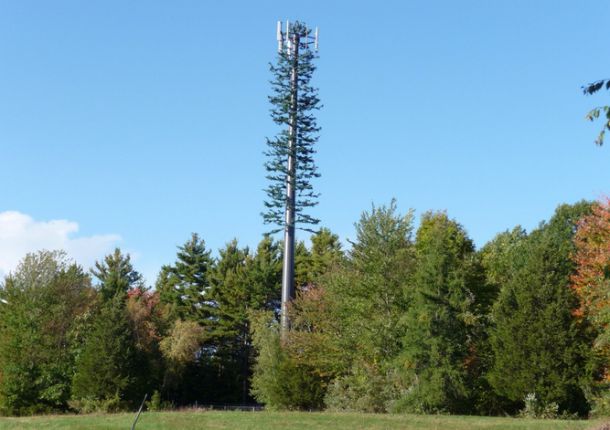
The 90-foot tower will be built and painted to resemble a brown leafless tree, although it will be at least slightly taller, and much more rigid, than nearby trees.
A total of 12 panel antennas and nine remote radio heads would be placed near the top of the tower. In addition, the tower would need a 12-foot by 30-foot equipment shelter. Both the shelter and tower would be inside an 8-foot-tall chain-link fence topped with strands of barbed wire.
All in all, if approved, the tower’s footprint would take up roughly 2,150 square feet.
According to the letter April 28 from Murphy Sullivan Kronk, the Burlington law firm representing Verizon in this project, “The moderate height and tree-like appearance of the tower will have no adverse effect on the town of Waterbury’s local wildlife habits or views of pristine ridgelines and peaks.”
In the backyard
The tower might be proposed for a Waterbury property, but one neighbor with a Stowe address is worried about the tower’s effect on his property.
Brian Doyal lives at the end of Hollow’s End, a quarter-mile stretch of road that is one of many offshoots of Stowe Hollow Road, the main artery that cuts more than 4 miles through the Hollow.
Doyal said he isn’t a “not in my backyard type of guy,” and acknowledges “the Hollow definitely needs better cell service.” As an executive with a financial services firm with offices near Chicago — where Doyal maintains his permanent address — he works from home when he’s in Vermont, as do plenty of people who populate the Hollow. But still, he thinks there might a better place for a cell tower.
“We have one of the few unblemished ridgelines in the area,” Doyal said. “I think it would be a shame to obstruct that wonderful setting.”
Doyal said other options — such as property owned by the Waterbury town government, or putting the new tower next to the three large WDEV radio towers jutting up at the top of Blush Hill — would be better than directly in the Hollow. He also said he has a philosophical issue “that one individual benefits economically” from a company like Verizon, which wants to put in a tower that other people have to look at.
But Doyal also says his cellphone service is lousy at home. Might the improved cell service be enough of a benefit?
“It might be,” Doyal said.
Helps pay the taxes
Swenson and Curtis own roughly 90 acres of mostly-forested property off Ruby Raymond Road in Waterbury Center, near the Stowe town line.
The previous property owners, Bill and Libby Post, had “left a great legacy” with the property, Swenson said, keeping trails open for people in the area, allowing hunters to use the land if they asked for permission, and giving neighbors access to the pond on the property — the Posts were avid fishermen. The property is a key part of a wildlife corridor that extends from Maine to the Adirondacks, according to Swenson.
That kind of spread-out topography was desirable to Verizon for its tower-siting needs, and the money that the company would pay Swenson and Curtis to lease a spot on the property was attractive to the couple, to help offset their property tax bills.
“Honestly, paying taxes on 90 acres isn’t always a piece of cake,” Swenson said.
The project has to be approved by the Vermont Public Service Board, but doesn’t need any local approvals, although the applicant is required to provide notice to the town governments, various state agencies, and abutting property owners, including Doyal.
But here’s the rub for Doyal: Since the tower is proposed for a Waterbury property, it is Waterbury, not Stowe, that has party status, per Vermont law. Doyal’s home may be the closest to the project, but it’s a whole town away.
For her part, Swenson said that, for all the legwork she and Curtis did in reaching out to neighbors and asking advice from property owners who have allowed cell towers to be built on their land, she thinks she could always have done something more.
For instance, while she and Curtis talked with her Waterbury neighbors along Ruby Raymond Road, they might not have thought enough about property owners on the Stowe side of the ridgeline.
“It’s not a comfortable place to be,” Swenson said. “I feel like I’m the bad guy here.”
