

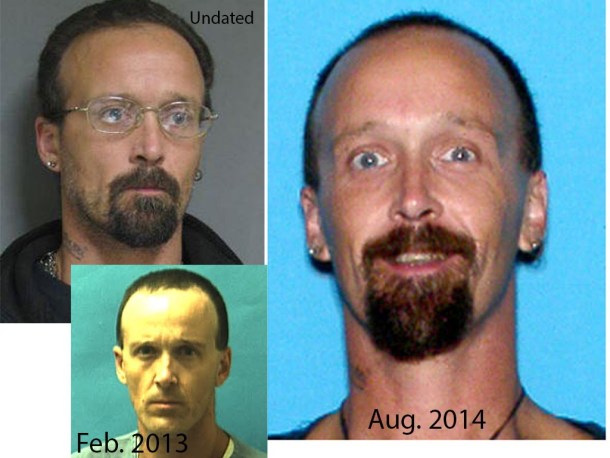
[O]n July 13, the Burlington Police Department received word from a 42-year-old Florida man that he planned to make the Queen City his home.
Joshua Baker, originally from Burlington, notified the police that he intended to return and planned to be homeless. But Baker was coming back to the state with a criminal record that includes four convictions for sex offenses – two of them counts for lewd and lascivious molestation of a child – and no reported history of completing treatment as a sex offender.
In compliance with sex offender mandates, Baker, who has brown hair, blue eyes, and is 5 feet 10 inches tall, reported his move to the Vermont Sex Offender Registry. Beyond that, Baker is free to live unsupervised, and unsheltered, in the Burlington community.
Vermont has laws in place that allow for lifetime sentences. What that means is, even when sex offenders are released from prison, they remain under supervision for the rest of their lives.
However, Baker’s arrival in Burlington illustrates a loophole in Vermont’s more recent sex offender laws. Because of the jurisdiction of his crimes – one of which was sentenced after the lifetime sentencing laws were put in place – Baker is not subject to the laws that require Corrections to stay in contact with sex offenders.
Prisoners like Baker, who are part of a marginalized population such as sex offenders, may move to the state after serving time, with zero safety net or oversight.
Complete records weren’t available by press time, but from his summonses and appearances recorded in the Lake County courthouse in Florida, it appears Baker often missed court dates, failed to provide valid or new addresses, violated parole, and swung between not-guilty pleas and admittance of guilt for each charge.
Baker, who turned 42 last month, previously had lived in Richford, as well as on Peru Street in Burlington. In June 2004, he was convicted on two counts for “lewd and lascivious molestation” of a child under 12 in Florida; and he was also convicted on two counts of “lewd or lascivious exhibition,” i.e. touching himself or exposing his genitals or doing so for a video camera (without engaging in a physical act) before a victim under the age of 16. He was sentenced to four years, six months in prison for the first crime – but was not sentenced for the latter crime – and was released early in 2008, according to Florida records.
In March that year, he was arrested in Vermont on what the Lake County court documents say was a parole violation. He was held in Vermont for more than a year following that, records show, even though he had signed extradition papers, and was transferred back to Florida by July 2009. On arrival, he was sentenced for the two counts of exhibition to a minor under the age of 16, a crime that happened back on Nov. 2, 2003, the same year he was charged with molesting a child. He faced a two year, three month sentence for the exhibition, but with the time served in Vermont, he only stayed in the Florida prison system for another 11 months.
Five months later, he broke the law again, by failing to register on the Florida state sex offender registry. He was handed a sentence of two years, eight months, and was released a year and 11 months later. He’s been free since February 2013, having maxed out – or completed – his sentences there, according to Florida’s Department of Corrections system.
Baker has several tattoos, including a massive, colorful cross on the back of his neck, and the name Sherri on the side of his neck. On his right arm is the cartoon skunk Pepe Le Pew in a heart.
Risks of release
Vermont has categorized Baker as a Category 3 rated offender, and the state registry marks him as “a violent sexual predator,” a spokesman said. That means, he is at high risk of repeating the offense, has a high potential violence level and is a threat to public safety.
“These are all closed charges and he is not currently connected to the VT DOC for supervision,” Kris Goldstein, a spokesperson for the Department of Corrections said via email. Calls asking for more detail were not returned.
Although a state law from 2006 allows for lifetime supervision of high-risk offenders, it cannot be made retroactive to already sentenced criminals.
Likewise, the supervision of high-risk offenders doesn’t apply to anyone who has been processed in a different jurisdiction, no matter what the crime.
“Wandering around”
Rita Markley, executive director of the Committee for Temporary Shelter (COTS), said the biggest issue for her with respect to offenders like Baker, and Richard Laws, who was sentenced for the violent rape of a woman in central Vermont and was released in April – was losing track of their locations.
“It’s in no one’s interest to have people who are sex offenders completing their terms in prison and then released without any sort of housing option,” she said.
“If they’re wandering around homeless, and don’t have a program or a fixed address, it’s impossible to monitor how they’re doing. And it sets up, to me, an ever greater risk because they’re sort of dropped off from any connection to people who might be able to flag if anything is wrong.”
She said when sex offenders don’t have a place to call home, the public is at greater risk.
“On the one hand, people don’t want sex offenders to be anywhere near them, but on the other hand, it’s a much greater risk to have them out there on the streets, wandering around,” Markley said.
No news articles appeared on Baker’s move to Vermont, aside from reports on his initial notification to the state. It was a stark contrast to the press melee around untreated sex offender Richard Laws, who maxed out his 23-year sentence in April before notifying the registry he was going to be homeless in Burlington. No fewer than 35 news articles appeared over the ensuing month, and they included interviews with victims and Laws himself. Laws is also unmonitored because his sentence precedes the reach of the later legislative changes.
Neither Baker nor Laws, both considered high risk, are subject to any kind of oversight.
In that same vein, they’re not required to participate in treatment programs.
“Community-based sex offender treatment is available to anyone who seeks it,” said Goldstein, from Corrections. “If the offender is under supervision, DOC would make a referral to the local provider,” Goldstein said, and they supply a list of referrals to “anyone who has inquired.”
But, as Markley noted, it’s a very different lifestyle for the homeless than those in a shelter or prison. Especially if they are not even eligible for overnight shelters, such as the beds at COTS, that are designed for families and must be enforced as safe spaces.
Homeless or transient ex-convicts congregating together in a certain area of town can still be harmful to a person’s recovery or ability to move past prison life, said Tom Powell, forensic psychologist who worked for the Corrections department for decades.
“Most of these guys don’t reoffend again,” Powell said. “Everybody in the public … they assume all sex offenders are massive recidivists. In fact, the numbers are quite low.”
Once someone is branded a sex offender, though, Powell says there is a chance they will be on the fringe of society, whether or not they have a home.
Different State, Different Sentencing
It’s not probable in Vermont that Baker would have served less than eight years total for two different sex felonies, said Sen. Dick Sears, D-Bennington.
As the chair of the Senate Judiciary Committee, he has worked on revamping the state’s laws over a number of years. One law, signed by Gov. Jim Douglas in 2009, allowed for longer minimum sentences for perpetrators of sex crimes against children.
If Baker had been processed in Vermont, he’d still be behind bars, said Sears.
A silver lining, he said, is that Vermont holds any incoming sex offenders to Vermont standards. While Baker might not be listed as a high-risk offender in Florida, when he registers on the Vermont sex offender list, his crimes and actions are weighted as if he had been processed here.
Compliance as a Sex Offender
Baker must report his whereabouts to the state registry every single day, officials said.
Sears said the registry is considered a first line of defense for lawmakers.
“We have different requirements of different statuses of different individuals. Part of the reasoning for that is that, if you’re high risk you also want to make sure that they’re compliant with the sex offender registry,” said Sears.
“Offenders who do not [keep up to date on registering] are more likely to reoffend,” he said.
Baker was compliant and up-to-date on his check-ins as of Aug. 17, and as long as he is homeless, he must register daily, a spokesman for the registry said.
If Baker were tried in Vermont – for instance if the state hadn’t extradited him in 2009 back to Florida – he might have been sentenced for the lesser felony of exhibitionism and released under the “lifetime supervision” rules, said Sears.
That indeterminate sentencing law allows for a reduction of time in exchange for treatment as a sexual offender. Those who refuse treatment will be monitored for life after release.
And, if Baker had been under that kind of monitoring in Florida, and tried moving to another state, as an offender, Vermont would have had to accept the conditions of his release for him to move.
“Chances are Vermont wouldn’t have accepted him if Florida had laws like Vermont,” said Sears. “Any average citizen can move about the country. And that’s where the difficulty comes in.”
Meet and greet
Although the Burlington Police said in a July 13 press release that they’d be periodically monitoring Baker, Deputy Chief Bruce Bovat told VTDigger, “There is no official mandated oversight on our behalf.” The law’s reach begins – and ends – with Baker’s compliance in reporting himself.
But even that isn’t such a reliable resource: Two different audits of the registry, including one in 2014, have found that several people were erroneously listed on the registry, while some offenders were left off it.
“If they say, ‘homeless’ they’re required to be pretty specific about where they’re going to be,” said Bovat. “So in the last couple of situations we’ve taken it upon ourselves to go down there and touch base and make sure he knows the resources that are available to him in this city. It’s sort of a meet-and-greet,” he said.
“Occasionally we will just go down and make sure the person’s still in the area, but they don’t need to report to us,” he added.
Though Baker’s precise location – as reported to the state registry – is on file, that location is not available to the public.
“We don’t want someone to drive down there and harass him and call him a sex offender,” said Bovat.
Currently Baker’s listed residence is simply “the waterfront.”
When asked what was meant by waterfront, and how the public could be cautioned about his proximity, Bovat said he wouldn’t say. “We’re saying it could be the entire city of Burlington. From Red Rocks to North Beach.”
VTDigger attempted to find Baker to interview him for this story, looking along stretches of the waterfront suggested by community workers, and stopping at the COTS Daystation to leave a message. Baker did not respond to the note left asking for comment.
Fictitious benefits?
The state of Vermont, unlike other jurisdictions, has no restrictions on Baker’s ability going forward to live near, or approach people in playgrounds or on beaches or other areas, officials said. The exception is if it’s tied to a person’s parole or probation order.
In several states, including Alabama, California, and Iowa, convicted sex offenders are not allowed to reside within a certain radius of public schools, libraries, churches, community centers, or other public areas where children can congregate. Sometimes it can be as little as 500 feet, other times it’s up to 5,000 yards.
“On the issue of housing limitations or requirements, the registry does not place any restrictions on where an individual may live or work,” said Jeff Wallin, director of the Vermont Crime Information Center, which maintains the registry.
“However, if a registrant is being supervised by the Department of Corrections, they must comply with those restrictions,” he said.
Powell says residency limitations like those in Florida, can pose even greater threats to the public.
“You can’t live in 5,000 yards of a school or whatever … so you have all these sex offenders living in an island under an interstate. It has nothing to do with their well-being, it has to do with this fictitious benefit,” said Powell, the psychiatrist. “It’s that at least we have them away from all of this. All you wind up doing is disenfranchising people that way, and strip them out of the mainstream.”
“People no longer have access to the social institutions like work, like housing and like social services,” after prison, he said. “They get depressed, it makes them less inclined to improve themselves, and they more or less live illegally,” he says.
A different story
On July 26, 2013, violent sex offender Timothy Szad, 53, was officially released from the Southern State Correctional facility after serving 13 years for aggravated sexual assault on a disabled, 13-year-old boy in Rockingham. His sentence was for seven to 20 years.
Originally Szad, who was treated and continued to get help after release from a program for sex abusers, was going to move in with his parents in Springfield. But the placement was resisted by the community and he faced homelessness. According to a statement on the “difficult situation,” Gov. Peter Shumlin said state workers found a resolution: shipping Szad off to California.
“I have shared the concerns expressed by many Vermonters about ensuring a placement for Mr. Szad that guarantees Vermonters’ safety and keeps Mr. Szad accountable,” Shumlin said. “I appreciate that the Department of Corrections and others were able to work together to find him an appropriate placement in California.”
Corrections field officers had apparently found a way to send Szad away – but a week later the state reported that the plan fell through, and instead they’d found housing for Szad in Hyde Park.
He met with law enforcement and local clergy, the press reported, who both left confident Szad would be OK.
“He’s determined to stay safe and to never offend again,” Pastor Peter Fiske, of the Church at Prison, told the Burlington Free Press. “He’s doing everything that he possibly can. He’s doing nothing wrong; he’s doing everything right.”
According to the state registry, Szad is in compliance, two years later.
