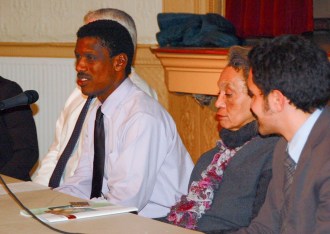
[A] Vermont man was a participant in a panel discussion at the White House on Monday in a celebration of the 25th anniversary of the signing of the Americans with Disabilities Act (ADA), the landmark civil rights law that protects people with disabilities from discrimination.
Max Barrows, outreach director at the Vermont disability rights organization Green Mountain Self-Advocates (GMSA), was one of nine advocates invited to speak at the celebration. The nine “Champions for Change” were selected for their work to “uphold and expand the spirit of the ADA,” according to a White House news release.
Barrows also serves on the board of national self-advocacy organization Self Advocates Becoming Empowered. The Worcester resident is being honored for his work mentoring youths and adults with developmental disabilities to speak up for themselves in the face of social stigma.
Click here to watch Barrows participate in a panel discussion Monday at the White House.
“I seek new ways to stand up toward the lingering negative attitudes that control the lives of persons with disabilities,” Barrows said in a news release. “One key is educating people about presuming competence. Don’t assume someone can’t do things by themselves. Even though people may need support, let us have opportunities to try and accomplish things on our own.”
Despite the signing of the ADA 25 years ago, Barrows said in a phone interview, people with developmental disabilities are still subject to institutionalized stigma. To illustrate his point, Barrows pointed to so-called “sheltered workshops,” in which people with disabilities perform tedious factory work for sub-minimum wage – sometimes only a few dollars or cents per hour. Though the last sheltered workshop in Vermont was closed in 2002, they still exist legally in most states across the country, he said.
“It is unacceptable that anybody with a disability should work in a segregated setting,” he said. “If the community would give us a chance, we would have so much to offer.”
Barrows, who has autism, said that people with disabilities must become their own advocates in order to protect themselves from harmful practices like sheltered workshops.
Through the self-advocacy movement, Barrows said, he came to view his autism as a way to become a leader within the community.
“I think that connecting with other individuals with disabilities helped me discover myself in ways I wasn’t aware of when I was younger,” he said, explaining that he drew strength from sharing his experiences and challenges with his peers.
“I used my disability as a way to kind of role-model for others, so that they know they don’t have to be afraid to have a disability,” he said.
In his work with the GMSA, Barrows acts as a mentor to others with disabilities. He described mentorship as a process of guiding and advising people as they come to recognize their own potential.
Barrows said his own mentor was Chester Finn – a prominent figure in the self-advocacy movement on a national scale, who saw leadership potential in Barrows. When Finn advised him, Barrows said, “he did it in a way that made me believe in myself.”
“I learned so much from seeing him speak up and collaborate with others with disabilities,” Barrows said.
Barrows expanded Finn’s example of collaboration beyond the community of people with disabilities to include other interest groups like Vermont Justice, 350 Vermont, the Vermont Workers Center and Vermont Interfaith Action. The way he sees it, Barrows said, all of these movements are interconnected.
“When we collaborate with organizations outside of just disability, our actions matter more,” he said. “There’s no workers’ rights without disability rights and no migrant justice without workers’ justice.”
Barrows said he hoped people take away two points from his speech at the White House. The first is that when considering somebody with a disability, it’s best to assume competence.
The second message, Barrows said, is “nothing about us, without us.”
“Whenever decisions are made about people with disabilities, people with disabilities need to be in the driver’s seat,” he said.