Editor’s note: The article is by Matt Hongoltz-Hetling of the Valley News, in which it was first published Friday, July 24.
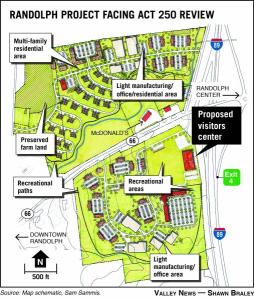 RANDOLPH — A state environmental commission last week asked the developer of a proposed mixed-use project near the Interstate 89 interchange in Randolph to go back to the drawing board, saying the initial proposal would use up too much prime farmland.
For more than a decade, developer Jesse “Sam” Sammis has tried to build a multi-use project that would include condos, a hotel, apartment buildings and light industry on the 172 acres he owns off Exit 4.
The project would also include a visitor’s center, an element that has drawn support from state officials, including Vermont Gov. Peter Shumlin.
Thursday, the state’s District 3 Environmental Commission issued a written order in which it found that Sammis had not satisfied an Act 250 requirement to minimize the impact of the project on the prime farming land, officially referred to as “primary agricultural soils,” that constitute 123 acres of the property.
“At present, the Commission is not persuaded that the project as designed is compact enough to satisfy” the section of Act 250 that protects primary agricultural soils, Commission Chairman Tim Taylor wrote in the order.
During a July 17 hearing that led to the order, Taylor, a farmer in Thetford, repeatedly suggested that the buildings on the site could be clustered more tightly together to preserve more of the open farmland on the site.
During the hearing, project engineer John Benson argued that shifting the building footprints would be difficult because of constraints imposed by other considerations, such as preserving buffers and open vistas, but Thursday’s order indicated that the commission was unswayed.
“We invite the applicant to present a new plan showing a more compact design,” wrote Taylor, which also suggested clustering could conserve more of the site’s open fields.
Pete Van Oot, a lawyer representing Sammis in the Act 250 process, said Thursday that he planned to submit a response to the order, and to the comments he heard from commissioners during the July 17 hearing.
“We had asked the commission for their feedback on how the applicants could best meet the commission’s concerns that the project better utilize innovative land use design resulting in compact development patterns,” he said, “and are pleased that the commission provided such constructive feedback.”
Diane McElhiney of the Exit 4 Open Space group, which is opposed to the project, said in an email, “We are pleased that the Act 250 commission recognizes the importance of preserving the prime agricultural soils, however, no matter how you design or situate that development on that land, there are a plethora of problems, including runoff, viewshed, traffic, Town Plan, and municipal services among others, that will need to be addressed under Act 250 at future hearings should the applicant pursue it.”
The order also asked Sammis to submit more information on another possible objection — under Act 250, he must also prove that the project can’t reasonably be relocated to less fertile farmland, on other property that he owns or controls. During the hearing, the Conservation Law Foundation and others opposed to the development argued that pieces of the project could be situated on other property that Sammis owns in Randolph.
The order from the commission asked Sammis to submit a list of each of Sammis’ properties and “a statement regarding its suitability for relocating some or all of the office, residential or light industrial components of the project.” Van Oot said the point would be addressed in an upcoming filing before the commission.
“We look forward to fully responding to the commission’s requests on both the innovative land use design, and providing even more information on the land use,” Van Oot said.
If the commission finds that the project meets the Act 250 permit requirements regarding primary agricultural soils, it will move on to evaluating other criteria under the law, which include the potential impact on aesthetics, wildlife habitat and pollution levels.
The commission established a deadline of Aug. 17 for Sammis to present new documentation; the commission will reconvene for another public hearing Sept. 25.
Matt Hongoltz-Hetling can be reached at mhonghet@vnews.com or 603-727-3211.