

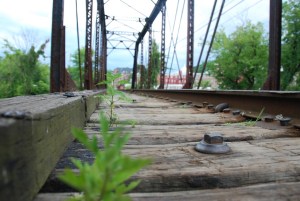
According to a news release, the city and the Washington County Railroad reached an agreement that will prevent the railroad from spraying glyphosate, a powerful herbicide, in a high-population area extending from Main to Granite streets. Railroad employees within this no-spray-zone will instead use weed whackers to clear vegetation along the railroad right of way. The City Council will take up the agreement Wednesday evening.
Under the agreement, the city will foot the bill for labor and equipment required to clear the half-mile stretch of track that extends through the no-spray-zone – a maximum of $10,800 for the rest of the year, Mayor John Hollar said.
While that sum may seem like an awful lot, the city was in no position to haggle, Hollar said.
“We didn’t have any way to force them to incur that cost. If we had said ‘no, we’re not going to pay for it,’ they would have gone back to the state and presumably gotten a permit to spray the entire section,” Hollar said.
Residents who live along the tracks had asked for the spraying to be halted, prompting the city to meet with railroad officials to reach a deal.
Hollar said the ubiquity of railroad pesticides makes Montpelier’s no-spray-zone exceptional.
“They’ve sprayed all the lines – all of them. I mean hundreds of miles throughout the state, every year including this year. So this is very much an anomaly,” he said. “There are more than 300 miles of rail lines in the state, and all of those lines, except for this half-mile in Montpelier, I believe, will be sprayed with herbicide and always have been.”
But environmental activist and pesticide researcher Sylvia Knight is not satisfied. Even with the no-spray-zone in effect, Knight is concerned that glyphosate, the herbicide used by the Washington County Railroad to maintain their railroads, poses a public health risk.
“There’s new stuff coming out about glyphosate all the time,” she said. “The international Agency on Research on Cancer, IARC, has determined that Glyphosate is now a class 2A – a possible carcinogen. It’s toxic to cells at low concentrations. If you expose cells, human cells to this stuff, it’s toxic. It’s also an endocrine disrupter. It changes the hormone function at low concentrations.”
According to the Environmental Protection Agency’s website, glyphosate has the potential to cause damage to kidneys, lungs and the reproductive system – but only in high concentrations. Knight said the EPA was too liberal in its assessment.
“The amount of glyphosate allowed in water is 700 parts per billion, but that’s way above the levels at which this stuff can create problems in cells,” she said.
Knight expressed frustration at the closed nature of the discussion that led up to the agreement between city government and the railroad. The mayor held an open forum on the issue, but the actual meeting at which the city sealed the deal was closed to the public, she said.
In the end, though Knight and other pesticide critics got a no-spray-zone, she said that it was slashed substantially from the group’s originally requested, mile-long stretch of track from the Main to Pioneer streets. Hollar said that there was nothing the city could do to wrest the full mile of track from the railroad company.
“There was no way we were going to be able to get that section,” he said. “We weren’t going to be able to afford it, and really the concerns that were raised by the community related to the spraying and the heavily populated area between Granite Street and Main Street, where there are gardens and houses close to the railroad.”
Hollar said that the deal was the best that could be expected under the circumstances.
“To be honest, I’m a little perplexed by the level of opposition to it,” he said.
The state will review other plant management systems for the following year. Knight said that she hoped the review process would more egalitarian, and taken more seriously, than the meetings leading up to the agreement.
“There should be a stakeholder process including equal numbers of the public and representatives from the railroad, VPAC, some NGO reps, and it should be an open, accountable process. The decisions on that process should have weight – more weight than these groups are typically given,” she said.
In the end, the railroad holds the cards, Hollar said.
“We have no leverage against the railroad,” he said.
Clarification: References to Agent Orange, which originally appeared in this story, have been removed.
