

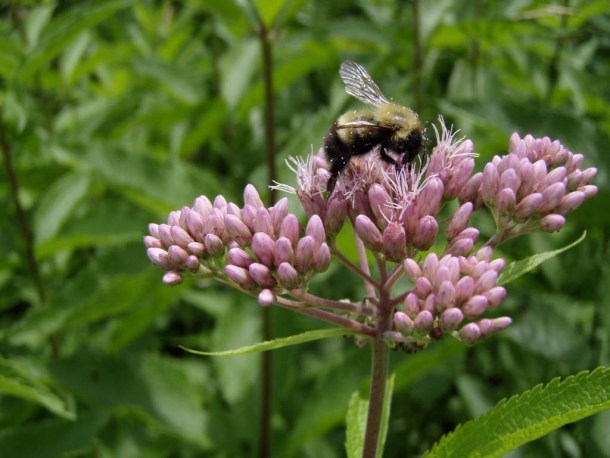
[S]cientists say that climate change may be bringing bumblebees to their knees.
In what researchers at the University of Vermont call “the most comprehensive study ever conducted on the impacts of climate change on critical pollinators,” a team of researchers have concluded that increasing global temperatures are largely responsible for the rapid disappearance of bumblebee populations from the southern edge of their range.
This could spell trouble for human populations as well, Leif Richardson, a bee expert at UVM’s Gund Institute for Ecological Economics who co-wrote the study, said in a news release issued by UVM.

As global temperatures rise, the increasing effort of maintaining a healthy body temperature places bees under more and more stress.
The research team poured over 420,000 historical and current records of bumblebee migrations, spanning 110 years of observation and study. They estimate that the bees have lost approximately 185 miles of territory due to climate change.
“The scale and pace of these losses are unprecedented,” the study’s lead author, Jeremy Kerr of Ottawa University, said in the release.
When warming temperatures force other species out of their southern territory, most respond by moving north to cooler climates, said Richardson in the release. The northern bumblebees, however, are stubborn — they refuse to move farther north, even as the southern edge of their range draws closer and closer.
“This was a surprise,” Richardson said in the release. “The bees are losing range on their southern margin and failing to pick up territory at the northern margin — so their habitat range is shrinking.”
The research team suggested that bumblebees unusual evolutionary track may be limiting their ability to adapt to increasing global temperatures. Whereas most other insect species adapted in tropical climates, bumblebees have “unusual evolutionary origins in the cool palearctic,” the release said.
Though modern insects of different types inhabit all sorts of climate regions, those with tropic-dwelling primordial ancestors may have a genetic leg-up in terms of adapting to rising temperatures, the release said.

Controversy Over Findings
The bee report has caused quite a buzz in the entomological community. After the study’s publication in the journal Science, other entomologists around the world have weighed in on whether the team’s findings support their conclusions.
In a New York Times article on the study, some experts suggested that the bee researchers may have bumbled by placing too much of the blame on climate change.
“They are concluding the future is dire and that bumblebees won’t move north. That’s a surprising conclusion given the data,” Dr. Sydney Cameron, an entomology professor and bumblebee specialist at the University of Illinois, said in the Times article.
“It’s correlative, not causal; they cannot say that a two-degree climate change caused these patterns,” she said.
Another researcher said that other factors could contribute to the findings.
“What they’ve shown is that climate change has at least some effects on the population changes of some bumblebee species,” said Dr. James Strange in the New York Times piece. “But I did not come away convinced that climate change is causing these movements,” Strange said, suggesting that pesticides and habitat destruction — two other well-known threats to bee populations — may still be the culprits.
Though he conceded that habitat destruction and pesticides are harmful to bumblebee populations, UVM’s Richardson said in a phone interview that neither of these factors can explain the distinctive northward range compression that his team has observed.
Richardson said that the bumblebee’s retreat to higher altitudes and cooler climates is consistent with other animal species that scientists agree have left their southern ranges to escape rising global temperatures.
During the phone interview, Richardson agreed with Cameron that bumblebees may eventually begin to expand into uncharted northern territory if forced by global climate patterns — but after searching through hundreds of thousands of documents covering a century of bee migrations, his team has found nothing to suggest that they will.
According to the UVM press release, the only proactive steps that some bumblebees have taken to protect themselves is to seek cooler temperatures at higher elevations — but Richardson doesn’t know how long that tactic will help them beat the heat.
“Eventually, they may run out of hill,” he said in the release.
Aided Migration Could Help or Harm
If bumblebee ranges are allowed to shrink too much, human populations may feel the sting.
“Pollinators are vital for food security and our economy, and widespread losses of pollinators due to climate change will diminish both,” said Kerr in the press release. “We need to figure out how we can improve the outlook for pollinators at continental scales, but the most important thing we can do is begin to take serious action to reduce the rate of climate change.”
But even under the best of circumstances, global climate change won’t stop on a dime. Even if it eventually screeches to a halt, it may be too late for bumblebee populations to survive without human intervention.
Though it’s a risky move, the bee research team suggested in their report that it may be necessary to move the bees into a new environment.
This technique, called assisted migration, is controversial within conservationist circles. In the New York Times article, Cameron said that the idea of transplanting bees outside of their native range was both impractical and dangerous to local populations, which might be exposed to pathogens carried by the invading bumblebees.
The research team believes that leaving bumblebee populations to their own devices may be riskier than transplanting them, however. Important crops and plants depend on bumblebees as pollinators. If the bees don’t survive in large enough numbers, the plants won’t be able to reproduce, Richardson said in the release.
“Bumblebees are crucial to our natural ecosystems,” he said.
