

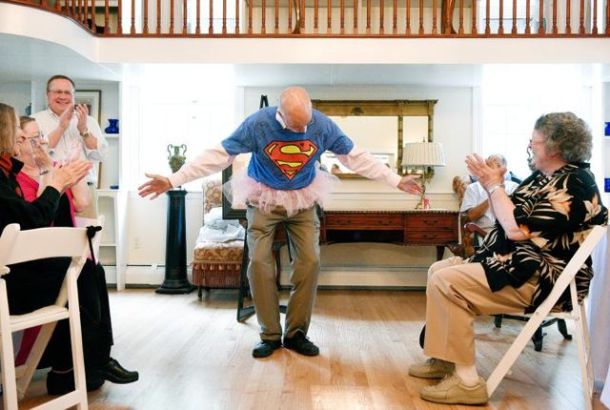
Take, for example, his pink tutu — two words that you’d be hard-pressed to find so closely associated with another medical professional of Conger’s caliber.
For the jocular 73-year-old, though, the pink tutu’s intermittent appearances somehow always made sense, whether Conger was marching in Hartland’s annual Independence Day parade or keeping things light in nearly 40 years as an internist at Mt. Ascutney Hospital and Health Center, where he was widely admired for his skills and beloved for his compassion.
“He’d do it to make people laugh,” said Rowena Stoughton, who received her primary care from Conger at the Windsor hospital for 36 years. “He’s more than a doctor. He’s a friend.”
That sentiment explains an outpouring of celebration and sadness surrounding Conger this month as he departs Mt. Ascutney and the Upper Valley, focusing his professional attention on a clinic targeting under-served populations in Burlington. He has been splitting his time between Mt. Ascutney and the clinic since 2009.
Behind him he leaves a long list of colleagues and patients, living and deceased, who came to recognize Conger as the face of the hospital and an icon in the community. He made house calls, he wrote books and regular newspaper columns, he spoke honestly and openly, and he was excited to see patients out and about in town — ready, if needed, to diagnose a mild ailment in the checkout line.
What’s more, they said, he was gifted in his ability to talk to his patients about death, and his humor stretched far beyond props like wigs and the tutu, wielding a dry wit and a quick-tongued response to most any situation.
A few longtime patients, including Hartland resident Pat Rosson, who’s seen Conger for three decades, said they plan to make the drives to Burlington to continue receiving his care.
“Someone could work in his office,” Rosson said Thursday during Conger’s packed goodbye party, where Conger broke out the tutu once more. “But no one could replace him.”
A Delayed Move to Burlington
It was San Francisco, 1977. Conger, a Harvard Medical School graduate whose first job was with the Center for Disease Control in Atlanta, had just spent the past five years establishing and directing the first federally funded neighborhood health center in the city, South of Market Health Center.
Conger’s wife, attorney Trine Bech , was a law school student at the time, and the couple wanted to move to Vermont for a change of pace and seasons. They decided he could work at a hospital and she could continue her studies, he said, in a “nice small town” like Burlington.
But when officials at the University of Vermont informed Bech that the law school she was looking for was located somewhere called South Royalton, the couple — after consulting a map — decided they could hang tight in the Upper Valley for two years and move to Burlington thereafter.
“It was a planned move,” Conger mused in an interview last week. “It just came 36 years later than we expected.”
Conger, who grew up in the suburbs of New York City, found work at a new private practice of physicians with an office inside Mt. Ascutney, a small community hospital less than a decade old. It was a time when internists did everything from regular consultations to emergency room work, and Conger thrived on the learning curve, such as when a farmer came in on one of Conger’s first shifts because the farmer’s cow had sat on him.
In all of his time at fancy medical institutions learning about the world’s diseases, “I can honestly say that ‘sat on by cow’ was not one of them,” Conger said during the goodbye party on Thursday, hosted by Mt. Ascutney at Hartland’s Sumner Mansion.
He compiled some of these tales into regular columns in the Valley News and three books, including It’s Not My Fault and It’s Probably Nothing. Perhaps his most recognized is Bag Balm and Duct Tape , taking its title from a farmer who sought care for an injury that could be treated with neither.
“Although the facts of the case and the events are all false, the stories are all true,” Conger said in the interview, “so that each one is related to something that may have happened, but then the rest of it was just my disordered imagination.”
While stories like the “sat on by cow” affliction stand out, Conger’s patients and colleagues say that it was his everyday interactions that set him apart.
“He had a gentle way about him. It’s almost like he feels for you, what you’re going through,” said Louise James, who said she and her late husband started seeing Conger, who lived near them in Hartland, “the day he moved here.”
“You’d walk into his office and he was always so friendly to greet you,” James said. “ ‘How are you,’ ‘what’s going on’ — he would always ask those questions, and he would listen. He would always give you the facts. There was nothing hidden with him.”
Adept at discussing difficult topics, Conger would nonetheless be telling jokes by the end of every visit, “kidding, laughing” and leaving James with a smile.
Betty French, Conger’s nurse of 25 years who retired a decade ago, said that’s how it was with Conger: He knew how to use his humor, which friends described as dry and honest.
“If he was a born Vermonter I could say he had a Vermont humor, but seeing he didn’t come from Vermont, I’d say he adapted well,” French said.
French and others described Conger as a dedicated doctor who worked long hours, never looking down at his watch to signal the end of a visit. Unlike today, when primary care doctors are more likely to refer patients out to specialists for various reasons, French said, Conger did most everything himself.
“He wore many hats and had very full days, and I think you’d find whoever worked for him in the emergency room or out in the hospital area, out on the floor, or as I said in the clinic, his patience and his dedication was certainly first and foremost,” French said. “It was for the good of who was there and what they needed to have done.”
Special and Unforgettable
Richard Slusky, former CEO of Mt. Ascutney who worked with Conger for nearly three decades, said he wasn’t always the easiest to get along with.
At the party, he remembered a time when Conger essentially sabotaged a meeting with a specialist whose business Slusky was courting by wearing a red wig and big glasses.
At various times, Conger served in a number of leadership positions at the hospital, including president of the hospital’s medical staff and medical director of the emergency department.
Over time, Slusky said, he learned to debate Conger on such issues as compensation, new technologies and clinical policies one-on-one instead of before other hospital staff.
“He’s very sure of himself, he’s a very bright guy, so it took me probably three or four years to learn that I probably wouldn’t win arguments with him in a group setting,” Slusky said in an interview before the party.
Despite some differences, Slusky said, he had a great respect for Conger, calling him special, unforgettable and “one of the best doctors that I’ve encountered.”
Slusky emphasized Conger’s ability to talk with patients about death, which Slusky said many doctors struggle to do.
Slusky recalled Conger making a presentation to some older patients once, telling them about the benefits of good eating, exercise, not smoking and the like. Then he asked how they would want to die, and they said “quick” — like going to bed, suffering a heart attack and never waking up.
Conger responded that if you’re exercising and doing all these healthy things, that’s probably not how you’ll die, and instead will probably experience a slower death from chronic illnesses, “so you may want to think about how much you want to do all this,” Slusky recalled.
When a group of physicians heard the story, they were horrified, Slusky said, but the patients who Conger was talking to got it.
“They just howled,” Slusky said. “They were laughing and got the humor. … If you don’t understand his humor and the way he perceives things, you kind of would be surprised that this would be coming from a physician or something. He’s very caring, compassionate and … an excellent physician.”
Wear Pink
Conger, who has racked up a number of medical awards in his career and worked as an adjunct associate professor at Dartmouth Medical School, took a hiatus from the Upper Valley from 2001 to 2006 to live and work in Philadelphia, including at the Drexel University College of Medicine and Temple University Hospital. At any time, about a quarter of the people he treated had HIV/AIDS, and few of his patients had any primary care outside the hospital.
“It was a microcosm of what happens in inner cities in this country, that primary care really doesn’t get established for a variety of reasons, not the least of which is that the patients who are struggling with basic survival issues kind of put health care down at the bottom of the pile,” Conger said.
It was a stark contrast from the tight-knit community around the Windsor area, where if somebody didn’t show up to a doctor’s appointment, “we called the police.”
Looking back on his time in Vermont, Conger said, what stands out for him is that he was so intertwined in the community he worked in. He and Bech raised two daughters and a son, and often Conger would find himself caring for one of their teachers or for the mechanic working on his car.
“One of the things about living where you practice,” Conger said, “is you don’t want to see interesting cases. … It was more a disappointment than an opportunity to demonstrate your medical skills.”
Indeed, Slusky said, Conger “made himself a part of the community.”
“He knew his patients well, not just as a patients but as people,” Slusky said.
“That’s harder to do today because you’ve got the technology and the electronic health records and you don’t have that intimate relationship with patients, and I think he really relished that, and people loved him for that.”
Conger said spending more of his time at the Burlington clinic, run by the Community Health Centers of Burlington, is an opportunity to return to his roots at the San Francisco clinic and the early days of Mt. Ascutney, when he said the hospital was smaller and had a different “connection … to the local community,” and when his job touched on a wider spectrum of medicine.
Conger said he wouldn’t interpret any of those feelings “primarily as a criticism,” saying that in today’s world of technological advancements, true community hospitals will continue only in the most rural locations, like Alaska or West Texas.
“It’s sort of an inevitable change of the stratification of medicine,” he said.
In Burlington, though, Conger performs a wide range of care for people who “you feel like they really need a good doctor to take care of them,” he said. They include refugees, homeless people, those without health insurance and those battling drug addiction. Support staff, including social workers and translators, help the process.
During his goodbye party, as he told the crowd about the “sat on by cow” incident, Conger said he told the farmer, “I’ve never fixed a broken wrist before,” and the farmer replied, “I never broke one before, neither.”
The farmer told Conger to “do your best,” and Conger struggled to put his arm in a cast, joking that it must have weighed 40 pounds. The farmer thanked him, and before he left, he told Conger, “don’t take it so serious.”
Conger said that’s what he’s appreciated most about his time at Mt. Ascutney — thanking his family, colleagues, patients and “all the people who have helped me not take myself so seriously.”
For younger doctors, he also had some advice.
“Nobody will ever take you seriously in a pink tutu,” Conger told them, to laughter. “I promise you.”
Maggie Cassidy can be reached at mcassidy@vnews.com or 603-727-3220.
