

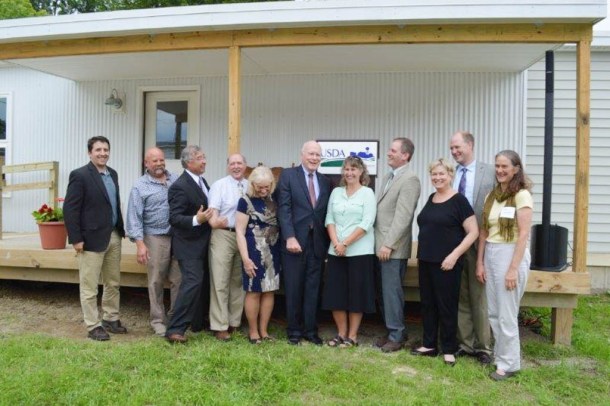
The program, operated by the U.S. Department of Agriculture’s Rural Development division, helps people buy modular homes worth more than $100,000 with no down payment, no closing costs and low interest over a long period of time.
VERMOD, based in Wilder, has been manufacturing the “net zero” one-story modular homes for about two years, according to owner Steve Davis. The company has installed about 20 of its 1,000-square-foot modular homes in mobile home parks across Vermont.
“We are a stick-built modular home company,” Davis said. “We happen to build one that looks like a mobile home to go into mobile home parks. The cost of running our home is virtually nothing in utility costs, and (traditional mobile homes) are very expensive.”
The Vermod homes have no carbon footprint and produce as much energy as they use, saving the average mobile homeowner between $300 and $400 per month, according to Davis. The company usually builds solar panels into the roof of the modular, but will build off-site solar if there is too much shade in the mobile home park, he said.
As part of the USDA program, the Champlain Housing Trust will loan up to $27,500 for downpayment assistance and closing costs to a modular home buyer, who would normally spend $131,000 on the whole transaction. That loan is interest-free and transfers to a new owner when the house is sold.
The USDA can then subsidize 30-year fixed rate mortgages at 3.25 percent. The mortgage term is twice the length of most mobile home mortgages, according to the Champlain Housing Trust, and the rate is competitive in today’s mortgage market. Further, very low-income Vermonters may qualify for a 1 percent interest rate under the program, according to the USDA.
“Often, the most accessible affordable housing option for a rural family is a manufactured home,” Tony Hernandez, the USDA Rural Housing Service Administrator, said in a news release.
“However, limited financing options, aging manufactured housing stock, and heating costs can make owning a manufactured home challenging,” Hernandez said. “Today’s new energy efficient manufactured and modular homes are a lower risk for lenders, a safe and affordable option for rural families, and are better for the environment.”
Becca Saour, a loan officer for Champlain Housing Trust, said the program will help low-income families because their monthly housing costs will be low.
“The longer term does mean that you’re paying more interest over time, but it does make the monthly payments more affordable,” she said.
Saour said the Champlain Housing Trust has made down payment loans to about 40 families since starting the program in late 2012. Many families prefer to have “their own four walls” as opposed to living in an apartment, and some buy the one-story modular homes to put on their own property.
A housing needs assessment from February shows there are 7,162 mobile homes in Vermont, and 352 vacant lots in mobile home parks. The mobile home vacancy rate is around 5 percent, the study says, which means the rate is several times higher than the roughly 1 percent vacancy rate on traditional apartment units.
Monthly rent on a mobile home unit is usually between $600 and $975, but fees at a park are closer to the $250 to $350 range, according to the housing needs study. Vermont has passed laws that encourage residents to either own the parks through a cooperative or allow a nonprofit affordable housing agency to take over the parks.
Jen Hollar, deputy commissioner of the Department of Housing and Community Development, said mobile homes are “an important part of affordable housing in Vermont” because they help people achieve home ownership instead of renting.
“They have their own four walls,” Hollar said. “They own it whether it’s on privately owned land or if it’s in a mobile home park. … It’s also really exciting because energy efficiency in homes is something that all Vermonters value, but it can be more challenging for lower income folks to access that,” she said.
Fifteen percent of homes destroyed during Tropical Storm Irene in 2011 were mobile homes, despite being just 7 percent of the housing market in Vermont, Hollar said. Currently, there are about 245 mobile home parks in Vermont, she said, and 45 are owned by nonprofit organizations that dedicate the sites to affordable housing. Another handful are owned by residents themselves.
“Living in an energy efficient home or one with healthy air quality should not primarily be an affordability issue,” Sen. Patrick Leahy, D-Vt., said at a news conference in Shelburne on Tuesday,
“The USDA Energy Efficient Manufactured Home Pilot Program is one way in which our state can help support middle-class homeowners who still need relief, and working families who dream of affording and owning their own homes,” Leahy said.
