

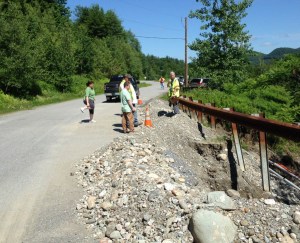
Gov. Peter Shumlin has 10 days to decide whether to make a request for federal disaster aid to repair damage caused by floods that tore through Chittenden, Franklin and Addison counties this month.
Shumlin’s decision hinges on the results of a preliminary damage assessment being conducted jointly by the Vermont Division of Emergency Management and Homeland Security (DEMHS) and the Federal Emergency Management Agency (FEMA), FEMA public affairs officer Donald Jacks said Monday.
Jacks said that FEMA and DEMHS sent two teams of analysts to Chittenden County and one to cover Franklin and Addison.
“The damage is sporadic, but where there was damage it was very severe,” he said. “We saw four different instances last week where flooding had come up over the roads. It washed up a bridge in one case – in another, on Otter Creek, which flows to Vergennes, at a bend in the river it had just taken out a huge section of the bank and the road.”
If Vermont receives federal disaster aid, Jacks said, the federal government will cover 75 percent of the cost of repairs. The remaining 25 percent will be split between the state and local governments. Though some temporary bridges have been set up in particularly damaged sections of road, Jacks said that the affected counties are waiting to see whether the state will receive aid before beginning their repair work in earnest.
To qualify, most states need to meet a minimum indicator threshold of $1.41 in damage per capita statewide, or $3.56 per capita within a given county, DEMHS Recovery and Mitigation Section Chief Ben Rose said. Due to its relatively low population size, however, Vermont has a modified minimum threshold of $1 million in damage. Though he won’t be sure until state emergency management officials and FEMA conclude their assessments Tuesday or Wednesday, Rose predicted that the damage caused by the floods would likely exceed the $1 million minimum threshold for Vermont, making the state eligible for disaster relief.
Just because the state is eligible for federal aid, however, doesn’t necessarily mean that the federal government will offer it, or that Shumlin will request it, Rose said. He said the minimum thresholds function more as general guidelines than as strict determinants.
In 2011, President Barack Obama approved a request for millions of dollars in aid to Vermont after a spring storm damaged the state’s roads and bridges – even though FEMA appraised the damage at only $794,000.
Conversely, when Shumlin requested aid from FEMA following storms and severe flooding in 2014, the request was denied even though FEMA’s preliminary damage assessment valued the damage at over the $1 million threshold.
Ultimately, Rose said, it comes down to whether the state or county is able to make the necessary repairs without federal aid. FEMA provides damage assessments, makes determinations regarding the state minimum thresholds and advises the president, but the president has the final say, Rose said.
There’s no surefire way to determine whether a federal disaster declaration request will be approved, so repeatedly requesting aid places the state’s credibility with FEMA and the federal government at risk, Rose said. Like the boy who cried wolf, governors who repeatedly and indiscriminately request aid may have trouble receiving it when they actually need it.
Rose said FEMA already views requests from Vermont with a critical eye, because the state’s unusually low minimum threshold makes it easier to obtain funding than in states with higher thresholds. Shumlin has to carefully consider whether Vermont actually needs to request federal disaster relief, and how such a request will reflect on the state, he said.
“It’s as much of an art as a science,” Rose said.
