

[C]ivil rights advocates across Vermont cheered Friday’s landmark decision from the U.S. Supreme Court that allows same-sex couples across the country to legally marry.
Fourteen same-sex couples brought the case, Obergefell v. Hodges, against the Ohio Department of Health. The case made its way to the U.S. Supreme Court, and judges ruled 5-4 on Friday that marriage is a constitutional right for same-sex and opposite-sex couples.
The decision held that the 14th Amendment to the U.S. Constitution “requires a state to license a marriage between to people of the same sex” and that the couples who brought the case “far from seeking to demean marriage, seek it for themselves because of their respect” for opposite-sex marriages.
Writing for the majority, Justice Anthony Kennedy described how the decision follows historical changes in marriage law, such as societal movement from arranged to voluntary marriages, and the elimination of marriages in which men legally dominated women.
Kennedy wrote that as recently as 1986 the high court ruled that Georgia could criminalize same-sex intimacy, before overturning it in 2003. Meanwhile, Vermont leaders were quick to point out that state courts had been making landmark strides toward gay, lesbian, and bisexual equality since 1993.
Vermont at the forefront
News of the same-sex marriage decision was welcomed in Vermont, which in 2000 was the first state to create an institution similar to same-sex marriage, with an invented legal term called “civil unions.”
The Vermont Supreme Court had decided unanimously in 1999 in the case Baker v. Vermont that the Legislature either needed to legalize same-sex marriage or start a new legal institution very similar to marriage to serve same-sex couples.
“We hold that the State is constitutionally required to extend to same-sex couples the common benefits and protections that flow from marriage under Vermont law,” then Chief Justice Jeff Amestoy wrote in the unanimous opinion.
“Whether this ultimately takes the form of inclusion within the marriage laws themselves or a parallel ‘domestic partnership’ system or some equivalent … alternative, rests with the Legislature,” the decision said. “Whatever system is chosen, however, must conform with the constitutional imperative to afford all Vermonters the common benefit, protection, and security of the law.”
The Vermont Supreme Court previously ruled in favor of allowing gay and lesbian couples to adopt children in 1993. The Legislature came close to overriding that decision in 1995, but in 1996 it passed legislation confirming the right for same-sex couples to adopt.
“It was a big deal back then, and it was a lot more difficult climate than it is now,” said Susan Murray, who was one of the lawyers for the plaintiffs in Baker v. Vermont. Murray had been working with gay and lesbian couples since 1989 to write wills and legal documents.
“We took a chink out of the wall, and Massachusetts took a bigger chink out of it, and the Supreme Court ruled against the Defense of Marriage Act in 2013,” Murray said Friday. “This is the final sledgehammer blow to the wall.”
In 1995, she, Beth Robinson, who is now an associate justice on the Vermont Supreme Court, and Mary Bonauto started work on the case. After doing years of grassroots advocacy, they brought three couples together who wanted to be married and were willing to serve as plaintiffs. Murray said marriage was the only way to give those couples equal legal rights in wills and adoptions.
“If you look at polls today, 70 percent of Americans support gay marriage,” Murray said. “Back in 1995 when we started working on this, the polls were reversed at best, and a lot of people hadn’t heard of the term ‘gay marriage.’ It was a foreign concept.
“The larger community in Vermont became more comfortable with the reality that their friends and their neighbors were also gay and were severely suffering from a lack of legal protection because they couldn’t get married,” she said.
Stan Baker and Peter Harrigan were one of those three couples.
“I had tears in my eyes this morning,” Baker said Friday. “I only read the last paragraph, but I think it’s going to be a very historical document.”
“We achieved full marriage equality here but I have friends who lived in other states that were struggling with the issue,” Harrigan said. “I think it’ll be 18 years next month since our lawsuit was first filed. In some respects it’s gone very quickly, and in other respects it’s gone very slowly.”
Amestoy said Friday the state should be proud of its role in the debate.
“It raised a fundamental issue about the right to marrying, a fundamental issue of dignity of those to enter into marriage,” Amestoy said. “Certainly the court had an understanding that the opinion would be critical in addressing the issue, and I think it helped frame that issue more broadly for the rest of the country.
“It was a decision that was going to have an impact on the public debate, the political debate, and the legal debate as the issue became more broadly discussed in the rest of the country,” he said. “I think Vermonters should be proud that the state’s response to the issue. From that standpoint, it’s a good day to be a Vermonter I guess.”
The civil unions law went into effect July 1, 2000, and quickly sprouted a “Take Back Vermont” campaign against it. In 2000 and 2002, several state lawmakers lost their seats in the Legislature because of their votes in favor of civil unions two years earlier. One of them was Marion Milne, a Republican who served the Orange County town of Washington.
Political fallout
Marion Milne, who died in August, had been filmed as a part of a recent documentary “The State of Marriage.” Milne repeated her speech from 2000, on her 40th wedding anniversary, when she said she was willing to give up her political career for her ‘yes’ vote on civil unions.

“I cast this vote because it is the right thing to do,” she said. “I will not be silenced by hatred and intolerance, and if I am measured by this one vote in my entire public life, I will have served the best interest of the people of Vermont by casting it.”
Scott Milne, a 2014 gubernatorial candidate, is Marion Milne’s son. “She wasn’t doing it to be on the right side of history,” Milne said of his mother. “It wasn’t political posturing. It was just looking at the act and doing what’s right. There are a lot of people in Vermont who did that in 2000.”
As the chair of the House Judiciary Committee in 2000, Rep. Tom Little, a Shelburne Republican, had helped craft the civil union law and the term itself. Lawmakers derived it from a term in French after a gay man told lawmakers that “domestic partnership” sounded degrading.
“He said that term made him feel like he was being hired to clean house, and that really kind of struck me and other members of the committee,” Little said. “It resonated, and we responded to that.
“It seemed to make the gay and lesbian activists reasonably happy that we weren’t calling it a domestic partnership,” Little said Friday. “They really wanted us to pass a marriage bill, but there weren’t even close to enough votes on the floor of the House to do that.”
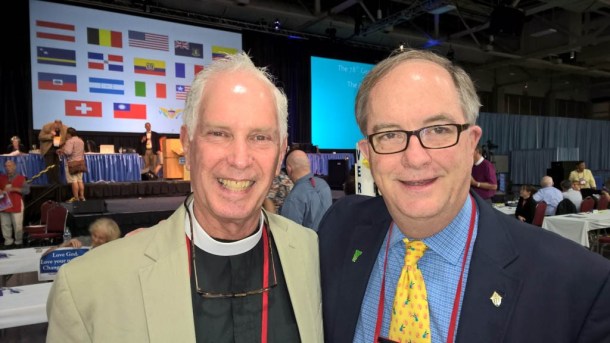
Little was re-elected in 2000 after fending off a Republican challenger, and returned to his law firm in 2002. Friday, he celebrated the decision at a convention of the Episcopal Church in Utah, which Stan Baker was also attending.
Vermont leaders, activists celebrate victory
In 2009, Vermont was the first state to legalize same-sex marriage through the Legislature, without a requirement from a judge. The Democratically controlled Legislature then overrode a veto by Republican Gov. Jim Douglas.
Massachusetts had been the first state to provide same-sex marriage through the state’s judicial process, in 2004. When the U.S. Supreme Court ruled Friday, same-sex marriage had quietly become law in 36 states.
House Speaker Shap Smith, D-Morristown, released a statement on Friday’s decision reflecting on the 2009 vote.
“One of my proudest moments as House Speaker was standing at the podium when the House passed marriage equality,” Smith said. “Few who sat through those debates would have foreseen today’s Supreme Court ruling legalizing marriage equality for all Americans. I am tremendously happy for all those who will now have equal rights to marriage under the law.”
Gov. Peter Shumlin said all couple “have much to celebrate” after the ruling.
“Today’s Supreme Court ruling is a rejection of fear, and instead an affirmation of hope and equal rights for all,” Shumlin said in a statement. “The Court has closed the door on a terrible injustice by ensuring that the right to marry can no longer be denied to any gay couple simply because of where they call home.”
Rep. Peter Welch, D-Vt., added: “To have the leadership that Vermont provided on a basic civil right now be affirmed by the U.S. Supreme Court is extraordinary. As a Vermonter I’m extremely proud. As an American I’m very happy.”
Vermont Freedom to Marry, one of the advocacy groups pushing for marriage equality in 2009, applauded Friday’s decision. The Pride Center in Burlington had been checking U.S. Supreme Court decisions routinely and wasted no time setting up a formal celebration.
Allen Gilbert, executive director of the American Civil Liberties Union of Vermont, issued a statement thanking “the heroes and heroines in this fight” for moving steps marriage equality.
“Gay and lesbian couples simply wanted to love one another and have their long-term loving relationship recognized for what it is — marriage,” Gilbert said. “Vermont should take great pride in its contribution to making this happen.”
Justice Anthony Kennedy wrote the following in the final paragraph of Friday’s decision. Justices Ruth Bader Ginsburg, Sonia Sotomayor, Stephen Breyer and Elena Kagan joined him in the majority. Chief Justice John Roberts and Justices Samuel Alito, Clarence Thomas and Antonin Scalia dissented.
“Nothing is more profound than marriage, for it embodies the highest ideals of love, fidelity, devotion, sacrifice, and family,” Kennedy wrote. “In forming a marital union, two people become something greater than once they were. As some of the petitioners in these cases demonstrate, marriage embodies a love that may endure even past death.
“It would misunderstand these men and women to say they disrespect the idea of marriage,” the decision said. “Their plea is that they do respect it, respect it so deeply that they seek to find its fulfillment for themselves. Their hope is not to be condemned to live in loneliness, excluded from one of civilization’s oldest institutions. They ask for equal dignity in the eyes of the law. The Constitution grants them that right.”
Roberts, in his dissent, said the definition of marriage should have been left to the states to decide.
“Supporters of same-sex marriage have achieved considerable success persuading their fellow citizens — through the democratic process — to adopt their view,” Roberts wrote. “That ends today. Five lawyers have closed the debate and enacted their own vision of marriage as a matter of constitutional law. Stealing this issue from the people will for many cast a cloud over same-sex marriage, making a dramatic social change that much more difficult to accept.”
VTDigger’s Sarah Olsen contributed to this report.
