[P]ine Street may get a facelift. City planners have their eye on a revamp of the 600-acre neighborhood in Burlington known as the South End, which includes residential neighborhoods with largely single-family homes, a few commercial stretches, and the antique industrial buildings that have long served as artists lofts and craftspersons studios.
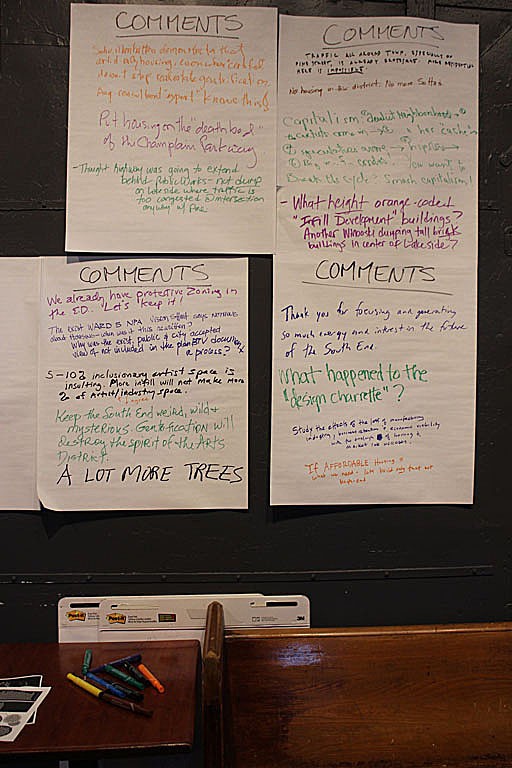
But the proposal, which could include residential towers on currently fallow plots of land, live-work studio housing geared towards artists and “makers,” and new multi-purpose retail-cum-industrial buildings, wasn’t enthusiastically embraced by local residents at a hearing on Wednesday.
Burlington city planners revealed their vision for “PlanBTV South End” this week, and defined the neighborhood as the area which is bounded by Maple Street to the north, Queen City Park Road to the south (where Red Rocks Park and Burton are located), Lake Champlain to the west, and Shelburne Road, which turns into South Union Street, to the east. The community makes up 15 percent of Burlington’s population, planners said.
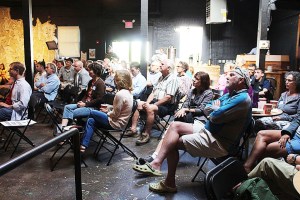
Two public meetings were held Tuesday night and Wednesday morning at ArtsRiot, a community art gallery on Pine Street.

Artist Teresa Davis was skeptical about plans for live-work space development along Pine Street.
“What you describe sounds like a great place to live when you’re right out of college,” Davis said. “To live by yourself. But I don’t think that’s realistic for the artists that are here.”
Davis operates a studio that teaches group art classes on Howard Street. She said the city’s effort to ensure studios would be built catering to the artists that lived in – or wished to move to – the area for its robust art scene seemed misguided, especially if the housing didn’t accommodate artists with families or established business.
“Are you getting that feedback from artists? I just am curious where that concept is coming from, because if we’re being displaced from our studios but being encouraged to move into a live-work space, I think that means the artists that currently exist here don’t have a spot,” she said.

A 100-page glossy brochure was available to attendees at the presentations, and more than 200 people came to listen to the two presentations, according to local press reports. The plan will soon be printed, and available for a fee, but wasn’t yet on hand for distribution. (A link is provided below the story.)
While the site plan area is called the PlanBTV: South End – in a logo on the city’s website features graffiti-esque scrawl and gears moving in the background – the plan actually zeroes in on a thin corridor in the center of a 225-acre Enterprise Zone (Fig. 1).
The area is currently zoned for industrial and manufacturing uses only – and is situated along the bustling Pine Street corridor. In the plan, housing would be located in three areas, shown in yellow in Fig. 2, deemed as underutilized portions of the industrial district.
Five areas in the South End were highlighted (shown in blue) as possible areas for housing development outside the Enterprise Zone.
The city’s planning team, which includes Boston design firm Goody Clancy, told Davis that recent surveys of residents showed support for live-work housing in the district.

Davis said artists in the area don’t want rents to go up. The enterprise zone, she said, “protects the makers’ spaces.”
David White, Burlington’s director of planning and zoning, said the idea was to preserve both the arts and business while also creating housing. “That’s the goal,” White said. “Artists and workers, living and working together. The fundamental objective is to maintain this area of our city as a cultural and industrial corridor.”
Amy Kohn, a lead designer for the Boston firm that produced the plan, echoed that as she showed the firm’s renderings. “Preservation and retention is a priority of this plan,” she said.
Still, comments regarding the live-work space and new housing in the “Maker’hood,” as it’s been branded by the company, promised housing of a different stripe, designed for all sorts of “makers.”
“That could be maker enterprises from making websites to making chocolates,” said Kohn.
When asked afterwards where the call for more housing came from, White said some of the larger local businesses had been very outspoken about the need for housing nearby.
In fact, the plan was partially funded by contributions from Burton Snowboards and Dealer.com, according to the documents, which together employ about 20 percent of the population of employees in the South End (about 1,200 people.) The plan was also sponsored by several grants, donations from local planning and housing groups, the AARP, and governmental bodies, but White said no single group had particular sway.
“Both Dealer and Burton provided some funding to help support the project, but they made no requests or had any unique influence over the recommendations,” he said.
In an email, White said, “like many other companies in the city and region, they will often tell you that the shortage of available and affordable housing is a major factor in their ability to grow and thrive (and for many other companies to locate here in the first place).”
Planners say the enterprise area alone comprises half of Burlington’s industrial and office space – or 2.6 million square feet – and the goal of the planning process is to boost economic development.
As designed, the Maker’hood could flourish, and serve the needs of the community by meeting the demand for more housing, especially for local workers, White said. Meanwhile, it could also respond to the need for diversified commercial spaces and mixed-use developments, he said.
“Gentrification is already happening in this very neighborhood,” White said. “Rents are being pushed upward by the types of development that we’ve seen and the types of land uses that we’ve seen evolve over the last 10 years, and that’s affecting artists and that’s affecting small businesses as these properties are becoming increasingly expensive to rent.”
The city hopes to help develop “protective mechanisms” for the art spaces, while stimulating economic growth with new buildings and property-owner incentives.
The South End, largely defined by its former role as an industrial hub in the 19th century, encompasses the homes of 6,400 residents and 472 businesses that employ about 6,300 workers, according to plan documents.
This iteration of PlanBTV is the second in a series of neighborhood planning initatives being undertaken by the City of Burlington, and follows a 2010 study and final plan adoption in 2013 for the city’s downtown and the waterfront.
The plan names areas and lots prime for housing and “infill” development – including a map highlighting in yellow which spots should be rezoned for residential use. One is a massive, former industrial area on Lakeside Avenue, near the future extension of I-89.
“The key element regarding housing, however, is to try to use it as a tool to help get the type of development we want in this area, and to ensure that there are affordable housing units and workspaces for the long term,” White said.
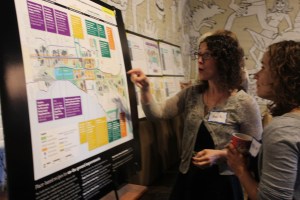
Thirteen pages of the plan are devoted to photos of community events and survey results gathered over the past nine months as evidence of the involvement of locals in guiding the plan.
Yet some local residents said the process ran, if not counter to, at least parallel to existing city initiatives, like the Neighborhood Planning Assembly of Ward 5, as well as an organic grassroots effort led by artists that culminated in a May summit that addressed housing and affordability in the neighborhood, that they did with the help of Champlain Housing Trust.
“There are different groups in the city right now, really we have overlapping concerns,”said Ibnar Avilix, a Web developer who works in a building on Howard Street. “It’s got so many layers, and it’s very complicated.”
Additionally Champlain Housing Trust, an affordable housing agency that helped fund the plan, warned that an approach to housing that included residential units along the main corridor of Pine Street could, as artists suggested, drive rents too high for existing tenants, or any small commercial operations, and also possibly create a residential friction that would drive businesses away.
“There’s two cautions: One is that (housing is) more valuable, and therefore, then people like artists and commercial uses could be displaced, and secondly, there’s an impact on the commercial and industrial uses if housing is too close and gets in the way. That’s happened quite often in the South End, actually, that’s not an unusual thing,” said Michael Monte, chief financial and operating officer of Champlain Housing Trust.
He mentioned a case of neighbors complaining about sounds emanating from Rhino Foods’ refrigeration units, on Industrial Parkway, running all night long, despite the fact that the machines needed to be on in order to preserve ice cream.
“To throw housing on areas that are at this point industrial and commercial uses could in fact jeopardize the current affordability and nature of the South End, Pine Street in particular,” he warned. “Housing is just more valuable.”
After the meeting, as she talked to neighbors, Teresa Davis said she wasn’t against new development, just that she felt that her voice was being pushed aside.
“I’m not not open-minded. I just feel like there’s this housing agenda that keeps getting pushed through. And we keep giving our feedback. And they keep saying, ‘Housing,'” Davis said.
Residents can submit comments on PlanBTV at the planBTV South End website.