

[G]ov. Peter Shumlin is Vermont’s chief executive until January 2017, and a lot can change in that time, but critics and supporters alike say abandoning single payer and the state’s ailing health insurance exchange will likely cast a shadow on his legacy.
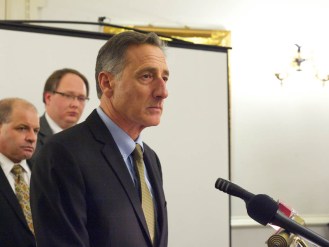
Shumlin touts Vermont Health Connect and the Affordable Care Act’s role in cutting the state’s uninsured population in half, but has also said building the website has been his most “frustrating” experience as governor.
Lt. Gov. Phil Scott, a Republican considering a run for Shumlin’s seat, said that a lot could change before Shumlin leaves office, but the lack of a well-performing exchange more than a year-and-a-half after its launch is a major blemish on his time in office.
There are signs that the exchange is improving, though it’s too soon to tell what impact new technology released last week will have, and up to this point no one is contending that Vermont did well implementing the Affordable Care Act. Its struggles have gained national attention.
The governor said Monday that a publicly financed health care program was the “exception” to the “ambitious goals” he set for himself. In December, Shumlin said that not proceeding with a single payer health care program was the “biggest disappointment” of his career in public service.
“What I learned the hard way was that, I always said you can’t support any health care system in Vermont or America if we keep spending the way we are,” Shumlin said. Bringing costs under control is the only way the state could pay for its health care system with taxes, he added.
The focus of his administration has turned to controlling those costs, an area where he said there has been much progress. That work will continue in the next 18 months, and he said he believes “we’re going to be able to transform the way we pay for health care” in that time.
Bob Stannard, a longtime lobbyist and former Democratic lawmaker, said Shumlin tried on many fronts to accomplish the “spectacular,” and though the record will show he had much success, “they didn’t all work out the way he expected” — most notably when it came to single payer.
“I think it left a heavy wound,” Stannard said.
James Haslam of the Vermont Workers Center said he wasn’t surprised to hear the governor’s announcement because “we thought his career was pretty much done” after he abandoned single payer in December.
The group had been a major thorn in the governor’s side all year, disrupting proceedings the day of his inaugural address and delivering him a plate of toast, with the message that his career would be the same if he gave up on single payer. Haslam said Monday that universal health care remains a priority for the Workers Center, but they were always skeptical whether it was for Shumlin.
“He was someone that liked to tell people what he thought they wanted to hear, but we never really trusted him,” Haslam said, adding that Shumlin was “just trying to capture the energy” that existed around a universal health care system.
As a businessman, and “one of the wealthiest people in the state, it’s not surprising that the political decisions that he made were often benefitting the wealthiest in our community,” Haslam said of the governor. His administration developed proposals for universal health care that “would benefit 95 percent of Vermonters, but it was just that you would have had to raise taxes on the wealthy to pay for it.”
In a VTDigger analysis of documents the administration released following Shumlin’s December single payer announcement, it appeared to experts that the governor painted a publicly financed system in a negative light.
Deb Richter, a physician in addiction medicine and a longtime single payer advocate, said she doesn’t believe Shumlin was deceptive when it came to the feasibility of a universal health care program.
“He didn’t do what he promised, you know, that’s a fact not an opinion, but I still think there’s a way forward that fulfills part of that promise,” Richter said. “The governor could have handed this over to the Legislature and said now the ball’s in your court.”
A weak economy was ultimately the deciding factor, she said, pointing to lawmakers’ resistance to investing in health care this year. Proposals from lawmakers shrunk from more than $50 million to just over $3 million in the five months of the legislative session.
There are bright spots in Shumlin’s legacy on health care that are overlooked as well, Richter said, specifically the creation of the Green Mountain Care Board. The regulatory body has curtailed the unnecessary build-out of the health care system, and reduced the growth in hospital expenditures, she said.
As for the future of single payer, Richter said it’s still critical to control health care costs. She would like to see the governor use his last term to move in that direction. Shifting the entire health care system to single payer may be “too big a bite,” but Richter said she would like to see the state finance primary care with taxes as a first step.
