


Valley News photo/Sarah Priestap
Two environmental groups are trying to block a 1.15 million-square-foot development off Exit 4 on Interstate 89 in Randolph.
Conservation Law Foundation and Vermont Natural Resources Council officials say the proposed Green Mountain Center development will destroy prime agricultural land and mar the rural character of Randolph, a small town in Central Vermont with about 5,000 residents.
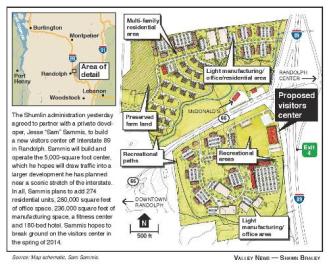
The development, proposed by Greenwich, Connecticut, developer Jesse “Sam” Sammis, would occupy an area roughly the size of 17 football fields on 173 acres, and would include housing, office space, light manufacturing, a fitness center, retail space and a hotel and conference center. The project would be constructed over a 20-year period. A late-evening call to Sammis for comment was not immediately returned.
The Green Mountain Center could draw 500,000 visitors a year, state officials have said.
A $15 million rest area, which would be central to the project, has been publicly endorsed by the Shumlin administration. Sammis also proposes to build a Vermont Products Showcase Center adjacent to the rest area.
Sammis told the Herald of Randolph that the public-private rest area project would not be built unless the Green Mountain Center project is approved in its entirety.
The proposed development is the largest of its kind since Tafts Corners, a large box store, retail and housing development complex was proposed in Williston in the 1980s. Environmental groups fought the project, near I-89 Exit 12, and succeeded in delaying it for years, but the commercial center was eventually built on farmland.
The Conservation Law Foundation and the Vermont Natural Resources Council are seeking party status in the Act 250 development review process. The two organizations say the case “is an important test” for the ability of Act 250 to protect valuable farmland.
Sandy Levine, an attorney with the Conservation Law Foundation, says the Randolph project is a massive development in a fairly undeveloped interchange on very valuable farmland.
“If Act 250 allows development of this scale on 200 acres outside of town on valuable farmland, then farmland isn’t protected anywhere in the state,” Levine said. “It doesn’t make sense to have commercial development by highway interchanges. We have state policies encouraging development in downtowns. Putting massive developments like this in farmfields on the edge of town moves Vermont in the wrong direction.”
Levine says Sammis is looking to use a new loophole in Act 250 that was passed by the Legislature last year. “Off-site mitigation” allows more development of farmland in exchange for paying money into a fund to protect farmland in other areas. The development must be clustered and minimize environmental impacts. The Sammis project does neither, Levine says.
Brian Shupe, executive director of VNRC, said the project could undermine the economic vitality of downtown Randolph. “With all the success Vermont has had bolstering our local food system, dropping a new Taft Corners on good agricultural land in rural central Vermont just doesn’t make sense,” Shupe said.
CLF and VNRC submitted the filings with the District #3 Environmental Commission, the regional board that reviews Act 250 applications for northern Windsor and Orange counties, last week. The commission held a public hearing on the project on Friday. About 60 people attended. The next hearing will be held in July.
The Preservation Trust of Vermont and a number of local residents also oppose the Green Mountain Center development.
Vermont Technical College, Gifford Medical Center, GW Plastics, Lake Sunapee Bank and several local businesses support the project.
The commission is undergoing a partial review of the project and will determine whether Green Mountain Center meets two Act 250 criteria, including what impact the development will have on primary agricultural soils and whether the project conforms with local and regional plans. The town of Randolph has already approved the development.
Sammis has owned property in Randolph since the early 1970s, notably the Three Stallion Inn, and has developed 10 acre to 100 acre house lots on 1,300 acres surrounding the inn. The development, Green Mountain Stock Farm, features hiking, a fitness center, golf, a swimming pool and a tennis court.
Sammis founded New England Land Company, Ltd., in Greenwich in 1971. His company has developed a 750,000-square-foot mixed use complex at The Center at Greenwich.
