

[T]he drowning death of a 12-year-old boy has spurred legislation that would allow private landowners to post warning signs about the dangers associated with swimming holes.
Bentley Seifer, of Burlington, drowned at the Bolton Potholes, a popular swimming hole, in July 2011. He was the great-grandson of Gov. Deane Davis, according to a WCAX news report.
Following Seifer’s death, a group of state representatives and concerned residents sought to find ways to prevent similar drownings at Vermont’s popular, but sometimes deadly, swimming holes.
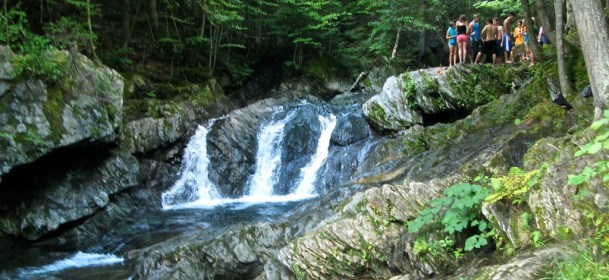
The Bolton swimming hole is surrounded by steep rocky ledges and has been the site of five deaths since 1985. Other swimming holes have proven even more deadly: The Huntington Gorge is the site of 15 deaths over the same period, according to the Vermont Department of Health. One of those deaths was of a rescue worker.
A swimming hole safety alert from the department shows that people have drowned at six Vermont swimming holes since 1985. Drownings have also occurred at Cobb Brook in Jamaica (12 deaths), Dog’s Head Falls in Johnson, Twin Falls in Saxtons River, Westminster Hamilton Falls, and New Haven River in Bristol.
 H.330 would allow landowners to post signs warning of swimming hole dangers, and protect them from liability associated with the signs about possible hazards. About 20 swimming holes in Vermont are on private land.
Vermont has a long cultural tradition of public access to private property for all manner of recreational activities, which are spelled out in state law, from inline skating to skiing, fishing, hunting, and even gleaning. Under the law, landowners are not held liable if someone on their property is injured or dies.
But a sign warning of the risks associated with swimming holes could, under current law, open landowners to liability associated with a death or injury, according to Erik FitzPatrick, an attorney with the Office of Legislative Counsel.
A person could claim a sign was not put in a place they could see it, for example, or could go after a landowner because of wording on the sign, or find some way to sue them based on the warning sign, he said.
H.330, sponsored by Rep. Tom Stevens, D-Waterbury, would amend current state statutes that protect landowners from being sued when someone uses their property for recreational purposes.
“No one wants to see anyone lost,” Stevens told the House Judiciary Committee. “We can’t legislate against people having fun or trying to cool off, but can we find a way to educate people as they cross their land to these sites that there is a danger to what they are trying to do?”
Stevens said it is very late in the session to expect a vote on the bill, and he thanked the Judiciary Committee for taking testimony on the bill.
Swimming holes on state-owned land are already posted with signs that alert people to the dangers, according to Michael Snyder, commissioner of the Department of Forests, Parks and Recreation.
On state lands, Snyder said, “We try to make hazards known.”
“Naturally we support this, we want you to encourage people to get outside despite the dangers, but we want people to know what those dangers are,” testified Snyder.
At the Huntington Gorge an historic marker installed by the state lists several dozen deaths from the 1950s through the 1990s.
Mark Kotler, an attorney with Darby Thorndike Kotler & Nordle, who is part of the ad hoc safety group, believes the sign has been a deterrent because the number of drownings in Huntington have gone down markedly.
Ken Schatz, commissioner of the Department for Children and Families, a friend of the Seifer family, also testified.
Schatz said the bill “is not a panacea.”
“It’s not going to solve everything, but it may make people think twice, especially young people,” he said.
The swimming hole safety group includes representatives from the Vermont Health Department, the Department for Children and Families, and the Department of Forests, Parks and Recreation, the Vermont River Conservancy, Place Creative Company, the Agency of Natural Resources, the Department of Environmental Conservation, and several individuals.
