


[P]ersonal income tax receipts for the month of April were the highest ever, according to the Vermont Agency of Administration.
General fund revenue came in 7 percent above projection for a total of $219.1 million collected in April, which is the most important month for the state budget because of the deadline for filing income taxes. The state collected $160 million in personal income taxes last month, about $10 million more than projected. The state anticipates $35 million in personal income in May and $67 million in June, according to the Joint Fiscal Office.
With two months left in the fiscal year, Vermont is $26.5 million (2.28 percent) above target, according to state figures.
But the good news has been tempered by estimates that show larger deficits in fiscal year 2017. And there is no guarantee that May and June tax receipts will be on target.
Gov. Peter Shumlin and lawmakers have indicated that any surplus at the end of the year will be held in reserve.
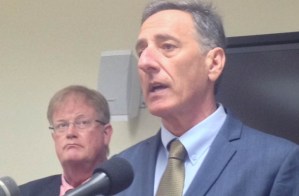
Shumlin told reporters at his weekly news conference that revenues have been volatile and if the state should have money left over it should be used to “build our reserves, recognizing that 5 percent in reserves are not adequate.”
“Any increase in revenue is good news for us, but we do have a fundamental problem we need to fix, which is that we’re still spending faster than revenue is growing,” Shumlin said.
A number of factors will have an impact on the state’s revenue over the next two months, including anticipated corporate refunds, and fluctuating sales and rooms and meals taxes.
Nevertheless, Justin Johnson, secretary of the Agency of Administration, said he is “pretty confident” the state will finish the fiscal year at or above target.
“It really shows that the economy, although it’s not growing at breakneck pace, it is growing,” Johnson said.
More pain ahead
Lawmakers are relieved that tax receipts are going in the right direction, but the positive revenue report is unlikely to change the complexion of budget and tax bills now in play.
“It lowers my blood pressure,” Rep. Mitzi Johnson, D-South Hero, chair of the House Appropriations Committee, said Tuesday of the revenue report. But she says, “all of us have shifted our thinking enough to a multiyear process, and we know ’17 and ’18 are going to be rough.”
Lawmakers are not banking on high April revenues as a way to soften budget cuts ($53 million) or lower the amount needed in new revenues ($35 million). As it is, the cuts and revenues won’t be enough to fill the $113 million budget gap; the state will need to use $24 million in one-time revenues to make up the difference.
While Shumlin and lawmakers don’t yet agree on budget and tax proposals, (the governor wants at least $8 million in more cuts) they are singing in unison on one refrain: Any surplus must be set aside in a reserve.
But as the governor and lawmakers work out their differences on resolving the fiscal 2016 budget hole over the coming days, a dark picture of next year’s budget is beginning to emerge.
Steve Klein, director of the Joint Fiscal Office, warned the House Appropriations Committee on Wednesday that the state has a “known problem” that amounts to $45 million to $50 million in fiscal year 2017.
Meanwhile, according to JFO, the state has been over-budget in Medicaid expenditures for months. With two months left in the fiscal year, Klein says that the high Medicaid expenses this year could have implications for the fiscal year 2016 budget that have yet to be addressed.
“It’s definitely at the level where it creates some anxiety,” Klein said.
The most recent weekly report on Medicaid expenditures shows that Vermont is set to spend $15.6 million to $20 million more than was appropriated for FY 2015 by the end of the fiscal year, which is June 30. Medicaid costs are paid for by a combination of state and federal money. The Medicaid cost overruns could leave the state with a general fund hole of between $7 million and $9 million in fiscal year 2016.
State spending on the low-income health care program, Klein says, is also a “cloud on the horizon” for fiscal year 2017 that could push the general fund gap to $60 million.
In addition, the U.S. Senate just passed cuts to federal spending on food stamps and other programs. Details of what reductions may be coming down the pike are not yet available.
Where will the surplus go?
Exactly what will happen with any revenue left over at the end of fiscal year 2015 depends on the language that ends up in the budget bill.
Vermont’s excess revenue is slated to go into a waterfall that automatically divvies it up into three categories: half goes to teacher pensions, a quarter to the education fund and the remainder to the general fund.
 However, language that the Senate added to the budget bill would postpone the waterfall, leaving lawmakers to appropriate surplus from fiscal year 2015 when they put together the fiscal year 2016 budget adjustment.
The House Appropriations Committee motioned Tuesday for a committee of conference with the Senate about the budget. The plan for any surplus depends on whether the Senate’s language survives the conference committee negotiations.
The House budget conferees are: Reps. Johnson, Peter Fagan and Kathleen Keenan. The Senate conferees are: Sens. Jane Kitchel, Dick Sears and Diane Snelling.
The House tax conferees are: Reps. Janet Ancel, Jim Condon and Carolyn Branagan. Senate conferees are Sens. Tim Ashe, Mark MacDonald and Richard Westman.
