

[V]ermont’s largest electric utility announced Friday it is partnering with Tesla Motors Inc. to sell batteries that store solar electricity for residential use.
Green Mountain Power will begin offering Tesla’s Powerwall home battery units to customers this fall in Rutland. The batteries store excess power coming from the grid or net-metered renewable energy generation projects to then be used during an outage or when wind and solar energy is not available.
The batteries can also be recharged at night when Vermont’s utilities pay less for power, and supply power when prices are high during peak demand, a process known as “load shifting.” GMP says it will encourage customers to draw electricity from the batteries during peak demand to reduce transmission and capacity costs, which are passed onto customers. The batteries can also be use to power homes during outages.
“This is a great example of how Vermont is leading the way with real-world solutions to a more sustainable future,” GMP President and CEO Mary Powell said. “We want to create a new definition of resiliency, where we move away from the 100-year-old grid system to a new electric system where energy is generated and used closer to home.”
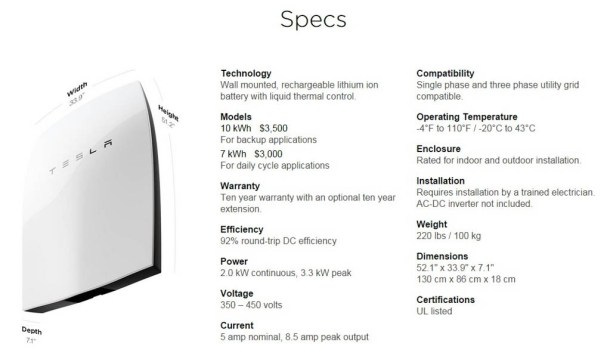
The Powerwall is a rechargeable lithium-ion battery pack that is mounted on a wall to harness excess electricity. Tesla sells a 10 killowatt-hour version for $3,500 or a 7 kWh version for $3,000. The batteries are warrantied to last 10 years. Tesla says it will recycle the batteries.
The 7 kWh unit can power essential services in a home such as the lights, furnace and refrigerator for about six hours during an outage, according to Kristin Carlson, a GMP spokeswoman.
She said 80 percent to 90 percent of the utility’s outages last two hours or less.
GMP will receive its first Powerwalls in October. It will distribute 400 to customers in Rutland and later statewide. GMP will offer product incentives combined with on-bill financing, the company says.
Carlson said the company aims to charge customers between $3,500 to $4,500 for the battery, an AC-DC inverter and installation. She said the company can subsidize the batteries because they could reduce peak power costs to the utility.
After the 10-year life of the battery, Tesla will pick up the battery from the customer and recycle it, Carlson said.
Tesla announced its home storage system Thursday in California.
