

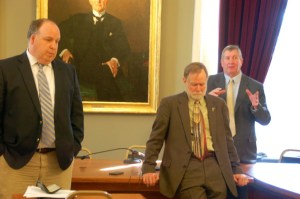
[R]ep. Scott Beck, R-St. Johnsbury, on Wednesday introduced an alternative to a controversial proposed cap on education spending.
Beck’s proposal is based on a per-student block grant formula.
The proposal would help districts that are homestead property poor, much like Act 60 does, Beck said, and would reward districts that hold down education costs.
Each district would receive $18,000 for each equalized pupil from the education fund, to be adjusted for inflation on an annual basis.
Under Beck’s proposal, each district’s education tax rate would be $2.41 in fiscal year 2015, to be adjusted by the Common Level of Appraisal.
Based on spending per equalized pupil approved at town meetings, each district would likely have an unspent amount of education funding, the plan assumes, which would be held in a district budget reserve fund by the Agency of Education.
School districts could use the reserve funds for capital construction or to lower property taxes. The state would no longer fund school construction under the plan. Instead, district reserve funds would pay for capital needs.
 If the concept was implemented, the excess spending threshold penalties now in place would no longer be necessary.
“The Legislature would no longer be the body that gets blamed for high education property tax rates,” according to the proposal.
Beck says his plan looks at education spending outside “the box that is Act 60,” and is an improvement on the reform bill, H.361, now being considered.
“(H.361) is a very strong step toward giving Vermont districts the tools they need to reduce costs, however, it does not guarantee that districts will reduce costs.”
The Senate Education Committee’s version of H.361 is now in Senate Finance.
The House and Senate bills call on school districts to find ways to form larger school systems to find cost efficiencies and to increase educational opportunities for students.
Vermont has lost nearly 25,000 students since 1997, but education spending continues to increase along with property tax rates to support school budgets.
Both versions phase out subsidies to schools, and offer incentives to try to spur merger activity among the state’s 277 school districts.
“The restrictions envisioned by modifying the small schools grant and phantom student provisions will force many districts to reconsider the actual costs of educating their children, but it does not require that they reduce their annual request from the ed fund,” Beck said.
Beck says under Act 60 school districts that are spending well above the state average aren’t impacted by the increased costs because under the funding formula all Vermont property taxpayers are picking up the tab through the statewide property tax.
“I believe that the primary reason for this is that when a district decides to increase its spending, it only has to generate a portion of the additional funds through its homestead tax rate. The rest comes from other districts and non-homestead tax revenue sources,” he said.
Beck said he hopes that a study to determine an adequate per-pupil spending rate will be conducted; that study was part of the House-passed version of H.361.
Once the rate is known, he said, it could be used to determine a more accurate per-pupil rate for the block grant formula.
