

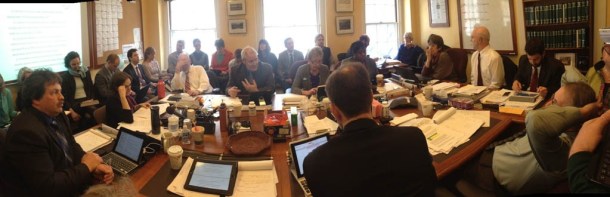
[A] scaled-back $12 million health care package passed the House Health Care Committee Thursday, and could get a vote before the full House early next week.
The package would strengthen primary care in Vermont and reduce out-of-pocket costs for low- and middle-income people insured through the Vermont Health Connect exchange. The package passed 8-3, with the three Republicans on the panel opposed.
“A lot of us were hoping for a larger investment, but I feel good about the priorities that it supports,” said Rep. Chris Pearson, P-Burlington, vice chair of the House Health Care Committee.
 Lawrence Miller, the Shumlin administration’s top advisor on health care, said he will continue to push for the governor’s more ambitious goals for health reform.
“It picks up the critical elements lost in the base budget and addresses those,” Miller said, but he added, “It’s not a health care reform bill, and the administration will continue to pursue the governor’s agenda through the rest of the legislative process.”
The package is a far cry from the governor’s $90 million payroll tax plan to increase Medicaid reimbursement rates for doctors and hospitals.
The House Ways and Means committee is expected to vote on a tax package to support the $12 million in annualized tax increases Friday morning.
Ways and Means is considering two options. Option one would remove an exemption of the sales tax on soft drinks and candy. The per pack cigarette tax is now $2.75 and would go up by 33 cents. Option two would also apply a sales tax on soft drinks and candy sales, and it would feature an increase in the employer assessment, a per employee tax on businesses that don’t offer health care or have employees that opt for Medicaid instead of the employer-sponsored benefit.
Rep. Adam Greshin, I-Warren, who is widely viewed as a swing vote on the Ways and Means Committee, said while he’s not keen to put a sales tax on candy and soda or increase cigarette taxes, he’ll likely support that option over the employer assessment.
The employer assessment runs counter to the Legislature’s goal of decoupling health care from employment, he said, and it “unfairly punishes” businesses that rely on part-time and seasonal workers. Greshin is co-owner of Sugarbush Resort, a ski area that employs seasonal workers.
The spending package includes (all amounts are annualized):
• $1.6 million to restore cuts in the House passed budget to cost-sharing subsidies on the Vermont Health Connect exchange, and $4.26 million to increase the subsidies. The increase would lower out-of-pocket costs for income-eligible people who buy insurance on the exchange.
• $3.5 million to increase state Medicaid reimbursement rates for primary care doctors, with a federal match of $3.7 million. Primary care providers lost a federal Medicaid bump after a provision in the Affordable Care Act sunsetted in January. Lawmakers expressed concern about whether Vermont’s primary care system can handle an influx of Medicaid beneficiaries newly covered by the program under the Affordable Care Act.
• $1.9 million to increase payments in the Blueprint for Health managed care program, which would receive a $2.2 million federal match. The Blueprint helps to coordinate the care of patients with chronic illnesses, and participating providers have not seen a pay increase since 2008.
• $281,354 for the Green Mountain Care Board to pursue a federal all-payer waiver which would allow the regulatory body to set Medicare payment rates.The board has the authority to set provider reimbursement rates. If the board could get federal approval to set Medicare rates it could move ahead with comprehensive reforms to provider compensation. The board would receive a federal match of $342,518 if the state funding is made available.
• $300,000 to restore money cut in the underlying budget from Vermont’s student loan repayment program for health care providers, which is eligible for a $400,000 federal match.
• $40,000 to restore money cut from grants to Legal Aid’s Office of the Health Care Advocate.
• $200,000 for the Joint Fiscal Office to study a publicly financed program that would ensure universal access to primary care services.
The new package was tacked onto S.139, a health policy bill passed by the Senate that includes greater regulation of pharmacy benefit management companies, and requires hospitals to notify patients who are placed on observation status about whether Medicare covers the service — a practice that has resulted in unexpected costs for beneficiaries. The underlying Senate bill also calls for several study reports, reinstates the joint Health Care Oversight Committee and extends the life of the Mental Health Oversight Committee.
Finally, the House Health Care Committee inserted placeholder legislation drawn from H.487 that puts contingencies relating to Vermont Health Connect into S.139 as well. It also allows exchange customers who are not eligible for subsidies to buy their insurance directly from participating carriers.
Rep. Bill Lippert, D-Hinesburg, said contingency language for the exchange would be proposed as an amendment on the House floor.
The House Appropriations committee must approve the bill before it goes to the House floor.
CLARIFICATION: The GMCB’s authority to set rates for Medicare was clarified.
