

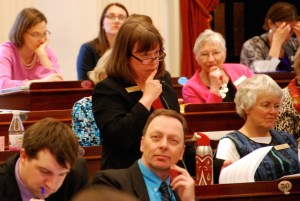
[T]he Vermont House of Representatives gave preliminary approval to the bill that would require employers to offer three days of paid time off to permanent employees starting in 2016.
The House took three hours of debate on H.187 before amending it and narrowly passing the bill by a 76-66 margin on second reading. Lawmakers then approved the underlying bill in a voice vote. Third reading is scheduled for Thursday.
The latest version of H.187 reduces paperwork required of small businesses and only applies to workers who have made long-term commitments to the companies.
Workers would accrue paid time off at a rate of one hour per 40 hours worked, maxing out at three days in 2016 and 2017, but moving up to five days in 2018. Employers would have the discretion to impose a waiting period of up to one year for part-time workers — or 1,400 hours for full-time workers — before new employees can use the paid time off.
 The language exempts federal employees, exempt state employees, certain temporary health care workers, substitute teachers, temporary workers and seasonal workers, and other categories of workers. Part-time workers are included, and employers with more robust time off packages for their full-time employees would not need to change their policies.
Workers could take the time off if they’re sick, if they have a preventive doctor’s appointment, if a close family member is sick, to take care of a child who is home from school on a snow day, or to address life events surrounding sexual assault, domestic violence, and stalking. Businesses could not retaliate against a person for using the time off, and the fine for a violation would be $5,000.
The bill passed out of the House Committee on General, Housing, and Military Affairs in a 5-3 party line vote April 17. The issue generated three hours of floor debate on Thursday between lawmakers who called H.187 a mandate on business and legislators who believe the new mandate will improve workers’ quality of life.
Minority Leader Don Turner, R-Milton, questioned the transparency of state government after lawmakers voted against referring the bill to three different House committees: Commerce, Health Care, and Transportation.
Rep. Butch Shaw, R-Pittsford, said time off policies are a “recruiting tool” for many businesses, and passing an “unfunded mandate” would make businesses less competitive.
Shaw suggested passing a resolution in favor of paid leave or giving businesses optional guidance on earned leave packages through the Department of Labor.
“We are demanding more accountability and stressing an already overburdened business community with another mandate,” Shaw said. “We will now fine employers possibly up to $5,000 for a violation [of the paid sick leave law]. This is unconscionable.”
Rep. Heidi Schuermann, R-Stowe, said the bill sends the “wrong message” to small business owners.
“The message you are sending is to your friends and neighbors: [that] they are simply not doing enough for their employees, and if they do not offer this benefit, they are a bad employer,” Schuermann said. “This is a top-down approach that we here in Montpelier know better.”
According to an analysis from the Joint Fiscal Office, the paid leave bill would cost the private sector between $3.6 million and $8.2 million per year in 2016 and 2017. Starting in 2018, the paid leave would cost employers between $6.2 million and $14.3 million, according to JFO.
Rep. Tom Stevens, D-Waterbury, said the young entrepreneurs he talks to often support paid time off “because they grew up in a world where they can’t understand why not having paid time off would be normal.”
Stevens said small businesses would be affected, but large corporations would be more affected because they employ the majority of people in Vermont.
House Majority Leader Sarah Copeland-Hanzas, D-Bradford, said she supports H.187 because the bill would require universal compliance, including on her small café in Bradford, where she employs about four people.
Copeland-Hanzas said all of her employees are women, and three of those workers have husbands without paid time off, so her workers take the day off to stay home with their sick children, leaving Copeland-Hanzas to cover their shifts because she is the owner.
“I think a universal benefit would be good for families, and it will be good for my small business,” she said.
Gov. Peter Shumlin issued a statement following the vote praising the House for giving the bill preliminary approval. He said Vermonters without paid leave are put in “a difficult and unfair” position.
“In the past, I have been skeptical of proposals that did not do enough to recognize the costs and burdens to businesses this legislation might create,” Shumlin said. “This bill addresses those concerns in a balanced and thoughtful way to provide this important benefit to Vermonters.”
The Senate is not expected to take up the bill this year.
