

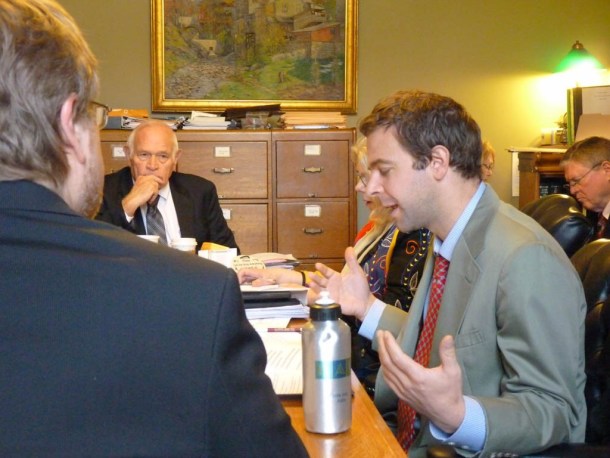
The Senate tax proposal could look significantly different than the plan that was passed by the House a few weeks ago.
The Legislature is looking to raise $35 million in new taxes to help fill a $113 million state budget gap.
The House approved the Shumlin administration’s proposal to raise $15.5 million through the elimination of a deduction for state tax refunds. The House proposal, H.272, also raises $20 million through caps on all itemized deductions, and senators are concerned that the cap treats all deductions equally and could hurt nonprofit organizations. The limit on all deductions — mortgage interest, donations, health care costs, etc. — would be $15,000 for individuals and $31,000 for couples under the House proposal.
Sen. Tim Ashe, D/P-Chittenden, chair of the Senate Finance Committee, wants to take a more “surgical” approach to income tax increases.
 “The committee appreciates what House Ways and Means is trying to achieve — a simpler, fairer tax code — that’s a goal we share,” Ashe said. “Any tax changes have strengths and weaknesses. We have some concerns about the House approach because they treat all deductions equally.”
In a Senate Finance Committee bill he introduced on Tuesday, Ashe proposes three changes: A cap on mortgage deductions (to be determined, but between $12,000 and $15,000); a 3 percent minimum income tax; the elimination of charitable deductions and the creation of a 5 percent income tax credit for donations of over $5,000 made in Vermont.
About 100 taxpayers who earn more than $150,000 and who pay little or no taxes would be affected by the 3 percent alternative minimum tax, Ashe says.
The committee is also looking at lowering the sales tax and extending it to services over time. The proposal would be phased in, starting in 2017. The idea is to lower the sales tax by a point over a two year period.
The sales tax has stagnated as more people buy services instead of goods, and the goods they do buy are more often purchased over the Internet (the state does not have an online sales tax).
Ashe says he recognizes that tax changes provoke anxiety among the public and businesses, but he says that it’s important for the legislature take a few “bold steps,” at a time when revenues are dropping over time because they aren’t tracking the state’s economic activity.
“It’s not unreasonable for people to be nervous about changes,” Ashe said. “My firm belief is that if we do not take some bold steps, as difficult as they may be, we will be back every year looking at a laundry list of winners and losers.”
The House cap on deductions is problematic, Ashe said, because it doesn’t distinguish between deductions, some of which benefit the economy as a whole and individuals in particular circumstances. He isn’t comfortable with the idea, for example, of increasing the tax payments of people who have incurred high medical expenses.
“It also treats charitable deductions like all other deductions,” Ashe said. “While there’s scant evidence about what behavioral change would happen if we capped or eliminated charitable deductions, the committee struggles to support human services programs dependent on charitable deductions.”
Senate Finance approved a $12,000 cap on mortgage deductions two years ago. The cap would hit people with mortgages of $300,000 or more, data from the Joint Fiscal Office shows. The median home value in Vermont is $220,000, according to Zillow, a national home pricing website.
“The vast majority of homeowners would not be affected, or barely affected,” Ashe said. “Those most affected would be those who have substantial home values or multiple homes.”
Ashe said there is a point at which state subsidies for high value homes “is no longer serving the public interest.”
The charitable tax credit of 5 percent would replace the current state tax deduction and would be limited only to in-state giving. Ashe says the credit is the same cash value for donors.
“The question we’ve asked is, do we want to support charitable giving to other states?” Ashe said. “If someone gives $100,000 to the law school in Texas or Florida we are subsidizing that. Clearly the federal government has an interest in subsidizing charitable donations all over the country, but why, when we are struggling with our own bills, should we be subsidizing other states?”
