

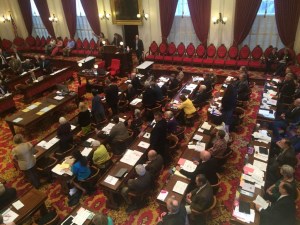
[T]he Vermont House gave preliminary approval Thursday to a Senate bill that would prohibit certain criminals and people with severe mental illness from possessing guns.
The 79-60 roll call vote on S.141 followed a four-hour floor debate in which the Speaker of the House called two Republican lawmakers for being out of order, and another for accusing former New York City Mayor Michael Bloomberg for funding the bill.
Four more lawmakers, including Rep. Bob Helm, R-Fair Haven, who made the Bloomberg comments, accused members of other parties of talking off topic. House Speaker Shap Smith, D-Morristown, rejected the complaints and pushed through to the bill’s final vote around 5:30 p.m. after lawmakers reduced the threshold of proof required for a person to regain their gun rights.
In the version amended and approved on the floor, S.141 creates a criminal misdemeanor at the state level for people found in possession of a gun who have been convicted of several violent crimes, convicted of sexually exploiting children, or convicted of trafficking large amounts of illegal drugs.
Vermont is the only state in the U.S. without a law of this nature, the bill’s advocates say.
 S.141 also directs the state’s Superior Court Administrator to report all people who are judged to be in need of mental health treatment — under the same section of state law that allows people to “plead insanity” — to the FBI’s National Instant Criminal Background Check System.
The state’s Department of Mental Health would report people who are issued hospitalization or non-hospitalization orders to the court administrator each year, and the administrator would send the report to the background check database.
Reports would be private, exempt from public records requests and clearly say the person was reported to the system in accordance with the federal law that applies to people who are “adjudicated as a mental defective” or “committed to a mental institution.”
If S.141 is enacted it would go into effect July 1, with reports starting on or before Oct. 1. A vote on final House approval is set for Friday. Changes in the bill would need to be approved by the Senate.
The Senate version included a waiting period for someone with severe mental health problems to be eligible to petition to get their gun rights back. The House eliminated the waiting period.
The House Judiciary Committee sought more stringent evidence requirements than the Senate — moving from “a preponderance of” to “clear and convincing” evidence of recovery from mental illness.
Jack McCullough of Vermont Legal Aid, says the organization represents people in mental health proceedings. He said most don’t have the money to hire a lawyer, and legal aid would not have the resources to represent them.
The committee voted 5-4 Thursday to amend the bill back to the lower threshold of a preponderance of evidence. The House approved the committee’s amendment.
“This lower standard does not jeopardize public safety, and it addresses concerns that the Judiciary Committee had that the higher standard could be an impediment to the restoration of rights,” said Rep. Maxine Grad, D-Moretown, chair of House Judiciary.
Rep. Tom Burditt, R-West Rutland, called S.141 “a bill of redundancy,” and had to reconfigure his speech after being ruled as speaking off topic. He was one of several lawmakers from the Rutland County delegation to argue against the bill Thursday.
Rep. Willem Jewett, D-Ripton, said redundancy was one of the primary reasons for the bill.

“Criminal justice is largely a state enterprise,” Jewett said. “As the law stands now, a state law enforcement officer coming into contact with a felon possessing a gun can only refer this offense to a federal prosecutor.”
Jewett echoed testimony from the Vermont Department of State’s Attorneys and the Vermont Police Association, who said they wanted to be able to prosecute felons at the state level.
But the mental health reporting requirement — and the mental health issues surrounding the study to keep guns away from suicidal people — dominated much of the debate Thursday.
“It does not apply to people who are mentally ill,” Jewett said of the bill. “It does not even apply to people who are seriously mentally ill. It applies to people who are seriously mentally ill, and have gone through an adjudication to find that they are a danger to themselves or others.”
Rep. Barbara Rachelson, D-Burlington, said the bill was about “public safety,” but said the words lawmakers use are a bigger problem.
“This bill, contrary to what has been said, is not meant to stop or stigmatize people who have mental health diagnoses,” Rachelson said. “Talking about the ‘mentally ill’ as one group is more damaging to people who have mental health issues than this bill.”
